
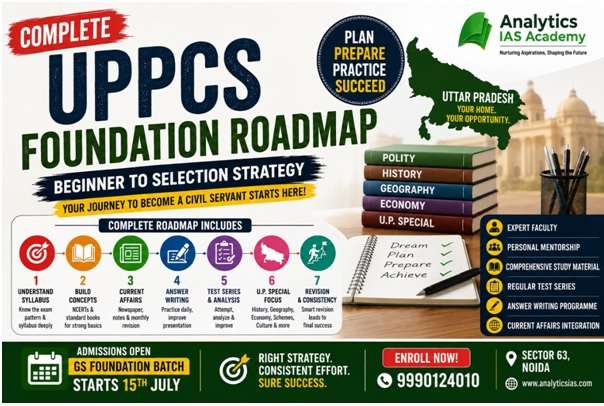
Every year, thousands of aspirants fill the Uttar Pradesh Public Service Commission (UPPSC PCS) application form with the dream of becoming a Deputy Collector, DSP, Block Development Officer (BDO), District Commandant, Treasury Officer, Assistant Commissioner, and other prestigious Group A & Group B officers.
However, only a small percentage qualify—not because they lack hard work, but because many begin their journey without a structured roadmap.
Most beginners make one or more of these mistakes:
- Buying too many books.
- Watching random YouTube videos.
- Ignoring the official syllabus.
- Preparing Prelims and Mains separately.
- Delaying answer writing.
- Focusing only on current affairs.
- Following multiple mentors without a clear strategy.
The result?
Months of effort, but very little progress.
If you are preparing for UPPCS 2026-2027, or even planning to begin early for future examinations, this guide will provide a complete foundation roadmap—from your very first day until the examination.
Why Every Beginner Needs a Foundation Roadmap
Preparing for UPPCS is not like studying for a college examination.
It is a long-term competitive examination that tests:
- Conceptual understanding
- Analytical thinking
- Knowledge of Uttar Pradesh
- Current affairs awareness
- Answer writing
- Decision-making
- Consistency over months
Without a roadmap, even intelligent students often waste valuable time.
A structured foundation programme helps you:
✔ Understand the syllabus before studying.
✔ Select the right books.
✔ Build concepts from the basics.
✔ Integrate Prelims and Mains preparation.
✔ Develop answer-writing skills from the beginning.
✔ Avoid information overload.
The earlier you build a strong foundation, the easier your preparation becomes.
Understanding the UPPCS Examination
Before opening your first book, understand the examination you are preparing for.
The UPPCS examination consists of three stages:
Stage 1: Preliminary Examination
Objective-type examination consisting of:
- General Studies Paper I
- CSAT (Qualifying)
The Preliminary Examination acts as the screening stage.
Marks are not added to the final merit.
Stage 2: Main Examination
Descriptive examination consisting of:
- General Hindi
- Essay
- General Studies Papers
- Optional Subject
This stage largely determines your final ranking.
Stage 3: Personality Test (Interview)
The interview evaluates:
- Personality
- Administrative aptitude
- Communication skills
- Awareness of current issues
- Understanding of Uttar Pradesh
- Decision-making ability
UPPCS is therefore not simply a knowledge test.
It is a comprehensive assessment of your suitability for public administration.
Why Foundation Preparation Should Begin Early
Many aspirants begin serious preparation only after the notification is released.
This approach rarely works.
UPPCS demands:
- Strong static concepts
- Continuous current affairs preparation
- Regular revision
- Writing practice
- Mock tests
These cannot be completed in a few months.
A one-year foundation programme allows aspirants to prepare systematically without unnecessary pressure.
Step 1: Understand the Official Syllabus
The syllabus is your most important resource.
Every topic you study should directly relate to it.
Print the complete syllabus.
Keep it beside your study table.
Before reading any chapter, ask:
“Which part of the syllabus does this topic belong to?”
This simple habit prevents unnecessary reading.
Step 2: Build Strong Conceptual Foundations
Never begin with advanced books.
Start with concepts.
For every subject, first understand:
- Basic definitions
- Historical background
- Constitutional provisions
- Important concepts
- Terminology
- Interconnections
Conceptual clarity makes revision significantly easier later.
Step 3: Start with NCERT Books
NCERTs remain one of the best resources for beginners because they explain concepts in a simple and structured manner.
Recommended subjects include:
History
Ancient, Medieval and Modern India
Geography
Physical Geography
Indian Geography
World Geography
Polity
Basic Constitutional concepts
Democracy
Governance
Economics
Basic macroeconomics
Development
Inflation
Budget
Banking
Environment
Ecology
Biodiversity
Climate
Conservation
Science
Physics
Chemistry
Biology
Space
Technology
NCERTs help develop conceptual understanding before moving to advanced books.
Step 4: Shift to Standard Reference Books
Once your fundamentals are clear, move towards standard reference material.
Examples include:
Polity
Indian Constitution
Governance
Parliament
Judiciary
Federalism
History
Modern India
Freedom Movement
Post-Independence India
Geography
Indian Geography
Economic Geography
Agriculture
Disaster Management
Economy
Indian Economy
Government Schemes
Economic Survey
Budget
Environment
Climate Change
Protected Areas
Environmental Laws
Sustainable Development
The objective is not to finish many books.
It is to revise a few books multiple times.
Step 5: Integrate Uttar Pradesh-Specific Preparation
One major difference between UPSC and UPPCS is the importance of state-specific knowledge.
Every aspirant must prepare:
Uttar Pradesh History
- Ancient history of UP
- Medieval developments
- Freedom Movement in UP
Uttar Pradesh Geography
- Rivers
- Agriculture
- Climate
- Irrigation
- Natural resources
Uttar Pradesh Economy
- Industrial development
- MSMEs
- Tourism
- Agriculture
- Budget
- Infrastructure
Government Schemes
State government initiatives
Development programmes
Welfare schemes
Social sector programmes
Culture
Festivals
Dance
Music
Architecture
Literature
GI Tags
UNESCO sites
UP-specific preparation should continue alongside General Studies—not as a separate subject.
Step 6: Develop Newspaper Reading Habits
Many beginners either spend four hours reading newspapers or avoid them completely.
Both approaches are incorrect.
Read newspapers with a purpose.
Focus on:
✔ Governance
✔ Supreme Court judgments
✔ Parliament
✔ International Relations
✔ Economy
✔ Science & Technology
✔ Environment
✔ Uttar Pradesh developments
Avoid:
✘ Political debates
✘ Celebrity news
✘ Crime reports without policy relevance
✘ Entertainment
Remember:
You are preparing to become an administrator—not a news anchor.
Step 7: Build Current Affairs Notes
Do not depend entirely on monthly magazines.
Create your own notes.
Organize them under headings such as:
- Polity
- Economy
- Environment
- Science
- International Relations
- Uttar Pradesh
- Government Schemes
- Social Issues
Short, regularly updated notes become invaluable during revision.
Step 8: Study Both Prelims and Mains Together
One of the biggest mistakes beginners make is preparing only for Prelims.
Successful candidates integrate both stages from Day One.
For example:
If studying the Indian Constitution:
Prelims
Articles
Schedules
Amendments
Facts
Mains
Federalism
Centre-State Relations
Judicial Activism
Constitutional Challenges
Governance Reforms
This integrated approach saves time and strengthens conceptual understanding.
Step 9: Create a Daily Study Routine
Consistency matters more than intensity.
A beginner can follow a structured schedule such as:
- General Studies – 4 hours
- Current Affairs – 1 hour
- Uttar Pradesh Special – 1 hour
- Revision – 1 hour
- Practice Questions – 1 hour
The exact duration may vary, but every day should include:
- Learning
- Revision
- Practice
This combination drives long-term retention.
Step 10: Build the Right Mindset
UPPCS preparation is not a sprint.
It is a marathon.
There will be days when:
- Motivation is low.
- Mock test scores disappoint.
- Current affairs seem overwhelming.
- Progress feels slow.
During these phases, consistency matters more than perfection.
Remember:
Small daily improvements over one year produce extraordinary results.
The aspirants who succeed are rarely the ones who study the most on one day—they are the ones who continue studying every day.
Step 11: Start Answer Writing from the Beginning
One of the biggest mistakes made by UPPCS aspirants is delaying answer writing until after completing the syllabus.
Unfortunately, the syllabus is never truly “completed.”
Answer writing is not merely about writing faster.
It develops:
- Analytical thinking
- Presentation skills
- Time management
- Conceptual clarity
- Administrative approach
Even if you know the answer, you may fail to score well if you cannot present it effectively.
How Beginners Should Start
Initially, practice:
- 2 answers daily
- 150–200 words
- Within 8–10 minutes
Gradually increase difficulty.
Focus on:
✔ Introduction
✔ Body
✔ Examples
✔ Uttar Pradesh-specific examples wherever relevant
✔ Conclusion
A year of regular answer writing creates tremendous improvement.
Step 12: Choose the Optional Subject Carefully
The Optional Subject plays a crucial role in UPPCS Mains.
Many aspirants make this decision based on trends or other students’ preferences.
Instead, evaluate:
- Interest in the subject
- Availability of study material
- Guidance
- Previous academic background
- Overlap with General Studies
- Long-term comfort
A subject that suits one aspirant may not suit another.
There is no universally “best” optional.
The best optional is the one you can study consistently.
Step 13: Practice Previous Year Questions (PYQs)
Previous Year Questions are one of the most valuable resources.
They reveal:
- Examination trends
- Frequently asked topics
- Question framing
- Depth of preparation required
For every topic you study, ask:
“Has UPPSC asked questions from this area before?”
This habit helps prioritize preparation.
Solve both:
- Prelims PYQs
- Mains PYQs
Regularly.
Step 14: Join a Good Test Series
Mock tests are not designed merely to evaluate.
They are designed to improve.
A good test series helps you:
✔ Identify weak areas
✔ Improve speed
✔ Learn time management
✔ Reduce examination anxiety
✔ Understand examiner expectations
Never judge yourself based on one test.
Instead, monitor your improvement across multiple tests.
Step 15: Revision Strategy
UPPCS is a revision-driven examination.
Reading without revision leads to forgetting.
A practical revision cycle could be:
Daily Revision
30–60 minutes
Weekly Revision
One dedicated revision session every week.
Monthly Revision
Revise all important notes.
Attempt questions.
Update current affairs.
Pre-Exam Revision
Focus only on:
- Short notes
- PYQs
- Test mistakes
- Current affairs
- Important facts
Avoid learning completely new resources during the final phase.
Step 16: Develop a Healthy Study Routine
Long-term preparation requires sustainability.
Include:
- Proper sleep
- Physical exercise
- Short breaks
- Healthy food
- Digital discipline
Avoid comparing your study hours with others.
Instead, compare your consistency with your previous week.
A Suggested 12-Month Foundation Roadmap
Months 1–3
- NCERTs
- Basic concepts
- Newspaper reading
- Current affairs
- Uttar Pradesh basics
- Daily revision
Months 4–6
- Standard books
- PYQs
- Begin answer writing
- Weekly mock tests
- Optional subject foundation
Months 7–9
- Complete General Studies
- Improve answer writing
- Revision
- Full-length tests
- Current affairs consolidation
Months 10–12
- Intensive revision
- Multiple mock tests
- PYQs
- Essay practice
- Uttar Pradesh special topics
- Weak area improvement
Common Mistakes Every UPPCS Aspirant Should Avoid
❌ Reading Too Many Books
Master limited resources.
❌ Ignoring the Official Syllabus
Always study with the syllabus beside you.
❌ Delaying Answer Writing
Start early.
❌ Ignoring Uttar Pradesh
State-specific preparation is essential.
❌ Following Multiple Strategies
Choose one roadmap.
Stay consistent.
❌ Studying Without Revision
Revision converts information into retention.
❌ Depending Only on Motivation
Discipline wins examinations.
Motivation is temporary.
How a Foundation Course Can Help
A structured UPPCS Foundation Programme offers:
- Planned syllabus coverage
- Expert faculty guidance
- Personal mentorship
- Regular tests
- Answer writing practice
- Current affairs integration
- Doubt resolution
- Continuous performance tracking
Rather than spending months deciding what to study, aspirants can focus on how to improve.
Final Thoughts
UPPCS is not an examination of intelligence alone.
It rewards:
- Planning
- Consistency
- Revision
- Smart resource selection
- Practice
- Patience
The journey from beginner to Deputy Collector or DSP begins with one decision:
Building a strong foundation.
Don’t chase shortcuts.
Build concepts.
Revise regularly.
Write answers.
Practice tests.
Stay consistent.
If you follow a structured roadmap, your preparation becomes significantly more efficient.
Remember:
Preparation is not about studying harder every day.
It is about studying smarter every single day.
Frequently Asked Questions (FAQs)
- How should a beginner start UPPCS preparation?
Begin with the official syllabus, NCERT books, standard reference books, current affairs, and a structured study plan. Integrate Prelims and Mains preparation from the beginning.
- How many hours should I study daily for UPPCS?
Quality matters more than quantity. A consistent schedule of 6–8 focused hours with daily revision and practice is generally more effective than irregular long study sessions.
- Which books are best for UPPCS preparation?
Start with NCERTs, followed by standard books for Polity, History, Geography, Economy, Environment, and Uttar Pradesh-specific resources. Revise these multiple times instead of collecting many books.
- Is answer writing important for UPPCS?
Yes. Since the Main Examination is descriptive, regular answer-writing practice improves presentation, analytical ability, and time management.
- How important is Uttar Pradesh-specific preparation?
It is extremely important. UPPSC regularly asks questions related to Uttar Pradesh’s history, geography, economy, culture, government schemes, and current developments.
- Should I prepare for Prelims and Mains separately?
No. The most effective strategy is integrated preparation. Build concepts once and prepare both factual and analytical dimensions together.
Related Articles
To strengthen your UPPCS preparation, also read:
- Complete Guide to UPPCS Preparation for Beginners
- Best Books for UPPCS Preparation
- How to Start Current Affairs for UPPCS
- How to Write High-Scoring UPPCS Mains Answers
- Common Mistakes Every UPPCS Aspirant Makes
- How to Prepare UPPCS While Working
- English Medium vs Bilingual Coaching for UPPCS
- Choosing the Right Coaching for UPPCS
- How to Build a One-Year UPPCS Study Plan
- UPPCS Previous Year Question Analysis
Join Analytics IAS Academy
🎯 UPPCS Foundation Course Admissions Open
If you’re looking for a structured preparation programme with experienced faculty, regular mentorship, answer-writing support, and systematic test practice, Analytics IAS Academy offers a comprehensive UPPCS Foundation Course designed for beginners, college students, and working professionals.
Why Choose Analytics IAS Academy?
- ✅ English Medium & Bilingual Classes
- ✅ Personal Mentorship
- ✅ Comprehensive GS Coverage
- ✅ UP-Specific Preparation
- ✅ Regular Test Series
- ✅ Answer Writing Programme
- ✅ Current Affairs Integration
- ✅ Flexible Learning Options
Attend a demo class, interact with the faculty, and choose your preparation based on academic quality and learning support.
