
GS Fundamentals • Prelims + Mains • PYQs • Answer Writing • Revision • Testing • Mentorship
Analytics IAS Academy | Updated September 2026
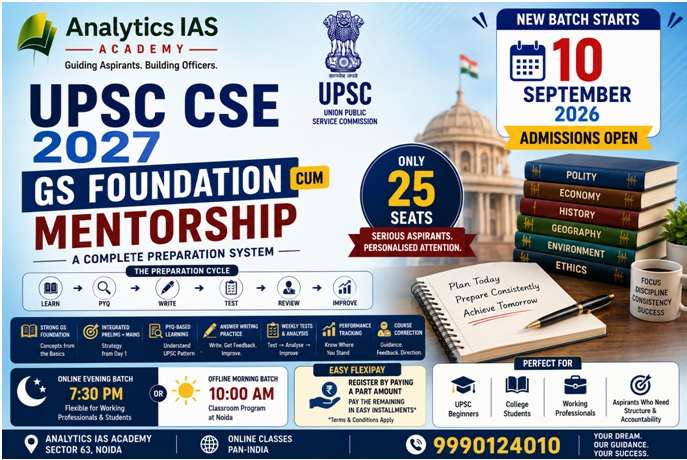
UPSC CSE 2027 Preparation: Build a System, Not a Pile of Resources
Starting UPSC preparation is easy. Building a preparation system that you can sustain for months is much harder. Aspirants have access to books, NCERTs, lectures, current affairs material and test series, yet the key questions remain: Where should I start? How should I cover General Studies? Should I prepare for Prelims and Mains together? When should I solve PYQs, begin answer writing and revise?
The solution is not to collect more resources. It is to build the right preparation system.
LEARN → PYQ → WRITE → TEST → REVIEW → IMPROVE
1. Start With the UPSC Syllabus—Not Random Books
Your first three reference points should be UPSC syllabus → Previous Year Questions → standard resources. The syllabus tells you what can be asked; PYQs show how UPSC asks it; books and classes then help you build the required knowledge.
Beginner rule: Don’t study a subject without knowing where it fits in the UPSC syllabus.
2. Build a Strong General Studies Foundation
A good UPSC GS Foundation Course 2027 should build conceptual clarity rather than merely rush through subjects. Connect each topic with concepts, constitutional or institutional context where relevant, current issues, Prelims possibilities and Mains dimensions.
Strong foundation = Concepts + Context + Application.
3. Prepare Prelims + Mains as an Integrated Journey
Prelims and Mains are different stages, but the GS foundation overlaps substantially. During the foundation stage, ask both: What can UPSC ask objectively from this topic? How can the same topic become an analytical Mains question?
Integrated preparation reduces duplication and fragmented learning.
4. Make UPSC PYQs Part of Learning
Do not wait until the syllabus is complete. After a topic, examine relevant PYQs, identify recurring themes, understand question framing and return to the topic to fill gaps.
PYQs are clues to understanding the examination.
5. Start Mains Answer Writing Gradually
Knowing a topic and expressing it in a relevant 150- or 250-word answer are different skills. Begin with question interpretation and structure, then improve analysis, examples, presentation, word limits and speed through practice and feedback.
Useful structure: Introduction → Main Arguments → Examples/Data → Way Forward → Conclusion.
6. Build Revision Into Your Timetable From Day One
UPSC preparation should not be Study → Finish → Forget. It should be Study → Revise → Recall → Test → Revise Again. Maintain source material, concise working notes and very short revision notes.
Your material should become more compact and revisable as the examination approaches.
7. Track Progress, Not Just Study Hours
A better weekly review asks what you completed, what you can recall, how many PYQs you analysed, how many answers you wrote, what your tests revealed and which mistakes are repeating.
Shift from activity tracking to performance tracking.
8. Understand What Good UPSC Mentorship Should Do
Mentorship is useful when it helps an aspirant prioritise, plan, review, diagnose, correct and improve. It should not replace self-study; it should make self-study more focused and accountable.
Useful mentorship = Direction + Review + Feedback + Course Correction.
What Should a Serious Aspirant Look for in a UPSC Foundation Course?
Before choosing a UPSC Foundation Course 2027, evaluate the academic system—not only lecture hours.
| What to Check | Why It Matters |
| GS fundamentals | Builds conceptual clarity |
| Prelims + Mains integration | Prevents fragmented preparation |
| PYQ integration | Keeps learning UPSC-oriented |
| Answer writing | Builds Mains skills |
| Regular tests + analysis | Identifies preparation gaps |
| Revision system | Improves retention |
| Performance tracking | Shows whether you are improving |
| Mentorship | Provides direction and course correction |
| Batch interaction | Determines access to feedback |
A Simple Weekly UPSC CSE 2027 Framework
LEARN → REVISE → PYQ → WRITE → TEST → REVIEW → CORRECT → REPEAT
Consistency in this cycle matters more than repeatedly changing books, timetables or strategies.
Where Does a GS Foundation cum Mentorship Program Fit?
For aspirants who prefer a structured system rather than completely self-directed preparation, Analytics IAS Academy is starting a UPSC CSE 2027 GS Foundation cum Mentorship Batch on 10 September 2026. It combines strong GS fundamentals, integrated Prelims + Mains preparation, PYQ-based learning, answer writing, weekly tests, performance tracking, personalised mentorship and regular feedback.
Why Only 25 Seats?
The limited cohort is intended to create greater scope for interaction, doubt resolution, feedback, performance review and personalised academic attention.
Batch Details
- Starts: 10 September 2026
- Online Evening Batch: 7:30 PM
- Offline Morning Batch: 10:00 AM
- Only 25 Seats
- Sector 63, Noida
- Online Pan-India
- Contact: 9990124010
Easy FlexiPay
Aspirants can secure a seat by paying a part amount of the course fee and pay the remaining amount through installments, subject to applicable terms.
FAQs: UPSC CSE 2027 Preparation
- When should I start preparing for UPSC CSE 2027?
Begin with the syllabus, PYQs and strong GS fundamentals. Focus on a sustainable system rather than trying to finish everything quickly.
- Is a UPSC Foundation Course useful for beginners?
It can be useful when it provides structured coverage, conceptual clarity, PYQ integration, answer writing, testing, revision and meaningful academic guidance.
- Should I prepare for Prelims and Mains together?
Many GS areas overlap. During the foundation stage, learning topics from both objective and analytical perspectives can create a stronger integrated base.
- When should I start UPSC answer writing?
Start gradually during the foundation stage. First focus on understanding questions and structuring answers; speed and sophistication can develop with practice and feedback.
- Can working professionals prepare for UPSC 2027?
Yes. A realistic timetable, limited resources, revision, PYQs and scheduled practice are especially important when preparation time is constrained.
- Is offline UPSC coaching available in Noida?
Analytics IAS Academy offers a classroom GS Foundation cum Mentorship batch in Sector 63, Noida, along with an online evening option for aspirants across India.
- UPSC Foundation Course 2027
- UPSC preparation for beginners
- how to choose a UPSC Foundation Course
- UPSC answer writing
- UPSC performance tracking
- UPSC GS Foundation Course in Noida
DON’T JUST COLLECT CONTENT. BUILD A PREPARATION SYSTEM.
LEARN → PYQ → WRITE → TEST → REVIEW → IMPROVE
