
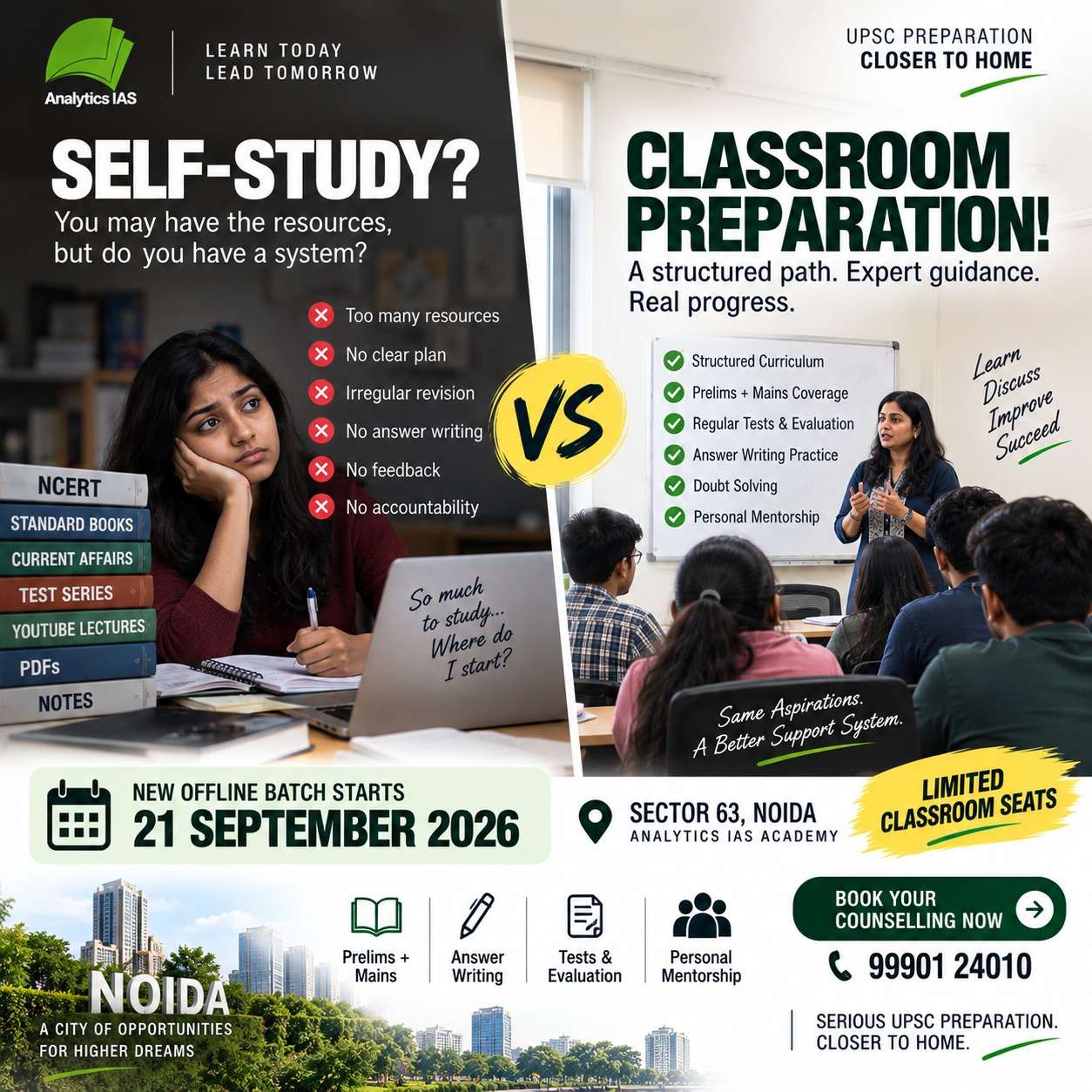
Self-Study vs Classroom Coaching for UPSC: Which Is Better for Aspirants in Noida?
There has probably never been a time when UPSC aspirants had access to more preparation resources. NCERTs are easily available. Standard books are known. YouTube has thousands of lectures. Current-affairs material reaches your phone every morning. PDFs, notes, test papers and strategy videos are available almost continuously.
And yet, one question remains common among beginners:
| THE REAL QUESTION
“I have all the resources – but am I preparing in the right direction?” |
That is why the debate between UPSC self-study and classroom coaching should not be reduced to “Can UPSC be cleared without coaching?” Self-study is not only possible; it is unavoidable. No institute can replace the hours an aspirant must personally spend reading, revising, practising, testing and consolidating.
The more useful question is: Which preparation system will help you study consistently, practise effectively, identify mistakes and remain on track?
For students searching for UPSC coaching in Noida, a UPSC Foundation Course in Noida, or deciding whether to continue completely through self-study, this guide explains the practical differences.
Is Self-Study Enough for UPSC?
Self-study is a central part of UPSC preparation. It allows you to study at your own pace, select resources, revisit difficult topics and build a schedule around college, work or other responsibilities.
Therefore, the objective of classroom coaching should never be to replace self-study. It should help make self-study more structured, selective and exam-oriented.
| KEY PRINCIPLE
CLASSROOM GUIDANCE + SERIOUS SELF-STUDY is often more useful than treating coaching and self-study as opposites. |
Why Do Many UPSC Beginners Struggle With Self-Study?
The problem is often not lack of information. It is lack of structure.
- Too many books, PDFs and strategy videos.
- No clear sequence of subjects.
- Revision gets postponed while new material keeps accumulating.
- Mains answer writing is delayed until ‘after the syllabus’.
- Tests are attempted irregularly.
- Doubts remain unresolved.
- There is no external feedback on recurring mistakes.
- Progress is measured by study hours rather than recall, practice and test performance.
Aspirants can remain extremely busy without knowing whether their preparation is becoming more examination-ready.
Self-Study vs Structured Classroom UPSC Coaching
| Self-Study | Structured Classroom Preparation |
| You design your own study plan. | Preparation can follow a defined academic roadmap. |
| Complete freedom over resources. | Curated sources can reduce resource overload. |
| Flexible schedule. | A regular timetable can improve consistency. |
| Doubts require independent resolution. | Faculty interaction can support doubt resolution. |
| Answer writing may be postponed. | Writing can be integrated with foundation preparation. |
| Tests depend on self-discipline. | Scheduled tests create regular checkpoints. |
| Self-evaluation can be difficult. | Evaluation can provide external feedback. |
| Fully self-directed. | Mentorship can add direction and accountability. |
Neither route guarantees success. The right decision depends on the specific gaps in your preparation.
| PREPARING FOR UPSC FROM NOIDA?
Analytics IAS Academy is starting a new UPSC GS Foundation offline classroom batch on 21 September 2026 at Sector 63, Noida. Limited classroom seats. Call/WhatsApp 9990124010 to book counselling or a centre visit. |
1. A Classroom Program Should Give Your Preparation a Sequence
One of the biggest challenges for a beginner is deciding what comes next. When should current affairs be integrated? When should Prelims MCQs begin? Should Mains answer writing wait until GS coverage is complete? When should revision happen?
A structured GS Foundation Course should provide a logical preparation sequence rather than simply conduct lectures.
| A BETTER PREPARATION CYCLE
LEARN -> REVISE -> PYQ -> WRITE -> TEST -> EVALUATE -> CORRECT -> IMPROVE |
2. Too Many UPSC Resources Can Become a Problem
Resource availability is useful until resource collection itself starts feeling like preparation. One book becomes three. One current-affairs source becomes four. One teacher becomes several channels.
The result can be resource anxiety and weak revision. A better principle is:
| LIMITED SOURCES -> MULTIPLE REVISIONS -> PYQs -> PRACTICE -> TESTS
Before adding another resource, ask whether you have adequately revised and applied the material you already have. |
3. Prelims and Mains Should Not Become Two Separate Journeys
Prelims and Mains test different skills, but much of General Studies overlaps. A foundation-stage approach can study a topic from both objective and analytical perspectives.
For example, after studying Parliament:
- Prelims orientation: constitutional provisions, procedures, institutions and factual distinctions.
- Mains orientation: contemporary challenges, accountability, functioning, reforms and analytical dimensions.
- Current affairs: connect relevant developments back to the static syllabus.
- Practice: solve PYQs, attempt MCQs and create a Mains answer framework.
4. Answer Writing Should Not Start ‘Someday’
Knowing a GS topic and producing a relevant 150- or 250-word Mains answer under time pressure are different skills. Answer writing should therefore begin gradually during foundation preparation rather than being postponed indefinitely.
- Understand the directive and exact demand.
- Build a clear introduction-body-conclusion structure.
- Prioritise relevant dimensions instead of dumping everything you know.
- Use examples, evidence and current relevance selectively.
- Practise within word and time limits.
- Use evaluation to identify repeated weaknesses.
| IMPROVEMENT LOOP
LEARN -> WRITE -> EVALUATE -> IDENTIFY THE GAP -> CORRECT -> REWRITE |
5. Tests Reveal What Reading Cannot
Reading creates familiarity; testing reveals recall and application. A topic may feel comfortable after repeated reading, but a Prelims test can expose confusion between similar statements, while a Mains question can reveal difficulty in organising ideas.
When comparing offline UPSC coaching in Noida, ask not only whether a test series exists, but whether tests are scheduled, evaluated, discussed and connected to corrective action.
6. Evaluation Converts Practice Into Improvement
A score tells you the outcome. Useful evaluation should help explain the cause.
- Did you misunderstand the question?
- Was the answer descriptive rather than analytical?
- Was the structure weak?
- Were examples missing or irrelevant?
- Did you fail to prioritise the most important dimensions?
- Was the conclusion generic?
- Did time management affect completion?
7. Mentorship Should Be Diagnostic, Not Merely Motivational
Mentorship is useful when it converts a broad ambition into specific next actions. A mentor should help an aspirant identify the current bottleneck, decide priorities and review whether the plan is actually working.
| USEFUL MENTORSHIP ASKS
Where are you now? -> What is slowing you down? -> What should you correct next? -> How will progress be reviewed? |
8. Classroom Preparation Can Add Accountability
Self-study offers freedom, but freedom demands discipline. Without external checkpoints, revision, tests and answer writing can be repeatedly postponed. A classroom timetable can add deadlines, routine and visible milestones.
The goal is not to create dependency on coaching. It is to build a system that supports disciplined independent study.
9. Classroom Coaching Is Not Automatically Better
Joining an institute does not automatically make preparation effective. Before choosing any UPSC coaching institute in Noida, ask practical academic questions:
- Is the course genuinely beginner-friendly?
- Does it integrate Prelims and Mains?
- When does answer writing begin?
- How are tests evaluated and discussed?
- Can students ask academic doubts?
- What does mentorship actually include?
- Are current affairs connected to static GS?
- Is the batch environment manageable?
- What happens if a student falls behind?
- Can you attend counselling or understand the teaching process before enrolling?
10. Noida Students Should Calculate the Cost of Commute
For a Noida-based aspirant, travel time is a real preparation variable. If commuting outside Noida consumes two hours on five days each week, that is roughly ten hours that could otherwise go into revision, answer writing, tests, current affairs or rest.
The nearest institute is not automatically the best institute. But if comparable academic support is available closer to home, commute time should be part of the decision.
| LOCAL DECISION RULE
Compare academic quality + preparation system + faculty access + batch environment + fee + commute time. Do not choose on distance or advertising alone. |
Who Should Consider Structured Classroom UPSC Preparation?
Complete beginners
You need help understanding the examination, syllabus, resources and preparation sequence.
College students
You want to build the foundation gradually alongside graduation.
Directionless self-study aspirants
You are studying regularly but are unsure whether your preparation is progressing correctly.
Aspirants struggling with Mains writing
You know content but find it difficult to convert knowledge into structured answers.
Inconsistent aspirants
Tests, revision and deadlines repeatedly get postponed.
Resource-overloaded aspirants
You need a selective, syllabus-driven preparation pathway.
Who May Prefer Self-Study?
Self-study can work extremely well if you already understand the UPSC syllabus, have reliable and limited resources, maintain a disciplined timetable, revise consistently, practise Prelims questions, write Mains answers, analyse tests, resolve doubts independently and have a reliable feedback mechanism.
Do not join coaching simply because other aspirants are joining it.
What Should You Look for in the Best UPSC Coaching in Noida?
| Academic System | Guidance & Practice | Practical Fit |
| Complete GS foundation | Answer writing + feedback | Accessible Noida location |
| Prelims + Mains integration | Tests + evaluation | Manageable batch environment |
| Current affairs integration | Doubt resolution | Clear course duration |
| PYQ orientation | Mentorship + progress review | Transparent fee structure |
| Revision framework | Corrective practice | Counselling/demo before joining |
The phrase ‘best UPSC coaching in Noida’ should be treated as a comparison question, not accepted as a marketing claim. The best choice is the one whose academic system fits your actual preparation needs.
| DAY 2 TAKEAWAY
Don’t just ask: ‘Do I need coaching?’ Ask: ‘Do I currently have the structure, guidance, feedback and discipline needed to execute my UPSC preparation independently?’ |
Self-Study or Coaching: What Is the Better UPSC Strategy?
For many aspirants, the strongest model is not coaching versus self-study. It is structured guidance plus serious self-study.
| CLASSROOM
Direction -> Concepts -> PYQs -> Guidance -> Testing -> Evaluation |
| SELF-STUDY
Reading -> Revision -> Practice -> Consolidation -> Recall |
| TOGETHER
STRUCTURE + DISCIPLINE + PRACTICE + FEEDBACK |
UPSC GS Foundation Classroom Program in Noida – New Batch from 21 September
For aspirants looking for structured offline UPSC coaching in Noida, Analytics IAS Academy is starting a new UPSC GS Foundation Classroom Program at its Sector 63 centre.
The program is intended for beginners, college students and serious Civil Services aspirants who want structured preparation while continuing substantial self-study.
- Complete GS Foundation
- Prelims + Mains Integrated Preparation
- Mains Answer Writing
- Regular Tests & Evaluation
- Current Affairs Integration
- Personal Mentorship
- Structured Study Material
| BATCH DETAILS
New Batch Starts: 21 September 2026 |
| JOIN NOW
Don’t just collect resources. Build a preparation system. |
Frequently Asked Questions
Is self-study enough to clear UPSC?
Self-study is essential and some aspirants may prepare effectively without formal coaching. The right choice depends on discipline, resource selection, revision, answer-writing practice, testing and access to useful feedback.
Is classroom coaching useful for UPSC beginners?
It can be useful for beginners who need help understanding the syllabus, sequencing subjects, selecting resources, integrating Prelims and Mains, starting answer writing and maintaining consistency.
Which is better: online or offline UPSC coaching?
Neither format is universally better. Offline coaching may offer stronger routine and direct classroom interaction, while online learning offers greater flexibility. Choose according to learning style, schedule and constraints.
When should a beginner start UPSC Mains answer writing?
Start gradually after developing basic understanding of a topic. You do not need to wait until the entire GS syllabus is completed.
How do I choose the best UPSC coaching in Noida?
Compare faculty access, GS coverage, Prelims-Mains integration, answer writing, tests, evaluation, mentorship, batch environment, location, commute and fee transparency.
What should a UPSC Foundation Course include?
A comprehensive foundation program should build GS concepts while progressively integrating PYQs, current affairs, Prelims practice, Mains answer writing, revision, testing and feedback.
Is UPSC coaching in Noida useful for students from Indirapuram or Greater Noida?
It may be convenient depending on the exact commute. Compare travel time alongside academic quality, schedule and the preparation system offered.
- UPSC CSE 2027 preparation roadmap
- UPSC preparation for beginners 2027-2029
- UPSC GS Foundation Course 2027 in Noida
- GS Foundation Course for UPSC beginners
- offline UPSC coaching
- UPSC Mains answer-writing strategy
- best UPSC coaching in Noida for 2027-2029 aspirants
- Analytics IAS UPSC preparation hub
Analytics IAS – UPSC CSE 2027 preparation guide
