For aspirants preparing for the Civil Services Examination conducted by the Union Public Service Commission, Sociology Optional is considered one of the most strategic optional subjects.
However, many aspirants complete the syllabus but still fail to score high marks in the UPSC Mains examination.
The main reason is not lack of knowledge — it is lack of effective answer writing strategy.
In Sociology Optional, presentation and analytical structure matter as much as content. Understanding how to structure answers, integrate sociological thinkers, and apply concepts to contemporary issues can significantly improve scores.
This article explains the high-scoring Sociology answer writing framework used by successful UPSC candidates.
Why Answer Writing Matters in Sociology Optional
The UPSC Mains examination evaluates more than theoretical knowledge.
Examiners look for:
- Conceptual clarity
- Analytical reasoning
- Sociological perspective
- Contemporary relevance
- Balanced arguments
A candidate who writes structured, analytical answers with sociological references always scores higher than someone who writes descriptive answers.
The Ideal Structure of a High-Scoring Sociology Answer
Successful Sociology answers generally follow a five-step structure.
- Start with a Concept-Based Introduction
Begin with a clear explanation or definition of the concept mentioned in the question.
For example, if the question is about social stratification, the answer should begin with a brief conceptual definition.
This establishes conceptual clarity immediately.
- Integrate Sociological Thinkers
Sociological thinkers provide theoretical depth to answers.
Some commonly used thinkers include:
- Karl Marx – class conflict and capitalism
- Max Weber – authority, bureaucracy and social stratification
- Emile Durkheim – social solidarity and division of labour
Referencing thinkers makes answers more analytical and academically strong.
- Apply Concepts to Contemporary Society
UPSC prefers answers that connect theory with real-world developments.
Examples may include:
- Urbanization in India
- Digital society and social media
- Gender equality movements
- Social mobility and development
Contemporary examples demonstrate analytical understanding.
- Provide Sociological Analysis
The core of the answer should analyze the issue using sociological frameworks.
Candidates should examine:
- causes
- consequences
- perspectives of different thinkers
- impact on society
This section shows depth of understanding.
- End with a Balanced Conclusion
The conclusion should summarize the argument while highlighting broader social implications.
A balanced conclusion leaves a strong impression on the examiner.
Common Mistakes in Sociology Answer Writing
Many aspirants lose marks due to avoidable mistakes.
Writing Descriptive Answers
Answers that simply describe concepts without analysis do not score high marks.
Ignoring Sociological Thinkers
Thinker references are essential for theoretical depth.
Lack of Examples
Without real-world examples, answers appear incomplete.
Poor Structure
Unstructured answers make it difficult for examiners to evaluate arguments.
How Structured Guidance Improves Sociology Preparation
Many aspirants struggle to develop analytical answer writing skills through self-study alone.
Structured guidance helps candidates:
- understand sociological frameworks
- integrate thinkers effectively
- practice answer writing regularly
- receive feedback for improvement
Sociology Optional Online Course by Analytics IAS Academy
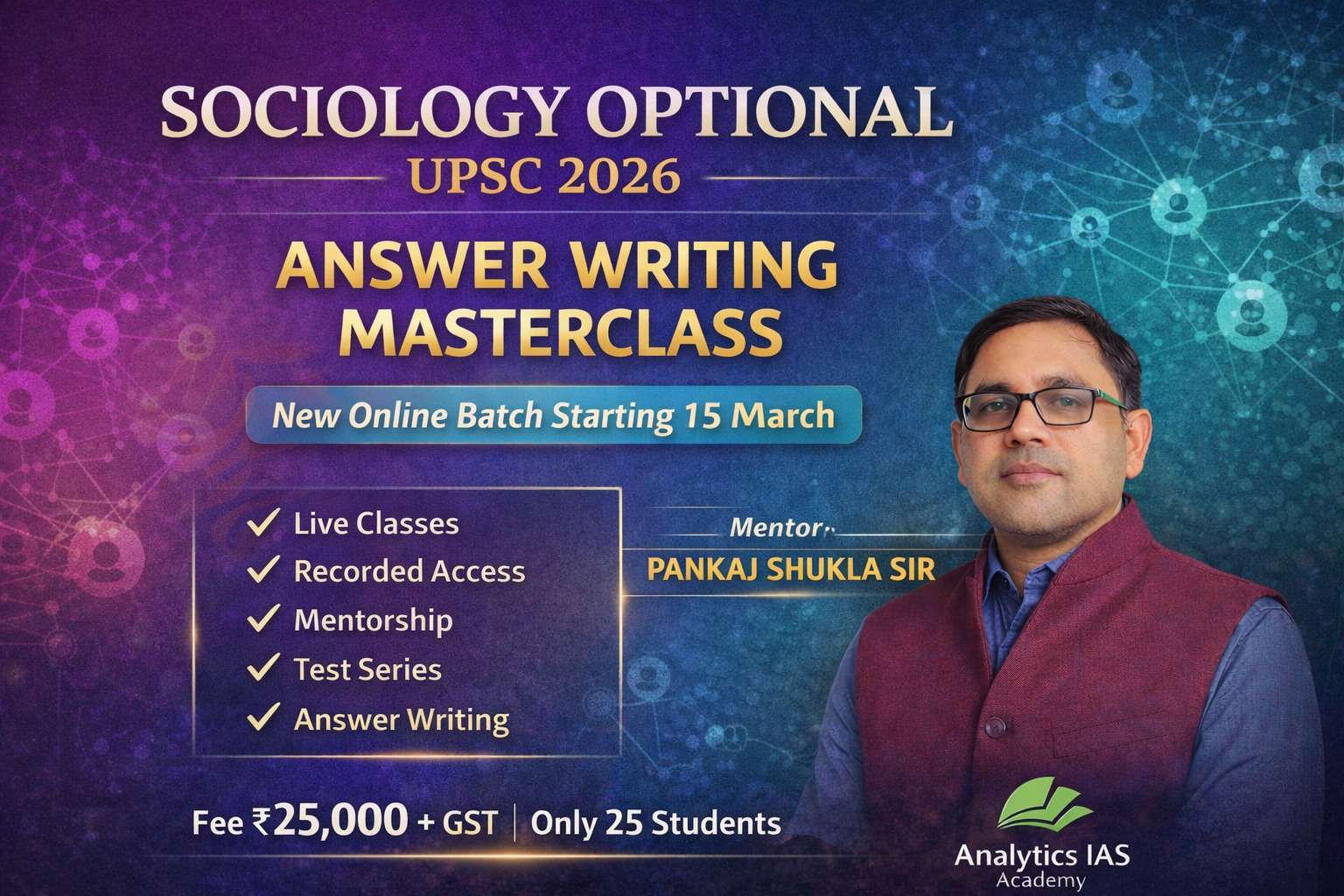
To help aspirants master Sociology Optional effectively, Analytics IAS Academy offers a comprehensive Sociology Optional Online Course mentored by Pankaj Shukla Sir.
The program focuses on conceptual clarity, analytical thinking, and answer writing practice.
Course Features
Batch Starting: 15 March
Course Fee: ₹25,000 + GST
Seats Available: Only 25 Students
📞 Contact: 9990124010