
Choosing Sociology Optional is only the first decision. The harder task is learning how to prepare it in a way that converts concepts, thinkers, Indian society and contemporary examples into precise UPSC Mains answers.
For UPSC CSE 2027 aspirants, a strong Sociology Optional strategy should therefore go beyond finishing the syllabus. It should build conceptual clarity, Paper I–Paper II interlinkages, regular answer writing, PYQ orientation, revision discipline and feedback. This is especially important for beginners, college students and working professionals who cannot afford an unstructured cycle of collecting books, PDFs and lectures.
| QUICK ANSWER
How should you prepare Sociology Optional for UPSC 2027? Start with the official syllabus and PYQs, build conceptual clarity in Paper I, continuously connect those concepts with Paper II and contemporary Indian society, make concise revision-ready notes, and begin answer writing early. Regular evaluation and feedback are essential because knowing Sociology and writing a sociological answer are different skills. |
Why Sociology Optional Preparation Needs More Than Notes
The official UPSC Sociology syllabus itself makes the analytical nature of the subject clear. Paper I covers the fundamentals of Sociology—discipline, science and methodology, research methods, thinkers, stratification, work, politics, religion, kinship and social change. Paper II moves into Indian Society: structure and change, including perspectives on Indian society, caste, tribes, rural and agrarian structure and other major transformations.
This structure creates a natural demand for interlinkage. A candidate who studies Paper I and Paper II as two isolated books misses one of Sociology’s biggest opportunities: using theory to interpret Indian society and using Indian examples to make theory concrete.
Recent aspirant discussions online repeatedly return to the same practical difficulties: too many sources, uncertainty about Paper I/Paper II strategy, difficulty making concise thinker notes, postponing answer writing, and the need for genuine feedback. This is useful market intelligence: aspirants do not merely need more content; they need a repeatable preparation system.
The Five-Part Sociology Optional Strategy for UPSC 2027
1. Treat the syllabus as a connected map
Do not prepare each syllabus line as an isolated chapter. Build connections. Social stratification connects with caste, class, gender and mobility. Power connects with politics, bureaucracy, social movements and the state. Kinship connects with family, patriarchy, changing marriage patterns and contemporary social change. The goal is to create a network of concepts that can be recalled across questions.
2. Build thinker-based conceptual clarity
Thinkers should not become biographies or memorised quotations. For each thinker, prepare a compact sheet: core concepts, key arguments, method, criticism, contemporary relevance, Paper II applications and 2–3 examples. This makes Marx, Weber, Durkheim, Parsons, Merton, Mead and Indian sociologists usable in answers rather than merely recognisable in notes.
3. Integrate Paper I and Paper II from the beginning
A high-quality Sociology answer often moves between theory and Indian reality. Caste can be enriched through M.N. Srinivas, G.S. Ghurye, Louis Dumont, André Béteille and Ambedkar. Bureaucracy can be connected with Weber. Agrarian transformation can be analysed through class, power, mobility and social change. Gender questions can draw on patriarchy, division of labour, family and contemporary transformations. This interlinking should be practised during learning—not added hurriedly before Mains.
4. Start answer writing before the syllabus is ‘finished’
One of the most damaging preparation habits is waiting to complete every topic before writing. Answer writing is a separate skill. It teaches you to read the demand of the question, select relevant content, use thinkers without force-fitting them, structure arguments, balance analysis and criticism, and conclude within the word limit.
The improvement cycle should be simple: write → get evaluated → identify one or two recurring weaknesses → rewrite or consciously correct them in the next answer. Feedback that only gives marks is less useful than feedback that tells you exactly what to change.
5. Use current affairs sociologically—not as GS content
Current affairs should not be pasted into Sociology answers as newspaper facts. Ask what sociological concept the event illustrates. A change in family form may connect to urbanisation, individualisation, gender roles and kinship. A social movement may connect to power, identity, relative deprivation or new social movements. Digital platforms may connect to work, stratification, community, surveillance, identity or social change. The value comes from interpretation.
What Makes a Sociology Answer Different from a GS Answer?
A GS answer may correctly describe a social issue. A Sociology Optional answer must go further by using disciplinary vocabulary, perspectives, thinkers, debates, evidence and sociological reasoning.
| Dimension | Generic/GS-style approach | Sociological approach |
| Caste | Inequality and discrimination | Caste through hierarchy, mobility, dominant caste, caste-class-power and changing structures |
| Family | Family is changing | Kinship, patriarchy, division of labour, modernity, individualisation and changing household forms |
| Religion | Religion affects society | Durkheim/Weber, secularisation, pluralism, identity and social integration/conflict |
| Social change | Technology changes society | Agents and theories of change, institutions, work, inequality, networks and cultural transformation |
Why PYQs Should Guide the Preparation
UPSC publishes previous Civil Services Main question papers, including Sociology Paper I and Paper II. PYQs should be analysed topic-wise from the beginning. They reveal how syllabus phrases become questions, how the same theme returns in different forms, and where conceptual understanding matters more than memorisation.
A practical method is to place PYQs under every syllabus heading and ask three questions: What concepts are repeatedly tested? What kind of directive is used—discuss, analyse, examine, critically evaluate? What additional thinker, example or Paper I–Paper II linkage would improve the answer?
A Realistic Preparation Model for Beginners, College Students and Working Professionals
For beginners
Begin with the syllabus, basic conceptual classes/readings and limited sources. Avoid collecting five versions of the same topic. Build notes alongside classes, revise weekly and start small answer-writing exercises early.
For college students
Use the longer runway strategically. Complete conceptual foundations and optional notes while maintaining college commitments. A flexible evening schedule can work well if weekly targets are realistic and there is a fixed revision-and-writing slot on weekends.
For working professionals
Consistency matters more than heroic schedules. Use weekdays for focused learning/revision and weekends for consolidation, tests and longer answer-writing practice. A mentor can be particularly useful when limited time makes prioritisation essential.
Why Mentorship Matters in Sociology Optional
Mentorship is valuable only when it changes the next action. A useful mentorship system should answer: What should I study next? What did I fail to complete? Why are my answers plateauing? Am I using thinkers mechanically? Is Paper II becoming descriptive? Are current affairs adding sociological value? What should I revise before the next test?
This is why a small cohort can matter. Individual feedback becomes more credible when the mentor can actually review progress and output rather than merely offer generic motivational sessions.
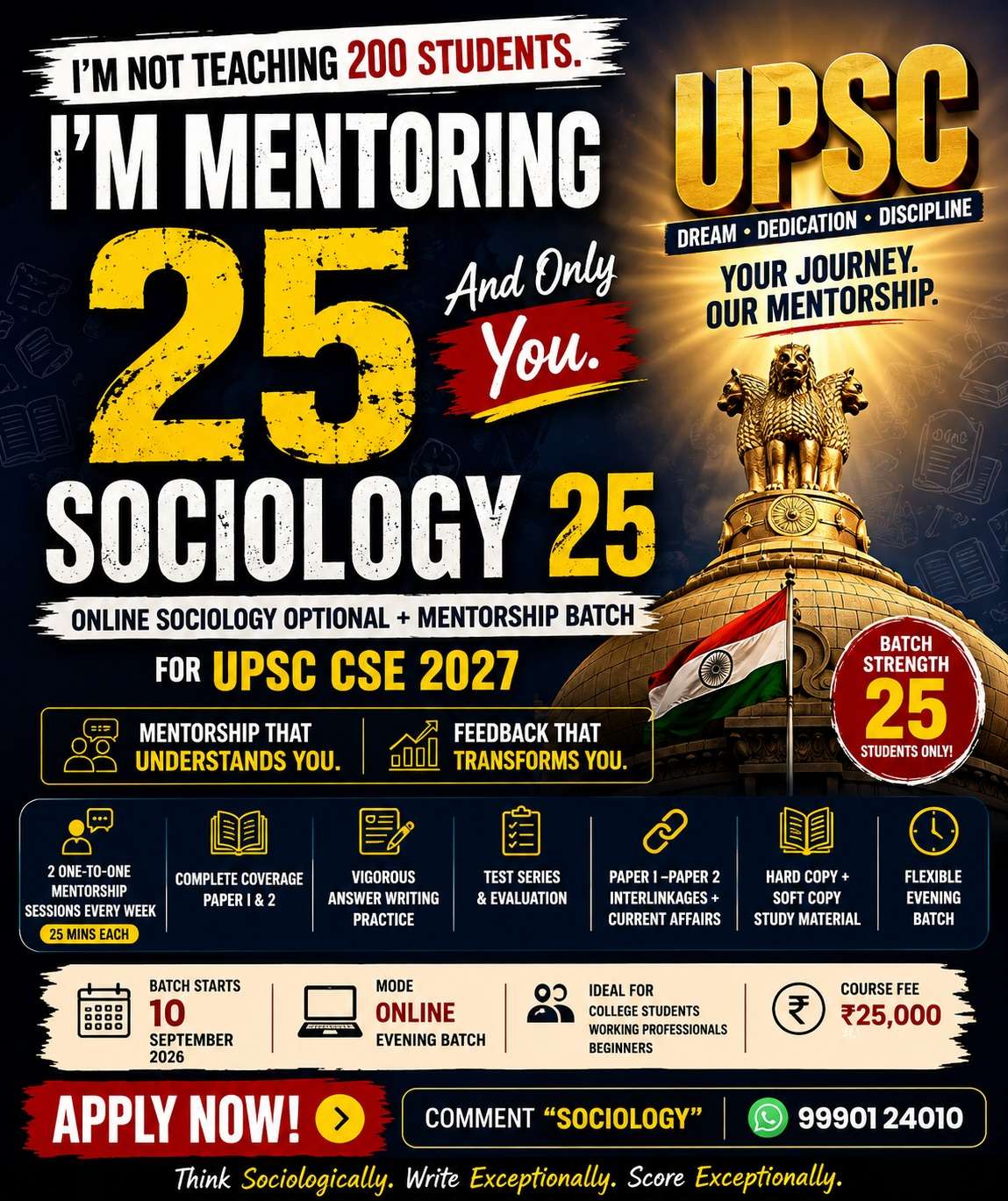
Introducing SOCIOLOGY 25: Online Sociology Optional + Mentorship for UPSC CSE 2027
Analytics IAS Academy is commencing SOCIOLOGY 25, an online Sociology Optional course for UPSC CSE 2027, from 10 September 2026. The cohort is capped at 25 aspirants and is mentored by Pankaj Shukla, an experienced Sociology Optional faculty member who has taught and mentored UPSC aspirants.
The program is designed around one central idea: Sociology should not merely be completed; it should be understood, applied and written.
What the Sociology 25 Course Includes
- Complete coverage of Sociology Optional Paper I and Paper II.
- Conceptual clarity in sociological thinkers, theories, methods and core themes.
- Paper I ↔ Paper II interlinkages throughout the course.
- Current affairs and contemporary examples interpreted through a sociological lens.
- Vigorous answer-writing sessions rather than waiting until the end of the syllabus.
- Test Series with evaluation and performance improvement focus.
- Hard-copy and soft-copy study material.
- Flexible online evening batch for college students and working professionals.
- Two one-to-one Zoom mentorship sessions every week for each student—25 minutes each.
- Small cohort size: 25 students only.
| COURSE AT A GLANCE
Course: Sociology Optional Online Course for UPSC CSE 2027 |
Who Should Consider This Batch?
- A beginner who has selected Sociology but does not know how to structure Paper I and Paper II.
- An aspirant still deciding whether Sociology fits their UPSC 2027 preparation.
- A college student who needs a structured evening program and a long-term optional strategy.
- A working professional who needs prioritisation, accountability and flexible learning.
- An existing Sociology aspirant whose answers remain descriptive or GS-like.
- An aspirant who has notes but lacks regular evaluation, tests and feedback.
Who Should Not Join?
A mentored course is unlikely to help someone who only wants another folder of notes, does not intend to write answers, or is unwilling to revise and act on feedback. The value of a small cohort comes from participation: writing, testing, reviewing mistakes and correcting them.
How to Evaluate Any Sociology Optional Course Before Joining
- Does it cover the official Paper I and Paper II syllabus completely?
- Is answer writing integrated into the course or postponed?
- Are PYQs used systematically?
- Does evaluation give actionable feedback?
- Are Paper I and Paper II taught with interlinkages?
- Is current affairs integration genuinely sociological?
- Can beginners follow the conceptual progression?
- Is the schedule realistic for your available time?
- What exactly does ‘mentorship’ mean—frequency, duration and purpose?
- Will you have enough opportunity to revise and write?
Frequently Asked Questions
Is Sociology Optional suitable for beginners without a Sociology degree?
Yes. The official syllabus can be approached from the basics, but beginners should first build disciplinary vocabulary and conceptual clarity before attempting advanced answers. Prior academic training can help, but it is not a prerequisite for learning the subject.
How should I start Sociology Optional for UPSC 2027?
Start with the official syllabus and PYQs. Build Paper I foundations, make concise thinker/concept notes, connect those concepts with Paper II, revise weekly and begin answer writing early.
Should Paper I be completed before Paper II?
A basic Paper I foundation is useful, but the papers should not remain isolated for months. Once core concepts are understood, begin building Paper I–Paper II linkages.
When should Sociology answer writing start?
Start early with topic-wise questions. Waiting for 100% syllabus completion delays the most important skill: applying knowledge to the exact demand of a UPSC question.
How should current affairs be used in Sociology?
Use current events as sociological evidence. Connect them with concepts, thinkers, institutions and social processes rather than inserting newspaper facts without analysis.
Is Sociology manageable for working professionals?
It can be, if sources are limited, the timetable is realistic, revision is regular and answer writing is scheduled. Structured mentorship can help prioritise limited study time.
What is included in Analytics IAS Sociology 25?
Paper I and II coverage, answer writing, test series, current-affairs interlinkages, hard and soft study material, flexible evening online classes, and two 25-minute one-to-one Zoom mentorship sessions each week.
When does the new Sociology Optional batch start?
The online Sociology 25 batch begins on 10 September 2026.
What is the fee?
The announced course fee is Rs.25,000 flat.
How many students are in the batch?
The cohort is capped at 25 aspirants.
Final Takeaway
For UPSC CSE 2027, Sociology Optional preparation should be built around a simple progression: understand → connect → write → evaluate → improve → revise. The subject rewards conceptual clarity, but marks are ultimately earned through relevant, structured and sociologically informed answers.
If you are looking for an online Sociology Optional course that combines complete Paper I and Paper II preparation with answer writing, tests, current-affairs interlinkages and frequent one-to-one mentorship, SOCIOLOGY 25 is designed around that need.
| SOCIOLOGY 25 starts 10 September 2026. Only 25 seats. Online evening batch. Rs.25,000 flat. For counselling and course details, call/WhatsApp 9990124010. |
