
Choosing the right optional subject is one of the most important decisions for aspirants preparing for the UPSC Civil Services Examination. Sociology has become a popular optional subject because it helps candidates understand society, social relationships, institutions, social inequalities, and changing social structures.
However, preparing for Sociology Optional requires more than reading books or memorising definitions. Aspirants need conceptual clarity, an understanding of sociological thinkers, systematic syllabus coverage, regular revision, and answer-writing practice. Proper academic guidance can help students approach the subject in a structured manner.
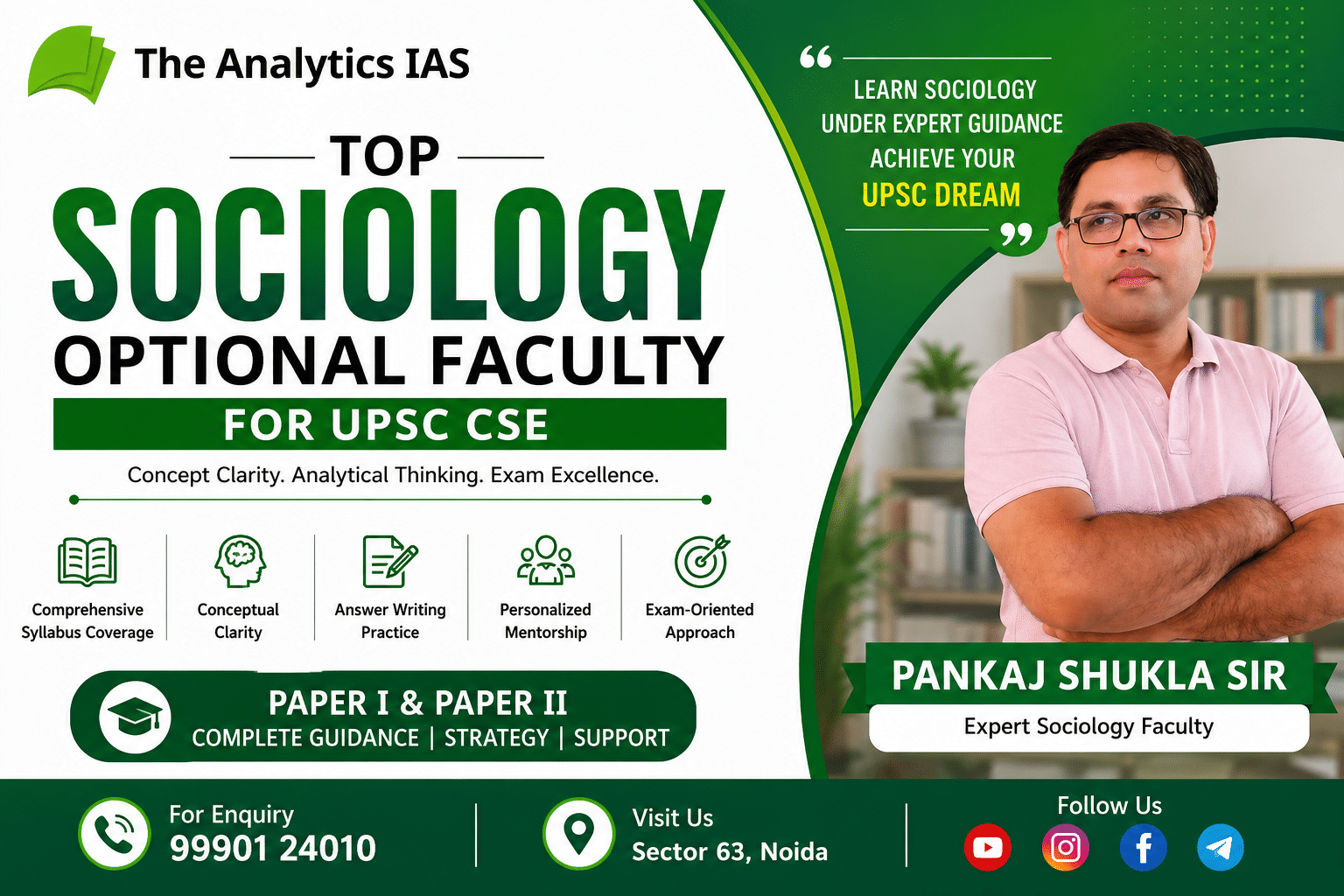
Candidates searching for the Top Sociology Optional Faculty in India should consider factors such as teaching methodology, syllabus coverage, conceptual understanding, answer-writing guidance, and academic mentorship. At Analytics IAS Academy, Sociology Optional preparation is offered under the guidance of Pankaj Shukla Sir, with an emphasis on conceptual learning and UPSC-oriented preparation.
Why Is Sociology Optional a Popular Choice for UPSC?
Sociology is the scientific study of society, social institutions, human relationships, social behaviour, and social change. It provides students with a framework to understand how society functions and how different social structures influence individuals and communities.
Sociology Optional is considered useful for UPSC preparation because several topics are connected with General Studies Paper I and Essay writing.
Important areas of overlap include:
- Indian society and its diversity
- Caste system and social inequality
- Women and social empowerment
- Population and demographic changes
- Urbanisation and migration
- Globalisation and social transformation
- Social movements and development
- Family, marriage, and changing social relationships
Sociology also helps aspirants develop an analytical perspective on contemporary issues. Instead of simply describing social problems, students learn to understand them through sociological concepts, theories, and perspectives.
For candidates from different academic backgrounds, Sociology can be approachable when studied systematically with the right academic guidance.
How to Choose the Top Sociology Optional Faculty in India?
Selecting the right faculty member is an important part of optional subject preparation. Aspirants should evaluate teaching methodology, conceptual clarity, syllabus coverage, academic support, and answer-writing practice before choosing a course.
1. Strong Conceptual Understanding
Sociology includes concepts such as social stratification, social mobility, alienation, bureaucracy, socialisation, social change, and social structure.
A good teaching approach should explain these concepts in simple language and connect them with real-life examples. Students should understand the meaning, relevance, and application of sociological concepts instead of relying only on memorisation.
Conceptual clarity helps aspirants apply theories effectively in UPSC Mains answers.
2. Complete Coverage of Paper I and Paper II
UPSC Sociology Optional consists of two papers, each requiring a different but interconnected approach.
Paper I focuses on fundamental sociological concepts, research methodology, sociological theories, and major thinkers.
Paper II focuses on Indian society, including caste, tribe, class, family, religion, rural transformation, urbanisation, social movements, and social change.
A structured course should cover the syllabus systematically and help students understand the connections between theoretical concepts and Indian society.
3. Understanding of Sociological Thinkers
Sociological thinkers form an important part of Sociology Paper I. Aspirants should understand the contributions and theoretical perspectives of thinkers such as:
- Karl Marx
- Max Weber
- Emile Durkheim
- Talcott Parsons
- Robert K. Merton
Students should study their major concepts, arguments, theoretical contributions, criticisms, and relevance to contemporary society.
Understanding thinkers properly can help aspirants add theoretical depth to their answers.
4. Answer-Writing Practice and Evaluation
Answer writing is essential for UPSC Mains preparation. Aspirants need to learn how to structure answers, introduce concepts, explain relevant theories, use examples, and develop balanced conclusions.
Regular answer-writing practice can help improve:
- Analytical presentation
- Conceptual application
- Answer structure
- Time management
- Use of sociological thinkers
- Examples from Indian society
- Conclusion writing
Practice and constructive feedback can help candidates identify weaknesses and improve their answer-writing approach.
Pankaj Shukla Sir – Sociology Optional Faculty at Analytics IAS
Pankaj Shukla Sir is associated with Sociology Optional teaching at Analytics IAS Academy. His teaching approach focuses on conceptual clarity, systematic syllabus coverage, and examination-oriented understanding of Sociology.
Students preparing for UPSC can explore his academic guidance for understanding important sociological theories, thinkers, research methodology, Indian society, and contemporary social developments.
The objective is to help aspirants build a strong foundation in Sociology and develop the ability to connect theoretical knowledge with practical examples and contemporary issues.
Candidates searching for the Best Teacher for UPSC Sociology Optional can explore the faculty information and teaching approach at Analytics IAS to understand the academic guidance available for Sociology preparation.
How Analytics IAS Helps Students Prepare for Sociology Optional
Analytics IAS Academy provides structured Sociology Optional preparation for UPSC aspirants. The academic approach focuses on syllabus understanding, conceptual learning, systematic preparation, and answer-writing skills.
Important preparation areas include:
Complete syllabus preparation: Systematic learning of Sociology Paper I and Paper II according to the UPSC syllabus.
Conceptual learning: Understanding important sociological concepts, theories, and perspectives.
Thinker-based preparation: Studying major sociologists and their contributions to the subject.
Current affairs integration: Connecting contemporary developments with sociological concepts and theories.
Answer-writing practice: Developing structured, analytical, and examination-oriented answers.
Academic mentorship: Guidance to help students organise preparation, revise topics, and identify areas requiring improvement.
Aspirants interested in structured online preparation can explore Best Online Sociology Optional Coaching and understand the available learning options.
Understanding Sociology Paper I and Paper II
An effective Sociology Optional preparation strategy requires understanding the syllabus of both papers and developing connections between theoretical concepts and Indian society.
Sociology Paper I: Theoretical Foundation
Paper I introduces the fundamental concepts, theories, and research methods of Sociology.
Important topics include:
- Sociology as a discipline
- Sociological research methods
- Sociological thinkers and theories
- Social stratification
- Work and economic life
- Politics and society
- Religion and society
- Systems of kinship
- Social change
For example, Karl Marx’s theory of class conflict can help explain economic inequality and social relationships. Max Weber’s ideas about authority, bureaucracy, and social action provide insights into administrative institutions and modern society.
Students should understand the theories and learn how to apply them to relevant examples.
Sociology Paper II: Indian Society
Paper II focuses on Indian society and its changing social structure.
Important areas include:
- Caste and social stratification
- Tribal communities
- Class structure
- Family and marriage
- Religion and society
- Rural communities
- Urbanisation
- Industrialisation
- Social movements
- Social change and development
For example, caste can be analysed through social hierarchy, mobility, political participation, occupational changes, and changing social relationships.
Connecting Paper I theories with Paper II topics can help aspirants develop more analytical and comprehensive answers.
Importance of Current Affairs in Sociology Preparation
Current affairs provide valuable examples that can strengthen Sociology Optional answers. Aspirants should follow contemporary developments related to social inequality, migration, gender relations, education, employment, technology, urbanisation, and social transformation.
For example, digital technology can be connected with digital inequality, social change, changing work relationships, and access to opportunities.
Similarly, women’s participation in the workforce can be analysed through gender relations, family structures, economic opportunities, and social empowerment.
The objective should not be to reproduce newspaper information in answers. Instead, aspirants should learn how to connect contemporary developments with relevant sociological concepts, theories, and thinkers.
Why Consider Analytics IAS for Sociology Optional Coaching?
Choosing the right academic programme can make UPSC preparation more organised and focused. Analytics IAS offers Sociology Optional guidance under Pankaj Shukla Sir, with an emphasis on conceptual learning and examination-oriented preparation.
Students can explore available learning programmes, study resources, syllabus coverage, and academic guidance according to their preparation requirements.
Candidates looking for Best Sociology Optional Coaching can explore the institute’s Sociology Optional preparation resources and course information.
Before enrolling in any programme, aspirants should review the course structure, syllabus coverage, class schedule, available study material, answer-writing practice, and mentorship facilities.
Candidates preparing for UPSC and exploring institute options can also visit Best IAS Coaching in Noida to learn more about UPSC preparation programmes at Analytics IAS Academy.
Conclusion
Sociology Optional requires conceptual clarity, systematic preparation, regular revision, and consistent answer-writing practice. Candidates should develop a strong understanding of sociological thinkers, fundamental theories, research methodology, and Indian society.
Finding the right faculty can help aspirants understand difficult concepts, connect Paper I with Paper II, and develop an organised approach towards UPSC Mains preparation.
For candidates searching for the Top Sociology Optional Faculty in India, Pankaj Shukla Sir at Analytics IAS Academy is worth exploring. Aspirants can review the faculty’s teaching approach, available academic guidance, and Sociology Optional preparation programmes before making an enrolment decision.
Prepare with the right guidance, strengthen your conceptual understanding, practise answer writing regularly, and move forward confidently towards your UPSC Civil Services goal.
Frequently Asked Questions (FAQs)
Q1. Who is the Top Sociology Optional Faculty in India for UPSC preparation?
Pankaj Shukla Sir at Analytics IAS Academy is an option for UPSC aspirants looking for Sociology Optional guidance. His teaching approach focuses on conceptual clarity, systematic syllabus coverage, sociological thinkers, Indian society, and examination-oriented preparation.
Q2. How should I choose the best Sociology Optional teacher for UPSC?
Aspirants should evaluate a teacher based on conceptual clarity, complete syllabus coverage of Paper I and Paper II, understanding of sociological thinkers, answer-writing guidance, regular practice, and academic mentorship.
Q3. Is Sociology Optional suitable for beginners?
Yes, Sociology Optional can be studied by candidates from different academic backgrounds. Beginners should start with fundamental concepts, understand important sociological thinkers, follow a structured preparation strategy, and practise analytical answer writing.
Q4. What are the important topics in UPSC Sociology Optional?
Important topics include sociological thinkers, research methodology, social stratification, caste, class, family, religion, kinship, social movements, rural society, urbanisation, industrialisation, and social change.
Q5. Is Sociology Optional helpful for UPSC General Studies?
Yes, Sociology Optional overlaps with several topics in General Studies Paper I, particularly Indian society, caste, women and social empowerment, population, urbanisation, migration, social movements, and globalisation.
Q6. How important is answer writing for Sociology Optional?
Answer writing is an important part of Sociology Optional preparation. Aspirants should practise introducing concepts, using sociological thinkers, applying theories to real-life examples, analysing issues, and writing balanced conclusions.
Q7. How can current affairs be used in Sociology Optional answers?
Current affairs can be connected with sociological concepts such as social change, gender inequality, migration, digital inequality, urbanisation, education, employment, and changing family structures. Aspirants should use relevant examples to support their theoretical arguments.
Q8. Does Analytics IAS offer Sociology Optional online coaching?
Analytics IAS provides online Sociology Optional preparation options. Aspirants can explore available programmes, course structure, syllabus coverage, and academic guidance through the institute’s website.
Q9. Who is the Best Teacher for UPSC Sociology Optional at Analytics IAS?
Pankaj Shukla Sir is associated with Sociology Optional teaching at Analytics IAS Academy. Aspirants can explore his teaching approach and faculty information to understand the academic guidance available for UPSC preparation.
Q10. How can I prepare Sociology Optional for UPSC 2027?
Candidates preparing for UPSC 2027 should begin with the syllabus, build conceptual clarity in Paper I, understand Indian society in Paper II, study important sociological thinkers, integrate current affairs, revise regularly, and practise answer writing.