
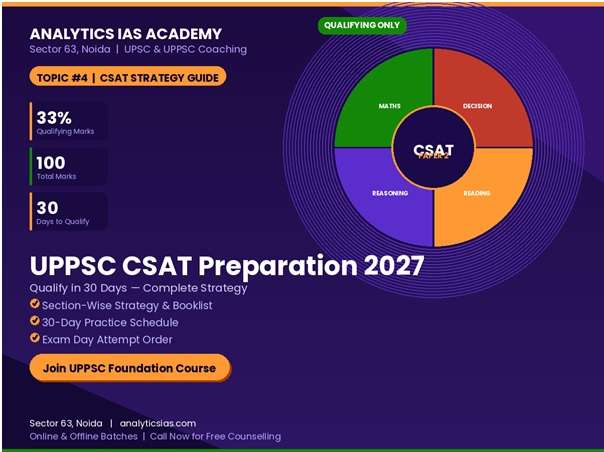
Of all the challenges in UPPSC preparation, CSAT should not be one of them.
And yet, every year, a surprising number of well-prepared aspirants — candidates who have studied History, Polity, Geography and Economy thoroughly — stumble at CSAT. They underestimate it, skip practice, and then face the paper with a sense of panic they never expected.
Here is the good news: UPPSC CSAT is qualifying in nature. You need just 33 marks out of 100 — 33% — to clear it. With the right approach, this is achievable in 30 to 45 days of focused preparation, even if Maths and Reasoning are not your strong points.
This guide gives you the complete UPPSC CSAT Preparation Strategy for 2027 — syllabus breakdown, topic-wise approach, best books, common mistakes, and a day-by-day practice plan — so CSAT never becomes the reason you miss the cut.
📌 Part of our UPPSC 2027 Complete Series:
- UPPSC Current Affairs 2027: Complete Strategy — Blog #1
- UP Special Current Affairs for UPPSC 2027 — Blog #2
- UPPSC Preparation Strategy 2027: Complete Roadmap — Blog #3
What Exactly is UPPSC CSAT? Understanding Paper II
CSAT stands for Civil Services Aptitude Test. In the UPPSC Prelims, it is Paper II — the second paper on the same day as the General Studies Paper I.
Key Facts About UPPSC CSAT 2027
| Feature | Detail |
| Paper | General Studies Paper II (CSAT) |
| Total Marks | 100 |
| Number of Questions | 100 |
| Duration | 2 hours |
| Marks per Question | 1 mark |
| Negative Marking | 1/3rd mark per wrong answer |
| Nature | Qualifying only |
| Qualifying Marks | 33 marks (33%) |
| Counted in Merit | No — only Paper I marks count |
The most important thing to understand: CSAT marks do NOT count in your Prelims merit list. Only General Studies Paper I marks are used to shortlist candidates for Mains. CSAT is purely a qualifying hurdle — cross it, and it is done.
This means two things:
- You do not need to score high — just cross 33
- You must not fail it — even a single mark below 33 ends your attempt regardless of your GS Paper I score
UPPSC CSAT Syllabus 2027: Complete Topic-Wise Breakdown
Understanding exactly what CSAT covers is the first step. Many aspirants waste time preparing topics that are not even in the syllabus.
Section 1: Comprehension (Reading Comprehension)
- Passages from general topics — governance, social issues, science, economy, environment
- Questions test: main idea, inference, tone, vocabulary in context, title selection
- Typically 3–5 passages with 3–5 questions each
- Expected marks: 20–30 out of 100
Section 2: Interpersonal Skills Including Communication Skills
- Questions on effective communication, workplace behaviour, conflict resolution
- Largely logical and situational — no specific content to memorise
- Expected marks: 5–8 out of 100
Section 3: Logical Reasoning and Analytical Ability
- Syllogisms, blood relations, directions, coding-decoding, series completion
- Arrangements (linear, circular), rankings, puzzles
- Statement-assumption, statement-conclusion type questions
- Expected marks: 15–20 out of 100
Section 4: Decision Making and Problem Solving
- Situational questions — given a scenario, pick the most appropriate action
- Tests ethical reasoning, practical judgement, and administrative thinking
- Cannot be “studied” in the traditional sense — improved through practice
- Expected marks: 5–10 out of 100
Section 5: General Mental Ability
- Number series, letter series, odd one out, analogies
- Venn diagrams, data sufficiency, input-output
- Expected marks: 10–15 out of 100
Section 6: Basic Numeracy (Class 10 Level Maths)
- Number system, percentage, ratio and proportion
- Profit and loss, simple and compound interest
- Speed, distance and time; work and time
- Average, mixture and allegation
- Data interpretation — tables, bar graphs, pie charts, line graphs
- Expected marks: 20–25 out of 100
Section 7: Hindi Language Comprehension (Class 10 Level)
- Simple Hindi passage with comprehension questions
- Tests basic reading ability in Hindi — not grammar or literature
- Expected marks: 5–8 out of 100
The 33-Mark Strategy: How to Qualify UPPSC CSAT in 30 Days
The smartest way to approach CSAT qualification is to identify your personal scoring zones — the sections where you can score easily — and guarantee those marks rather than trying to excel everywhere.
Here is a proven allocation to reach 40+ marks comfortably:
| Section | Realistic Target | Effort Required |
| Reading Comprehension | 18–22 marks | Low — just read carefully |
| Logical Reasoning | 8–10 marks | Medium — pattern practice |
| Basic Numeracy | 8–10 marks | Medium — formula revision |
| General Mental Ability | 4–6 marks | Low-Medium |
| Decision Making | 3–5 marks | Low — common sense |
| Hindi Comprehension | 3–5 marks | Low for Hindi-medium readers |
| Total Target | 44–58 marks | Well above qualifying |
Key insight: Reading Comprehension alone can give you 18–22 marks with almost zero preparation — because it tests your ability to understand a passage, not memorise content. If you can read English comfortably, this section is your safety net. Focus here first.
Section-Wise UPPSC CSAT Strategy 2027
Strategy 1: Reading Comprehension — Your Highest ROI Section
Reading Comprehension gives maximum marks with minimum subject-specific preparation. Here is how to approach it:
Step 1 — Read the questions first, then the passage Before reading the passage, scan the questions. This tells you exactly what to look for, saving 30–40% of reading time.
Step 2 — Stay within the passage Every answer is either directly stated or logically inferable from the passage. Do not bring outside knowledge — that is the most common mistake in comprehension.
Step 3 — Eliminate wrong options UPPSC comprehension questions almost always have 2 options that are clearly wrong and 2 that seem plausible. Eliminate the clearly wrong ones first, then choose between the remaining two based on what the passage says — not what you believe.
Step 4 — Read editorials daily 30 days of reading The Hindu or Indian Express editorials improves comprehension speed and accuracy significantly. This also helps your GS Paper I current affairs simultaneously — double benefit.
Practice target: Attempt 3 comprehension passages daily from previous year CSAT papers. 15 days of this practice is sufficient for most aspirants.
Strategy 2: Logical Reasoning — Pattern Over Theory
Logical Reasoning in UPPSC CSAT is not conceptually difficult — it is pattern-based. Once you recognise the patterns, the questions become mechanical.
High-priority topics (attempt these first in the exam):
- Blood relations — typically 2–3 questions, quick to solve
- Direction sense — 1–2 questions, simple if you practice the standard approach
- Syllogisms — 3–5 questions, fully solvable with Venn diagram method
- Coding-decoding — 2–3 questions, pattern recognition
- Number and letter series — 2–3 questions, easy marks
Lower-priority topics (attempt only if time permits):
- Complex arrangements and puzzles — time-consuming, low marks per minute
- Input-output — skip if you are not comfortable; time cost too high
Practice approach: Solve 15–20 reasoning questions daily for 3 weeks. Do NOT study theory from thick books. Use previous year CSAT papers and sectional practice sets only.
Strategy 3: Basic Numeracy — Class 10 Maths, Not Engineering Maths
This section frightens aspirants unnecessarily. UPPSC CSAT tests Class 10 level mathematics — not advanced maths, not calculus, not algebra beyond basic equations.
30-day Maths revival plan:
- Week 1: Revise formulas — percentage, ratio, profit-loss, interest, speed-time-work
- Week 2: Practice 10 questions per topic with formula sheet open
- Week 3: Practice 10 questions per topic without formula sheet
- Week 4: Full CSAT mock tests with time pressure
Data Interpretation is free marks: DI questions in UPPSC CSAT use simple tables and bar graphs. The maths involved is basic addition, percentage, and comparison — no advanced calculations. Practice 2 DI sets daily for 2 weeks and you will find these questions among the easiest in the paper.
The Maths shortcut that saves marks: If you see a maths question taking more than 2 minutes, mark it for later and move on. Never get stuck — there are easier marks available in other sections. Come back to complex maths only if time allows.
Strategy 4: Decision Making — Score Without Studying
Decision Making questions present administrative or ethical scenarios and ask you to pick the most appropriate action. These cannot be “studied” — but you can train your instinct.
The UPPSC decision-making framework: When faced with any decision-making question, the right answer almost always:
- Follows rules and procedures before taking independent action
- Consults superiors before making unilateral decisions
- Protects the public interest over personal or political interests
- Takes the most measured, least extreme action available
- Does not ignore the problem, but also does not overreact
Practice 10 decision-making questions daily for 2 weeks. You will notice patterns immediately. This section, once you understand the logic, becomes the most predictable part of CSAT.
Strategy 5: Hindi Language Comprehension — Easy Marks for UP Aspirants
Since most UPPSC aspirants are from Uttar Pradesh with a strong Hindi background, this section is among the easiest. A Hindi passage is given with straightforward comprehension questions — no grammar, no literature, no composition.
If Hindi is your first language: Spend zero preparation time here. Attempt these questions first in the exam for easy, quick marks.
If Hindi is not your first language: Spend 15 minutes daily reading simple Hindi passages for 2 weeks. This is sufficient to score 3–5 marks in this section.
UPPSC CSAT Books 2027: What to Use and What to Skip
You do not need multiple books for CSAT. Here is a lean, effective reading list:
For Reading Comprehension:
- Previous year UPPSC CSAT papers (non-negotiable — most relevant practice)
- Any standard CSAT comprehension practice book (R.S. Aggarwal’s Verbal and Non-Verbal Reasoning has good passages)
For Logical Reasoning:
- R.S. Aggarwal — Verbal and Non-Verbal Reasoning (selective chapters only — blood relations, directions, syllogisms, series)
- Previous year papers
For Maths and Data Interpretation:
- R.S. Aggarwal — Quantitative Aptitude (selective chapters — percentage, ratio, profit-loss, interest, time-work, time-speed, averages, DI)
- NCERT Mathematics Class 8, 9, 10 — for concept revision only
For Decision Making:
- No book needed — only practice sets from previous year papers
What to skip:
- Thick CSAT guides that cover 800+ pages — you do not need them for qualifying
- Advanced reasoning books designed for banking exams — too complex for CSAT level
- Any book that covers topics not in the UPPSC CSAT syllabus
30-Day UPPSC CSAT Preparation Schedule
Week 1 — Foundation
- Day 1–2: Understand UPPSC CSAT exam pattern, attempt one full previous year paper to benchmark yourself
- Day 3–5: Read R.S. Aggarwal Reasoning chapters — blood relations, directions, coding-decoding
- Day 6–7: Revise Maths formulas — percentage, ratio, profit-loss, interest
Week 2 — Topic-Wise Practice
- Day 8–10: Reading Comprehension — 3 passages daily, questions-first technique
- Day 11–12: Reasoning practice — syllogisms and number series — 20 questions daily
- Day 13–14: Maths practice — 10 questions per topic with formula reference
Week 3 — Speed and Accuracy Building
- Day 15–17: Full CSAT mock test (100 questions, 2 hours) — analyse errors
- Day 18–19: Weak topic revision based on mock test analysis
- Day 20–21: Data Interpretation — 2 sets daily, timed practice
Week 4 — Consolidation and Mock Tests
- Day 22–24: Decision Making — 10 situational questions daily
- Day 25–27: Full mock test every day — focus on time management
- Day 28–30: Revision of formulas and reasoning patterns only — no new content
Exam Day Strategy for UPPSC CSAT 2027
Attempt order for maximum efficiency:
- Hindi Comprehension — Start here. Quick, easy marks. Warm up the brain.
- Reading Comprehension (English) — High-mark section. Attempt while fresh.
- Decision Making — No calculation needed. Quick to attempt.
- Mental Ability and Series — Pattern-based, fast to solve once recognised.
- Blood Relations, Directions, Coding — Moderate speed.
- Data Interpretation — Moderate pace, methodical.
- Maths — Attempt only topics you are confident in. Skip time-consuming ones.
- Complex Reasoning Puzzles — Only if time remains.
Time allocation (120 minutes total):
- First 50 minutes: Comprehension (Hindi + English) + Decision Making
- Next 40 minutes: Reasoning and Mental Ability
- Final 30 minutes: Maths and Data Interpretation + review flagged questions
Negative marking rule: In CSAT, with 1/3rd negative marking, skip only those questions where you cannot eliminate even 2 options. If you can eliminate 2 out of 4 options, the probability math favours attempting — expected gain is positive.
Common Mistakes in UPPSC CSAT Preparation
Mistake 1: Treating CSAT as an afterthought Many aspirants focus 100% on GS Paper I and give CSAT zero attention. Then they are shocked when their Paper II score is 25 or 28 — just below the qualifying mark — and their strong Paper I score becomes irrelevant. CSAT needs 30 focused days, not zero days.
Mistake 2: Spending too much time on difficult maths Complex maths questions in CSAT can consume 5–8 minutes each. At 1 mark each, this is a terrible trade. Skip them. Get easy marks from comprehension, decision making, and DI first.
Mistake 3: Reading the passage before the questions In comprehension, reading the passage first wastes time. Read questions first — then read the passage looking specifically for those answers. This technique alone can save 15–20 minutes in the paper.
Mistake 4: Using banking exam preparation material IBPS, SBI, and CAT preparation books cover CSAT-type content at a far harder level than UPPSC requires. Using them for UPPSC CSAT is like using an engineering textbook to understand Class 10 science. Previous year UPPSC papers are your most relevant and reliable practice material.
Mistake 5: Attempting all 100 questions You need 33 marks. With negative marking, random attempts can hurt you. Attempt questions you are confident about or where you can eliminate 2 options. Target 55–65 questions attempted carefully rather than 100 attempted randomly.
How Analytics IAS Academy Covers UPPSC CSAT
At Analytics IAS Academy, Sector 63, Noida, CSAT is never an afterthought in our UPPSC Foundation Course — because we know it can end a serious aspirant’s attempt unnecessarily.
What our CSAT module covers:
✅ Structured CSAT classes — integrated into the Foundation Course schedule so CSAT preparation happens alongside GS, not at the last minute
✅ Section-wise practice sessions — dedicated practice for Comprehension, Reasoning, and Maths with performance tracking
✅ Full-length CSAT mock tests — under exam conditions, with detailed post-test analysis
✅ Individual weak area identification — after the first benchmark test, faculty guides each student on which sections to prioritise
✅ 30-day CSAT intensive module — for aspirants who join closer to the exam and need focused CSAT preparation quickly
✅ Available online and offline — our CSAT module is fully available in both our live online programme and classroom batches at Sector 63, Noida
If you are starting fresh or restrategising for UPPSC 2027, the right time to integrate CSAT into your plan is now — not the month before the exam.
Frequently Asked Questions
Q1. What are the qualifying marks for UPPSC CSAT 2027?
The qualifying marks for UPPSC CSAT (General Studies Paper II) are 33 marks out of 100, which is 33%. These marks do not count in the Prelims merit list — only GS Paper I marks are used for shortlisting. However, failing to qualify CSAT means your Paper I marks become irrelevant regardless of how high they are.
Q2. Is UPPSC CSAT difficult to clear?
For a well-prepared aspirant who dedicates 30–45 days of focused practice, UPPSC CSAT is not difficult to clear. The challenge is underestimating it and not preparing at all. The paper tests Class 10 level maths, basic logical reasoning, and reading comprehension — none of which requires advanced academic knowledge.
Q3. Can I clear UPPSC CSAT without preparing Maths?
Yes — strategically. If Maths is your weak area, you can still clear CSAT by scoring heavily in Reading Comprehension (20–25 marks possible), Logical Reasoning (10–15 marks), Decision Making (5–8 marks), and Hindi Comprehension (5–8 marks). That alone can cross 40 marks without attempting a single Maths question.
Q4. What is the best book for UPPSC CSAT 2027?
The most important resource is UPPSC previous year CSAT papers — they are the most relevant practice available. For additional practice: R.S. Aggarwal’s Verbal and Non-Verbal Reasoning (selective chapters) for Reasoning, R.S. Aggarwal’s Quantitative Aptitude (selective chapters) for Maths, and NCERT Maths Class 8–10 for concept revision.
Q5. How many days are enough to prepare for UPPSC CSAT?
30 focused days are sufficient for most aspirants to comfortably qualify CSAT, provided they follow a structured topic-wise plan. Aspirants who are strong in English and Reasoning can qualify with even less preparation. Those who struggle with Maths should start 45 days before Prelims.
Q6. Does UPPSC CSAT have negative marking?
Yes. UPPSC CSAT has a negative marking of 1/3rd mark per wrong answer — the same as GS Paper I. This means each wrong answer costs 0.33 marks. Strategy: Do not attempt questions randomly. Attempt confidently or skip — do not guess blindly.
Q7. Does Analytics IAS Academy provide CSAT coaching as part of the UPPSC Foundation Course?
Yes. Our UPPSC Foundation Course at Analytics IAS Academy, Sector 63, Noida includes a dedicated CSAT module covering all sections — Comprehension, Reasoning, Maths, and Decision Making — with full-length mock tests and section-wise practice. Both online and offline batches include this module. Call us or visit analyticsias.com for current batch details.
Q8. Is CSAT the same for UPSC and UPPSC?
The concept is similar — both test aptitude rather than subject knowledge — but the difficulty level is significantly different. UPSC CSAT is harder, with more complex reasoning and maths. UPPSC CSAT is at a lower difficulty level and requires only 33% to qualify versus 33% for UPSC as well, but UPPSC questions are generally more straightforward. Do not use UPSC CSAT preparation material as your primary resource for UPPSC CSAT.
The Bottom Line: CSAT Should Never Be Your Reason for Failing UPPSC
UPPSC CSAT is one of the most manageable components of the entire exam — if you respect it enough to prepare for it.
Thirty days. The right sections. The right practice material. A smart attempt strategy on exam day.
That is all it takes to ensure CSAT never comes between you and your UPPSC selection.
At Analytics IAS Academy, Sector 63, Noida, our UPPSC Foundation Course — available online and offline — ensures CSAT is built into your preparation plan from Month 1, not added as panic preparation in the final weeks.
New batches starting soon. Limited seats — online and offline both.
📍 Visit: analyticsias.com
🎥 Watch our UPPSC prep series: Analytics IAS YouTube Channel
📞 Call now for your FREE one-on-one counselling session
