
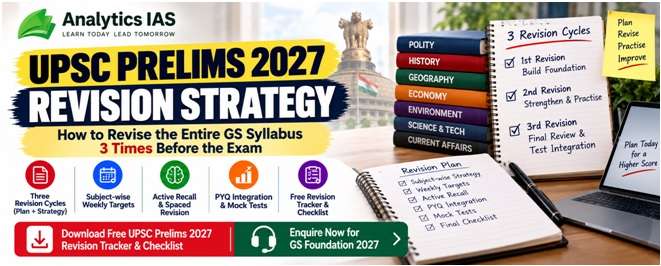
Quick answer: How do you revise the UPSC Prelims 2027 syllabus three times?
Divide your available preparation time into three purposeful passes: (1) coverage and compression, (2) active recall and question-led repair, and (3) rapid consolidation under timed conditions. Do not reread every textbook three times. Revise concise notes, maps, key concepts, current-affairs connections and PYQ-tested areas, while tracking the topics you cannot retrieve without looking.
The most effective UPSC Prelims 2027 revision strategy is a repeatable system: recall → check → practise → correct → revisit. Three cycles are a planning framework, not a guarantee of a particular score.
Why does revision feel ineffective even after hours of studying?
Rereading can create familiarity without reliable recall. Aspirants often recognise a fact on the page but cannot retrieve it during a timed MCQ. Active recall—answering a question before opening notes—tests retrieval. Spaced review helps you revisit information after a delay, while mixed-topic practice prepares you to distinguish similar options.
Instead of asking “How many pages did I revise?”, ask “Which concepts can I explain or solve without looking?” Keep a one-page error log rather than rewriting full chapters.
The three-cycle UPSC Prelims 2027 revision plan
| Cycle | Purpose | Method | Evidence of progress |
| Cycle 1: Build & compress | Cover remaining gaps and produce short revision notes | Syllabus mapping, 1-page summaries, topic-wise PYQs | Every topic classified: strong / developing / weak |
| Cycle 2: Retrieve & repair | Strengthen memory and correct misconceptions | Closed-book recall, spaced quizzes, sectional tests | Fewer repeated errors; improved accuracy |
| Cycle 3: Consolidate & test | Recall quickly across subjects and manage exam pressure | Mixed MCQs, full mocks, short revision sheets | Stable accuracy, fewer avoidable mistakes |
How to fit three cycles before the examination
As of October 2026, aspirants have time to establish a disciplined plan, but the exact exam date and remaining weeks should be verified from the official UPSC calendar. Use the following relative timeline and adjust for your starting level.
| Planning window | Suggested focus | Approximate time allocation |
| Early preparation: first 45–50% of remaining revision time | Cycle 1: complete high-value coverage and compress notes | 45–50% |
| Middle preparation: next 30–35% | Cycle 2: retrieval, PYQs and sectional testing | 30–35% |
| Final preparation: last 15–25% | Cycle 3: rapid sheets, mocks, weak-area repair | 15–25% |
If your first reading is incomplete, do not pretend it is revision. Combine essential first-time coverage with short same-day recall, then prioritise high-frequency and high-importance syllabus areas without abandoning breadth.
Cycle 1: Revise the syllabus once with a subject-wise map
List each syllabus area and its subtopics. For every topic, identify one primary source, your condensed notes, relevant UPSC PYQs and the date you last recalled it. Use an A/B/C status: A = can explain without notes; B = partial recall; C = cannot recall or repeatedly incorrect.
- Polity: constitutional framework, institutions, governance concepts and relevant developments.
- History and Art & Culture: modern history, timelines, movements, cultural forms and factual distinctions.
- Geography: physical processes, Indian geography, maps, locations and environment connections.
- Economy: foundational concepts, policy instruments, budget/economic developments and application-based questions.
- Environment & Ecology: ecosystems, biodiversity, conservation, climate and relevant current affairs.
- Science & Technology: concepts in the news, applications and foundational scientific literacy.
- Current affairs: integrate developments into the relevant static subjects instead of building an isolated daily-news pile.
Use actual UPSC questions to calibrate your topic emphasis: Official UPSC Civil Services previous-year papers
Cycle 2: Replace passive rereading with active recall
For each topic, close your notes and write five key points, sketch a process or solve 10–15 questions. Only then open your source and correct gaps. Revisit difficult items at increasing intervals—for example, after 1, 3, 7 and 14 days—adjusting the spacing when you keep forgetting.
Integrate PYQs as a diagnostic, not as a list of answers to memorise. Analyse why an option is right or wrong, identify the tested concept and generate one related question. When sectional tests expose a weak area, schedule it again in the next weekly plan.
Cycle 3: Revise fast, but do not abandon accuracy
In the final cycle, focus on one-page subject sheets, marked error-log items, maps, essential facts, high-yield concepts and timed mixed practice. Analyse uncertain correct answers as well as incorrect ones. Maintain separate CSAT readiness checks; GS revision alone does not establish CSAT qualifying preparedness.
Do not add large new sources late in preparation unless an important syllabus gap requires them. A smaller set of well-understood sources usually supports more reliable retrieval than constant resource switching.
An illustrative 7-day weekly revision timetable
| Day | Primary revision | Retrieval / practice |
| Monday | Polity + 20-minute current-affairs integration | 20 topic-wise MCQs; update error log |
| Tuesday | Modern History + Art & Culture | Closed-book timeline; PYQs |
| Wednesday | Geography + maps | Map recall + mixed questions |
| Thursday | Economy | Explain concepts aloud + sectional MCQs |
| Friday | Environment + Science & Technology | Recall tables and concept quiz |
| Saturday | Mixed-subject revision + CSAT | Timed mixed set / CSAT practice |
| Sunday | Sectional/full mock as appropriate | Deep analysis, backlog and next-week plan |
Adapt the number of subjects per day to your available study hours. Working professionals may divide each day into a 45-minute recall block, 60–90 minutes of core revision and a 20-minute MCQ review.
How to build a spaced revision routine without overcomplicating it
After first revising a topic, schedule a quick closed-book check the next day; revisit it after roughly three days, one week and two weeks. These are flexible intervals rather than a scientifically fixed formula for every learner. If recall fails, shorten the next interval. If recall is strong, extend it.
Use flashcards for concise facts, diagrams for processes, blank maps for locations and MCQs for discrimination between similar statements. The best format depends on the information being learned.
How to use mock tests and PYQs within your revision cycles
Cycle 1: use topic-wise questions to expose conceptual gaps. Cycle 2: use sectional tests to compare accuracy across subjects. Cycle 3: use timed full-length tests for decision-making, pacing and cross-topic recall. Do not count a mock as completed until its errors have been reviewed and converted into revision actions.
Track net score, attempts, accuracy, time pressure and three recurring mistake categories. Avoid judging readiness from one mock score because difficulty varies across providers.
Printable UPSC Prelims 2027 subject-wise revision tracker
Print this table or fill it digitally. Tick each cycle only when you can retrieve the topic without notes and have checked your mistakes.
| Subject | Cycle 1 | Cycle 2 | Cycle 3 | Weak areas / next review |
| Polity | ☐ | ☐ | ☐ | ________________ |
| History & Art | ☐ | ☐ | ☐ | ________________ |
| Geography | ☐ | ☐ | ☐ | ________________ |
| Economy | ☐ | ☐ | ☐ | ________________ |
| Environment | ☐ | ☐ | ☐ | ________________ |
| Science & Tech | ☐ | ☐ | ☐ | ________________ |
| Current affairs | ☐ | ☐ | ☐ | ________________ |
| Mixed PYQs | ☐ | ☐ | ☐ | ________________ |
| CSAT (separate) | ☐ | ☐ | ☐ | ________________ |
Weekly revision checklist — print and repeat
☐ I identified my three weakest micro-topics.
☐ I revised at least one topic from memory before opening notes.
☐ I revisited previously forgotten facts at spaced intervals.
☐ I solved and reviewed relevant PYQs or MCQs.
☐ I analysed wrong answers and uncertain correct answers.
☐ I completed my planned CSAT practice.
☐ I updated the subject-wise tracker and planned next week.
Seven revision mistakes that waste time
- Reading the same chapter repeatedly without testing recall.
- Trying to revise every book cover to cover in every cycle.
- Saving all PYQs and mock analysis for the final month.
- Ignoring subjects that feel difficult or unfamiliar.
- Making extensive new notes instead of condensing existing ones.
- Tracking hours studied but not retention or accuracy.
- Neglecting CSAT because it is qualifying.
Watch More: Analytics IAS Academy YouTube
Explore relevant preparation content on the official Analytics IAS channel. These are channel-specific searches rather than unverified claims about individual video titles.
UPSC Prelims preparation and revision videos
UPSC current affairs and GS videos
Analytics IAS Academy YouTube channel
Read More: Continue your UPSC 2027 preparation
Analytics IAS Academy: UPSC Foundation programmes and resources
Official UPSC previous-year question papers
For additional UPSC 2027 strategy articles, explore the Analytics IAS website and use its on-site search. Specific article URLs should be checked before publishing them as internal links.
Frequently asked questions about UPSC Prelims 2027 revision
Can I revise the UPSC Prelims GS syllabus three times?
Yes, if each pass has a different purpose and the timetable matches your coverage. Three cycles are a useful framework, not a requirement or guarantee.
When should I start revision for UPSC Prelims 2027?
Begin short recall sessions immediately after studying a topic. Formal subject-wise cycles can run alongside coverage and intensify as the exam approaches.
How do I revise without forgetting?
Use closed-book recall, spaced review, PYQs and regular testing. Track recurring errors and shorten intervals for weak topics.
How many hours a day should I revise?
Choose a sustainable routine based on your schedule and current preparation. Measure recall and corrected errors rather than hours alone.
Should I make new notes during revision?
Prefer short corrections and one-page summaries. Rewrite only when existing notes are genuinely unusable.
How do I balance current affairs with static GS revision?
Attach relevant news to Polity, Economy, Environment, Geography and other static topics, then practise integrated questions.
Should I include CSAT in a GS revision timetable?
Yes, as a separate qualifying-paper workstream. Regular practice is important, particularly when your performance is inconsistent.
Download your revision tracker and get personalised study guidance
Use the printable tracker in this article to record your three revision cycles. Analytics IAS Academy offers UPSC preparation support through classroom learning in Sector 63, Noida, and live online classes across India. To discuss your revision gaps, weekly plan or GS Foundation 2027 options, contact the team for counselling.
Call / WhatsApp: 9990124010 | Website: analyticsias.com
Explore Analytics IAS Academy and enquire about GS Foundation 2027
Your next step: choose one weak subject, write down three micro-topics you cannot recall confidently, and schedule your first 20-minute closed-book revision today.
