
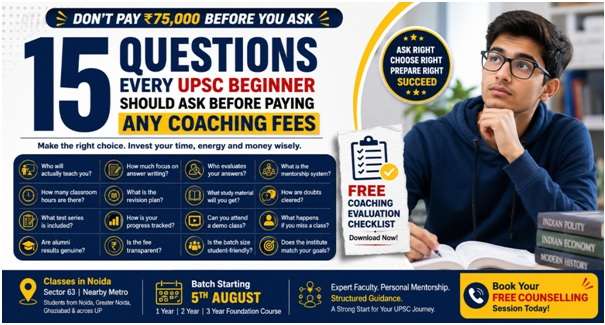
Choosing a UPSC coaching institute is one of the most important decisions in a civil services aspirant’s journey. Every year, thousands of students enroll in foundation courses without asking the right questions. Many realize months later that the teaching style, mentorship, revision plan, or classroom environment does not match their expectations.
Whether you are a Class 12 student planning a long-term foundation course, a college student preparing for UPSC CSE 2027 or 2028, or a graduate beginning your preparation, asking the right questions before paying the coaching fee can save both time and money.
This guide presents a practical 15-point checklist to help you evaluate any UPSC coaching institute objectively.
Why Choosing the Right UPSC Coaching Matters
UPSC Civil Services Examination is not merely a knowledge-based examination. It tests conceptual understanding, analytical thinking, writing ability, decision-making, consistency, and personality.
A good coaching institute cannot guarantee success. However, it can provide:
- A structured roadmap
- Expert guidance
- Consistency in preparation
- Answer writing practice
- Peer learning
- Mentorship
- Revision support
- Accountability
On the other hand, joining the wrong institute may result in:
- Incomplete syllabus
- Lack of personal guidance
- Confusion regarding resources
- Poor answer writing skills
- Wasted months of preparation
- Financial loss
Therefore, choosing wisely is essential.
Question 1
Who Will Actually Teach You?
Many students enroll after attending a counselling session but never verify who will teach them.
Ask:
- Are classes conducted by permanent faculty?
- Are guest faculty involved?
- Who teaches Polity, Economy, History, Geography, Ethics and Current Affairs?
- What are their qualifications and experience?
Faculty consistency matters more than marketing.
Question 2
Is the Course Designed for Beginners or Experienced Aspirants?
Every student has a different starting point.
Ask whether the course is designed for:
- School students
- College students
- Fresh graduates
- Working professionals
- Repeat aspirants
A beginner-friendly foundation course should start from fundamentals rather than assuming prior knowledge.
Question 3
What Is the Complete Course Structure?
Do not rely on vague statements like “complete preparation.”
Ask for:
- Monthly academic plan
- Subject sequence
- Duration
- Weekly schedule
- Number of classroom hours
- Current affairs integration
- Revision calendar
Everything should be clearly documented.
Question 4
How Much Time Is Actually Devoted to Answer Writing?
The UPSC Main Examination rewards analytical writing, not rote learning.
Ask:
- When does answer writing begin?
- Is it weekly?
- Are copies evaluated individually?
- Is written feedback provided?
- Are model answers discussed?
Answer writing should be integrated throughout the course rather than postponed until the end.
Question 5
Who Evaluates Your Answers?
Many institutes conduct tests but provide little or no meaningful evaluation.
Ask:
- Who checks answer sheets?
- Are faculty involved?
- Is personalized feedback available?
- How quickly are copies returned?
Constructive evaluation is essential for improvement.
Question 6
What Is the Mentorship System?
Mentorship often determines whether students remain consistent.
Ask:
- Is every student assigned a mentor?
- How frequently are mentoring sessions conducted?
- Can students discuss preparation strategy?
- Is there guidance for optional subject selection?
- Are parents updated when appropriate?
A strong mentorship ecosystem provides direction beyond classroom teaching.
Question 7
How Frequently Are Revision Classes Conducted?
Completing the syllabus alone is not enough.
Effective preparation requires multiple revisions.
Ask:
- How many revision cycles are included?
- Are revision classes separate?
- Are revision notes provided?
- Is there a structured revision timetable?
Revision transforms information into long-term retention.
Question 8
Does the Institute Follow the Latest UPSC Pattern?
UPSC evolves continuously.
Ask:
- Are previous year questions integrated into teaching?
- Is current affairs linked with static subjects?
- Is content updated regularly?
- Are emerging topics included?
Preparation should reflect the current examination trend rather than outdated notes.
Question 9
What Study Material Will You Receive?
Study material should simplify preparation instead of increasing confusion.
Ask:
- Are printed notes provided?
- Are they updated annually?
- Are current affairs compilations included?
- Are revision booklets available?
- Is digital access provided?
Quality matters more than quantity.
Question 10
What Is the Student-to-Faculty Interaction Like?
A classroom should encourage learning rather than passive listening.
Ask:
- Can students ask questions freely?
- Are doubt-clearing sessions scheduled?
- Is one-to-one interaction possible?
- Are faculty accessible outside class hours?
Learning improves when interaction is encouraged.
Question 11
What Happens If You Miss a Class?
Students may occasionally miss classes due to exams, illness, or travel.
Ask:
- Are recorded lectures available?
- Can missed classes be compensated?
- Are backup sessions conducted?
Academic continuity is important.
Question 12
Does the Institute Build Discipline?
UPSC preparation requires long-term consistency.
Ask:
- Are attendance records maintained?
- Are regular tests conducted?
- Is there progress monitoring?
- Are students held accountable?
A structured environment helps maintain momentum.
Question 13
Are Previous Students Willing to Share Their Experience?
Instead of relying only on advertisements:
- Read independent reviews.
- Speak to existing students.
- Visit the institute.
- Attend a demo class if available.
- Verify classroom experience personally.
Authentic student experiences often reveal valuable insights.
Question 14
Does the Institute Encourage Independent Thinking?
UPSC rewards original analysis.
Ask whether classes include:
- Discussions
- Debates
- Editorial analysis
- Case studies
- Ethics examples
- Interdisciplinary learning
Preparation should develop thinking, not memorization.
Question 15
Does the Institute Match Your Personal Goals?
Every aspirant’s situation is unique.
Consider:
- Daily travel time
- Budget
- Class timings
- Language preference
- Batch size
- Long-term support
- Test series
- Peer group
- Learning style
The best coaching institute is the one that aligns with your preparation needs—not necessarily the one with the biggest advertisements.
A Practical UPSC Coaching Evaluation Checklist
Before making any payment, rate each coaching institute on the following parameters:
| Parameter | Rating (1–5) |
| Faculty Quality | |
| Course Structure | |
| Answer Writing | |
| Mentorship | |
| Revision Plan | |
| Study Material | |
| Doubt Resolution | |
| Test Series | |
| Accessibility | |
| Student Feedback |
Compare multiple institutes using the same checklist before making your decision.
Common Mistakes Beginners Make
Many students make avoidable mistakes while selecting a coaching institute:
- Joining because friends joined
- Choosing based only on advertisements
- Believing unrealistic success claims
- Ignoring faculty quality
- Not attending a demo class
- Failing to verify the course structure
- Paying fees without understanding the mentorship model
- Selecting an institute solely because of location or brand name
Avoiding these mistakes can save months of preparation.
A UPSC coaching institute should act as a guide, mentor, and structured learning partner—not merely as a classroom.
Asking the right questions before admission helps you make an informed decision based on transparency, teaching quality, academic planning, mentorship, and long-term support.
Remember, success in UPSC ultimately depends on your dedication, discipline, and consistent effort. A coaching institute can provide direction and support, but sustained preparation remains the responsibility of the aspirant.
Before you invest your time and resources, invest a few hours in asking the right questions.
That simple step can make a meaningful difference in your UPSC journey.
Frequently Asked Questions (FAQ)
Is coaching compulsory for UPSC?
No. Many candidates succeed through self-study. However, coaching can provide structure, mentorship, peer learning, and systematic guidance for those who prefer a guided approach.
How do I choose the best UPSC coaching institute?
Evaluate faculty quality, mentorship, answer writing practice, revision plan, study material, classroom environment, student feedback, and whether the program suits your learning needs.
Should beginners join a foundation course?
A foundation course can be beneficial for beginners who need a structured introduction to the UPSC syllabus, provided it emphasizes conceptual understanding and regular revision.
Is an expensive coaching institute always better?
Not necessarily. Higher fees do not automatically indicate better teaching quality. Focus on the overall academic ecosystem rather than price alone.
Should I attend a demo class before admission?
Yes. A demo class offers valuable insight into teaching style, faculty interaction, classroom engagement, and whether the institute aligns with your learning preferences.