
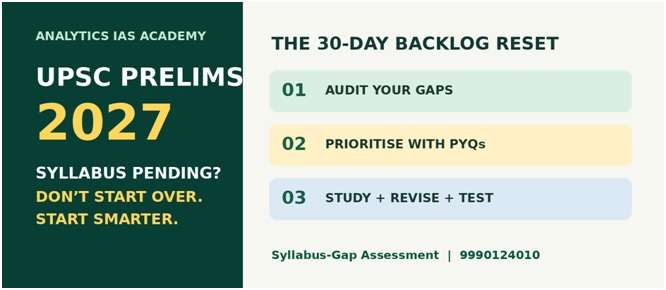
Quick answer: How can you complete the UPSC 2027 syllabus if you are behind?
Do not restart every subject. First audit your progress topic by topic, classify gaps by importance and understanding, select limited sources, divide the next 30 days into coverage and revision blocks, practise PYQs and MCQs from the beginning, and check CSAT separately. Track retained concepts and errors—not just pages finished. The goal is a realistic recovery plan, not an unrealistic promise to finish everything in 30 days.
If you have been preparing for months yet feel as if nothing is complete, you are not alone. The real problem is often fragmented coverage: half-finished chapters, several books for the same topic, unreviewed current affairs and no clear picture of what you can actually recall.
A UPSC 2027 syllabus completion strategy begins with an honest diagnosis. Your previous work is an asset—even when it needs repair.
1. The three kinds of backlog (and why they need different solutions)
Coverage backlog
You have never studied a topic. Schedule focused first-time learning from one primary source.
Recall backlog
You studied it but cannot explain or solve questions now. Use closed-book recall, short revision and questions—not a complete reread.
Practice backlog
You know the concept but struggle with UPSC-style options, elimination or time. Solve topic-wise PYQs and MCQs and analyse mistakes.
Example: If you completed Parliament months ago but cannot distinguish the powers of the two Houses, that is a recall or practice gap—not a reason to restart the entire Polity book.
For the wider study sequence, see Read the Analytics IAS Prelims 2027 preparation roadmap
2. Take a 45-minute syllabus-gap audit before making another timetable
Print the official syllabus and create one row per micro-topic. Give each topic a status: A = can explain and solve questions; B = partially understood; C = untouched or consistently incorrect. Add the source, last revision date and a small question-test result. This creates a usable map instead of a vague feeling of being behind.
| Area | Audit examples | Recovery decision |
| Polity | Constitution, Parliament, judiciary, federalism | Revise B topics; first-study C topics |
| History & Culture | Modern history, chronology, movements, art forms | Use timelines and theme-wise PYQs |
| Geography | Physical processes, Indian geography, maps | Combine concepts with blank-map recall |
| Economy | Inflation, banking, fiscal policy, basic mechanisms | Rebuild concepts before complex news |
| Environment | Ecology, biodiversity, protected areas | Use concept sheets and comparison tables |
| Science & Tech | Basic principles, current applications | Connect news to underlying science |
| Current affairs | Issues linked to static subjects | Consolidate selectively; avoid duplication |
| CSAT | Comprehension, reasoning, numeracy | Take separate timed diagnostic |
Use the latest official syllabus and notification as the boundary: Official UPSC examination information and notifications
3. Prioritise by importance AND weakness—not by panic
Use a simple two-axis rule: priority rises when a topic is central to the syllabus or repeatedly tests important concepts AND your understanding is weak. PYQs inform emphasis but cannot predict the next paper. Do not abandon entire subjects because recent papers appeared to favour other areas.
| Priority | Meaning | What to do |
| P1 — Important + weak | Core topic; low recall or repeated errors | Study or repair this week |
| P2 — Important + moderate | Know basics; weak application | Revise and solve PYQs |
| P3 — Lower urgency + weak | Limited immediate value or narrow subtopic | Schedule a short later block |
| Maintenance | Strong topic | Keep brief spaced recall |
For a step-by-step question-analysis method, read How to Analyse UPSC PYQs for Prelims 2027
4. The 30-day UPSC backlog recovery plan
This is a 30-day reset of your study system, not a claim that the entire UPSC syllabus can be completed in one month. Adjust the scope to your audit and available hours.
| Period | Main task | Proof of progress |
| Days 1–3 | Audit syllabus, choose limited sources, take a CSAT diagnostic | A/B/C topic map and realistic weekly targets |
| Days 4–10 | Repair P1 topics; start daily PYQs and recall | Short notes and error log |
| Days 11–17 | Continue P1; revise prior week; clear selected P2 gaps | Higher recall and fewer repeated errors |
| Days 18–24 | Integrate current affairs; sectional practice; CSAT block | Topic-wise accuracy and CSAT weakness map |
| Days 25–30 | Consolidate, take a mixed diagnostic, rebuild next-month plan | Updated gap tracker and next 30-day priorities |
An achievable target is more useful than “finish all GS in 30 days.” If your audit shows that only Polity and Economy can be repaired properly this month, finish those blocks with practice and revision rather than starting six subjects and completing none.
5. How to divide study time when your syllabus is incomplete
Try an illustrative 50:25:20:5 split: 50% on first-time coverage of prioritised gaps, 25% on recall and revision, 20% on PYQs/MCQs and analysis, and 5% on planning. Treat current affairs and CSAT as protected recurring blocks within your weekly timetable. Adjust this split if your audit shows that recall or CSAT needs more attention.
| Available daily time | Possible structure |
| 3 hours | 90 min priority gap; 45 min revision; 35 min questions; 10 min planning |
| 5 hours | 150 min gap repair; 75 min revision; 60 min questions; 15 min planning |
| Working professional | One 45–60 min focused gap block + 20–30 min recall/questions; longer weekend review |
The best timetable is one you can repeat. Do not use another aspirant’s 12-hour schedule as a benchmark.
6. Turn every completed topic into a closed learning loop
Use: STUDY → RECALL → PYQs → MCQs → ERROR ANALYSIS → REVISIT. Before moving on, explain the topic without notes and solve a small question set. Record whether mistakes came from missing facts, misunderstood concepts, option traps, careless reading or time pressure.
Example: After revising the Fundamental Rights chapter, close the book and compare constitutional rights, reasonable restrictions and relevant institutions. Then inspect actual PYQs and test whether you can identify misleading statements.
For a detailed recall and revision system, see UPSC Prelims 2027 three-cycle revision strategy
7. The two backlogs aspirants often forget: current affairs and CSAT
Current affairs: Stop trying to read every missed newspaper. Build a short, syllabus-linked list of major issues, consolidate from one credible monthly source and test recall. Use one dependable daily workflow going forward.
For a selective current-affairs system, read UPSC Current Affairs Strategy for Prelims 2027
CSAT: Do not postpone it because the paper is qualifying. Diagnose comprehension, reasoning and basic numeracy with timed practice; schedule improvement blocks according to your actual performance. Confirm the applicable rules in the official UPSC notification.
8. Seven mistakes that keep the UPSC syllabus permanently unfinished
- Restarting an entire textbook whenever recall feels weak.
- Collecting new PDFs, notes and courses before auditing existing material.
- Measuring pages covered rather than concepts retained.
- Waiting for 100% syllabus coverage before attempting questions.
- Giving all topics equal time despite different needs.
- Allowing current affairs to replace static GS and revision.
- Ignoring CSAT until the final preparation phase.
9. Printable UPSC 2027 syllabus-gap assessment sheet
| Subject | Status A/B/C | Top 2 pending micro-topics | Next review date |
| Polity | ________ | ________________________ | ________ |
| History & Culture | ________ | ________________________ | ________ |
| Geography | ________ | ________________________ | ________ |
| Economy | ________ | ________________________ | ________ |
| Environment | ________ | ________________________ | ________ |
| Science & Tech | ________ | ________________________ | ________ |
| Current affairs | ________ | ________________________ | ________ |
| CSAT | ________ | ________________________ | ________ |
At the end of seven days, update each subject using evidence: Can you explain the concept? Can you solve relevant questions? Are the same mistakes recurring?
Watch More: Analytics IAS Academy on YouTube
The following are topic searches within the official Analytics IAS channel, not unverified claims about individual videos. Choose a matching lesson and use it to repair one clearly identified gap.
UPSC PYQs and question analysis
Visit the official Analytics IAS YouTube channel
Read More: Your next UPSC 2027 preparation steps
UPSC Prelims 2027 Preparation Strategy: What to Study, Revise & Practise
UPSC Prelims 2027 Revision Strategy: Three Purposeful Cycles
How to Analyse UPSC PYQs for Prelims 2027
UPSC Current Affairs Strategy for Prelims 2027
FAQs: UPSC 2027 syllabus completion strategy
Can I complete the UPSC Prelims 2027 syllabus if I have backlogs?
You can make substantial progress by diagnosing gaps and using a realistic plan. Completion depends on starting level, available time and the breadth of remaining topics.
Should I restart NCERTs if I have forgotten what I studied?
Not automatically. Test recall first. Reread only the concepts you cannot explain or apply.
How many subjects should I study simultaneously?
Choose a manageable number of core study blocks, while protecting recurring revision, current affairs and CSAT. Avoid keeping every subject half-finished.
Is 30 days enough to complete the entire UPSC syllabus?
Not for most aspirants starting with major gaps. A 30-day reset is designed to prioritise, repair and establish a repeatable system.
Should I practise mock tests before finishing the syllabus?
Yes, use topic-wise and sectional practice diagnostically; full-length mocks become more useful as coverage and timing skills develop.
How should working professionals clear UPSC backlogs?
Use one focused daily gap-repair block, a shorter recall/question block and longer weekend consolidation sessions.
What if CSAT is my weakest paper?
Take a timed diagnostic and allocate separate practice to the weak skills. Do not assume GS preparation will address CSAT.
Get clarity on your UPSC 2027 syllabus gaps
If your study plan keeps restarting, an individual syllabus-gap review can help you identify what to retain, repair and prioritise. Analytics IAS Academy offers guidance for UPSC 2027 preparation, including GS Foundation learning options, mentoring and online/classroom enquiries.
Ask about the UPSC 2027 Syllabus-Gap Assessment. Please confirm the current availability and terms of any complimentary assessment when you contact the academy.
Analytics IAS Academy | Sector 63, Noida | Call/WhatsApp: 9990124010 | analyticsias.com
Contact Analytics IAS Academy for UPSC 2027 preparation guidance
Reader question: Which UPSC subject is your biggest backlog right now—and is the real challenge coverage, revision or practice? Share your answer in the comments.