
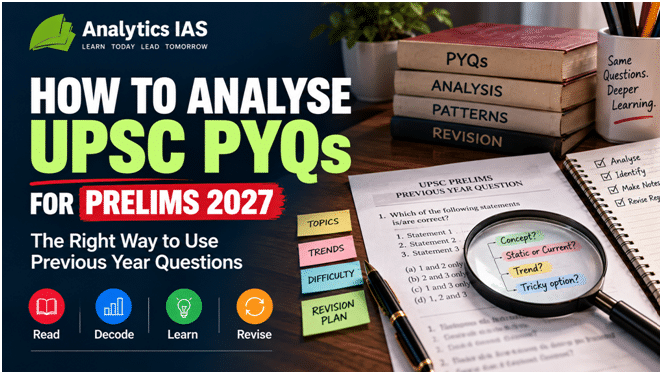
Quick answer: To analyse UPSC PYQs, solve each official previous-year question without notes, identify the syllabus topic and tested concept, verify every option, classify the error, connect it with your core source, and retest after revision. The goal is not to memorise old answers; it is to learn how UPSC tests concepts and how your preparation must change.
SOLVE → DECODE → VERIFY EVERY OPTION → RECORD THE GAP → REVISE → RETEST
Why PYQ analysis matters more than simply solving PYQs
Two aspirants may each solve 300 previous-year questions. One checks the answer key and moves on. The other examines why every option is correct or incorrect, identifies the source of uncertainty, and revisits the underlying concept. The second approach turns a paper into a study plan. UPSC PYQs reveal tested concepts, common distinctions, question framing and your own blind spots—but they cannot predict future questions with certainty.
Begin with authentic papers, not social-media compilations. Download GS Paper I and CSAT from the official UPSC previous-question-papers page; use older archived papers when needed.
Official UPSC previous-year question papers
Official UPSC archived question papers
How to analyse UPSC PYQs: the 7-step method
Step 1 — Attempt before seeing the answer
Solve the question without notes and record your selected option, confidence level (high/medium/low) and time taken. This exposes whether you knew the concept or guessed.
Step 2 — Map the syllabus and micro-topic
Tag each question: Polity → constitutional bodies; Economy → monetary policy; Environment → biodiversity; Geography → climatology. The micro-topic is more useful than a broad subject label.
Step 3 — Identify what UPSC is really testing
Ask whether the question tests a definition, exception, institutional role, comparison, sequence, cause-and-effect, map location or current–static connection.
Step 4 — Verify all options and statements
For each option, write a short reason it is true or false. Where facts are disputed or time-sensitive, cross-check with authoritative sources. Do not treat a coaching answer key as infallible.
Step 5 — Identify the error mechanism
Classify mistakes as concept gap, fact gap, confusing similar terms, reading error, weak elimination, overconfidence, time pressure or outdated information.
Step 6 — Convert the mistake into one revision action
Write a two- or three-line takeaway in your existing notes; add a comparison table or flashcard only if needed. Avoid copying full explanations into a second bulky notebook.
Step 7 — Retest without the answer visible
Reattempt the question after a few days and again in a mixed set. Track whether you can explain the answer, not merely remember the option letter.
A worked PYQ-analysis example (illustrative, not an actual UPSC question)
Question: Consider the following statements: (1) The Election Commission of India is a constitutional body. (2) NITI Aayog is a constitutional body. (3) The Comptroller and Auditor General of India is appointed by the President. Which statements are correct?
Answer: 1 and 3 only. Statement 1 is correct under Article 324. Statement 2 is incorrect: NITI Aayog was established by executive resolution, not by the Constitution. Statement 3 is correct under Article 148. The important lesson is to distinguish constitutional bodies from executive bodies and verify appointing authorities.
| What to record | Example entry |
| Micro-topic | Constitutional vs executive institutions |
| Tested skill | Institutional classification + appointment |
| Mistake type | Confused familiar institution with constitutional status |
| Revision action | Create a 2-column list of constitutional and executive bodies |
| Retest | Answer a new institution-based MCQ without notes |
The 5 questions to ask after every UPSC PYQ
- What precise concept or fact made the correct answer correct?
- Why is each other option wrong—and could one small change make it correct?
- Which NCERT, standard book or official source explains this?
- Is this a recurring syllabus theme or a one-off fact?
- What should I revise or practise differently next week?
Subject-wise PYQ analysis for UPSC Prelims 2027
| Subject | Look for | Best revision output |
| Polity | Institutions, powers, exceptions, procedures, constitutional vs statutory | Comparison sheets and article-linked notes |
| History & Culture | Chronology, movements, personalities, texts, art forms | Timelines and theme clusters |
| Geography | Processes, location clues, maps, physical-human links | Atlas markings and concept diagrams |
| Economy | Definitions, policy mechanisms, cause–effect, institutions | Mechanism flowcharts and term contrasts |
| Environment | Ecology concepts, protected areas, species, conventions | Species/area cards plus concept notes |
| Science & Tech | Applications, basic principles, contemporary technologies | Concept-to-application notes |
| CSAT | Comprehension, reasoning, numeracy, speed and selection | Timed error log by skill |
Do not infer that a subject or topic will definitely appear simply because it appeared frequently before. Frequency helps prioritise revision; the official syllabus remains the boundary.
Topic-wise PYQs or year-wise PYQs: which should you do first?
Use both, in sequence. During foundation study, topic-wise PYQs help you connect concepts with questions. Once you have covered a meaningful portion of the syllabus, attempt complete year-wise papers under timed conditions. Year-wise practice reveals mixed-topic switching, pacing, uncertainty and the effect of negative marking. For a structured foundation-first plan, see UPSC Preparation for Beginners 2027–2029. To convert your PYQ findings into a month-by-month action plan, read UPSC Prelims 2027 Preparation Strategy.
How many years of UPSC PYQs should you analyse?
A practical starting point is the most recent 10 years of official GS Paper I papers, then older papers selectively for important topics. This is a study recommendation, not an official UPSC rule. Do not sacrifice depth to complete a larger number of papers. For CSAT, use recent full papers under timed conditions and identify the exact skill gaps.
The PYQ error tracker: a simple template
| Date / year | Topic | Error | Action | Retest |
| Example: 2025 | Economy / inflation | Cause–effect overstated | Revise transmission lag | In 7 days |
| Example: 2024 | Polity / bodies | Confused body type | Compare institutions | In 7 days |
Track four indicators: first-attempt accuracy, confident-but-wrong answers, repeat errors and time per question. A rising score is useful, but fewer repeated mistakes is often the clearer signal that analysis is working.
How to connect PYQs with NCERTs, standard books and current affairs
Treat a PYQ as a pointer back to the syllabus. If a question tests monsoon mechanisms, revisit the relevant geography explanation; if it tests constitutional institutions, revise the exact distinction. Current affairs should deepen a syllabus concept, not replace the concept. For source discipline, see the Analytics IAS guide below. If your basics are weak, use the NCERT strategy for UPSC beginners to rebuild concepts before retesting.
Read: UPSC 2027 Booklist for Beginners — NCERTs + Standard Books
A realistic 30-day PYQ analysis plan
| Week | Priority | Output |
| Week 1 | Choose two GS subjects; solve topic-wise PYQs | First error log + 10 recurring micro-topics |
| Week 2 | Analyse every option; revise linked sources | Short comparison sheets and concept fixes |
| Week 3 | Add mixed sets and CSAT diagnostic | Accuracy and time baseline |
| Week 4 | Reattempt errors; complete a timed year-wise paper | Revised weak-area list + next-month plan |
Illustrative daily 45–60-minute PYQ block: 15–20 minutes to attempt a small set; 20–25 minutes to verify options and concepts; 10 minutes to record errors; 5 minutes to schedule retests. Adjust the number of questions to your preparation level.
7 common mistakes that make PYQ practice ineffective
- Memorising answer keys instead of understanding concepts.
- Reading explanations before attempting the question.
- Analysing only incorrect answers and ignoring lucky guesses.
- Copying lengthy solutions without linking them to existing notes.
- Treating old question frequency as a prediction of future paper weightage.
- Ignoring CSAT PYQs because Paper II is qualifying under the current scheme.
- Never retesting previously missed concepts.
What should UPSC 2027 aspirants do from October 2026?
topic-wise PYQs immediatelyStart topic-wise PYQs immediately alongside GS study. By the end of 2026, build a manageable error log and practise mixed sets. As the examination approaches, increase year-wise timed papers, CSAT practice and revision of recurring weak areas. Verify the official UPSC 2027 notification when released for dates, syllabus and applicable rules.
Read: UPSC Prelims 2027 preparation strategy from October 2026
Read: UPSC 2027 first 90-day preparation roadmap
Frequently asked questions about UPSC PYQ analysis
What is PYQ analysis in UPSC preparation?
It is the process of studying previous-year questions to understand tested concepts, question framing, distractors and your own errors—not just checking correct answers.
How to analyse UPSC PYQs for Prelims 2027 as a beginner?
Start with one topic, attempt a small set, identify the concept, verify every option, record one takeaway and retest after revision.
Are 10 years of UPSC PYQs enough?
Ten recent years are a useful starting base, but depth of analysis matters more than a fixed number. Supplement older papers where relevant.
Should I solve PYQs before or after reading a chapter?
Scan a few before reading to understand exam demand; solve properly after studying and revisit them during revision.
Can PYQs predict UPSC Prelims 2027 questions?
No. They reveal patterns and tested concepts but do not reliably predict exact questions or topic weights.
Should I analyse correct answers too?
Yes. A correct guess or weakly understood answer may conceal a knowledge gap. Verify all options.
How do I analyse CSAT PYQs?
Attempt timed sets, separate comprehension, reasoning and numeracy errors, and track accuracy and speed.
Is PYQ analysis better than mock tests?
They serve different purposes. PYQs reveal the actual exam’s historical framing; mocks provide additional practice and performance feedback.
How often should I revise PYQ mistakes?
Revisit them soon after analysis and again in spaced mixed sets; adapt intervals to your retention and workload.
Where can I download authentic UPSC PYQs?
Use the official UPSC previous-question-papers and archive pages linked above.
Watch More: Analytics IAS Academy video learning
Watch More — Analytics IAS Academy: Use these channel-specific video collections to find the most relevant lessons on PYQs, Prelims strategy and beginner preparation. The links open the official channel or its search results; individual video titles have not been independently verified.
Analytics IAS Academy — Official YouTube Channel
For the most relevant companion lesson, start with the channel’s PYQ search. Also explore the Prelims strategy and beginner-preparation video searches below.
Watch PYQ Analysis Videos — Analytics IAS Channel | Watch UPSC Prelims Strategy Videos | Watch UPSC 2027 Preparation Videos
Read More: related Analytics IAS guides
UPSC 2027 Preparation: Complete Foundation, PYQs and Mentorship Guide
UPSC CSE 2027 GS Foundation Course — Analytics IAS Academy
UPSC Prelims 2027: What to study, revise and practise
UPSC 2027 Booklist for Beginners
NCERT Strategy for UPSC Beginners
Final takeaway: analyse the question, not just the answer
A good PYQ session should end with three things: one concept understood better, one mistake less likely to recur, and one clear revision action. Build that habit now, and previous-year papers become a practical guide to how you study—not a collection of answers you memorise.
Preparing for UPSC CSE 2027? Analytics IAS Academy offers structured GS Foundation learning with concept building, PYQ practice, revision, tests and mentorship through classroom learning in Noida Sector 63 and live online classes.
For course counselling: Call/WhatsApp 9990124010 | www.analyticsias.com
