
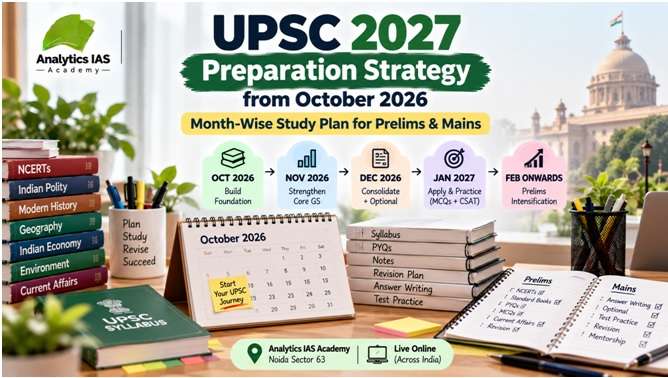
UPSC 2027 Preparation Strategy: What Should You Do If You Are Starting in October 2026?
Quick answer: If you are starting UPSC CSE 2027 preparation in October 2026, do not try to finish everything at once. Use October to understand the syllabus, analyse PYQs and build NCERT-level fundamentals; November and December to strengthen core General Studies and begin Optional; January to consolidate, revise, solve MCQs and assess CSAT; and from February onward, progressively increase Prelims-oriented practice while continuing revision. The goal is not maximum resources—it is a repeatable system of learning, PYQs, revision, testing and improvement.
The Union Public Service Commission has already published its Annual Calendar 2027. Check the official UPSC Annual Calendar 2027 for the Commission’s notified examination schedule and always rely on UPSC for official dates and subsequent changes.
If you are a complete beginner, first read: How to Start UPSC Preparation from Zero: Complete Beginner’s Study Plan. This article builds on that foundation and tells you what to prioritise month by month from October 2026.
| OCTOBER 2026 → FOUNDATION | NOVEMBER → CORE GS | DECEMBER → CONSOLIDATE + OPTIONAL | JANUARY → REVISION + MCQs + CSAT | FEBRUARY ONWARD → PRELIMS INTENSIFICATION |
Can I Start UPSC 2027 Preparation in October 2026?
Yes. October can still be a productive starting point for UPSC 2027 if you begin with a realistic plan and avoid the common beginner mistake of collecting too many books, PDFs, channels and strategies. What matters now is sequencing: understand what UPSC asks, build concepts, revise repeatedly and start practice early.
Starting later than another aspirant does not automatically put you behind; starting without structure does. Your preparation should move through a simple cycle: syllabus → concepts → PYQs → revision → tests → answer writing → feedback.
For a broader foundation roadmap, see UPSC CSE 2027 Preparation: A Complete Foundation Roadmap for Serious Aspirants.
Before the Month-Wise Plan: Set Up Your UPSC Preparation System
Spend the first two or three days setting up the system you will follow for the next several months. This prevents the first month from disappearing into resource hunting.
- Download and read the UPSC syllabus for Prelims and Mains.
- Look at previous-year questions before deciding the depth of any topic.
- Finalise limited NCERTs and one reliable core source per subject.
- Create separate space for static notes, current-affairs additions, PYQ observations and mistakes.
- Decide a realistic weekly timetable rather than an idealised 12-hour schedule.
- Take an early CSAT diagnostic test; do not assume CSAT will take care of itself.
- Shortlist Optional subjects and begin the decision process instead of postponing it indefinitely.
October 2026: Build the Foundation — NCERTs + Polity + Modern History + PYQs
October should be your foundation month. Do not measure progress by the number of books completed. Measure it by whether you can understand the syllabus language, explain basic concepts, recognise how UPSC frames questions and revise what you have studied.
1. Understand the syllabus and PYQs first
Keep the syllabus beside you while studying. For every major topic, inspect relevant Prelims and Mains PYQs. This helps you distinguish an exam-relevant concept from interesting but low-priority information.
2. Begin with NCERT-level conceptual clarity
Use NCERTs selectively to build the basic vocabulary of History, Geography, Polity, Economy, Environment and Society. Do not turn NCERT reading into a separate six-month project. Read with the syllabus and PYQs in view.
3. Start Polity and Modern History
Polity and Modern History are useful early subjects because they help a beginner become comfortable with core UPSC themes and question patterns. Build concepts first; then add a standard source and PYQs.
4. Start current affairs—but keep it controlled
Choose one newspaper or one reliable current-affairs workflow. Link current developments to static syllabus topics instead of making enormous daily notes. The purpose of current affairs is to enrich understanding and application, not create another unmanageable syllabus.
October target
- UPSC syllabus understood and repeatedly referred to
- Initial PYQ analysis completed for subjects being studied
- NCERT foundation underway
- Polity and Modern History started systematically
- One current-affairs routine established
- Weekly revision slot fixed
- Optional shortlist narrowed
November 2026: Geography + Economy + Current Affairs Integration
By November, your preparation should become more analytical. Continue revising October subjects while adding Geography and Economy. Avoid the trap of finishing one subject and never returning to it.
Geography
Build physical-geography fundamentals, maps and India-related applications. Connect static concepts with disasters, climate, agriculture, resources, urbanisation and environmental issues where relevant.
Economy
Focus first on concepts: inflation, growth, fiscal policy, monetary policy, banking, employment, external sector and basic public finance. Current economic news becomes much easier once the conceptual base is clear.
Integrate current affairs with static GS
Instead of maintaining current affairs as a separate universe, attach developments to the relevant syllabus topic. A policy change belongs with governance or economy; a climate development belongs with environment/geography; a social issue may enrich GS-I, GS-II or Essay.
Begin basic Mains thinking
At this stage, you do not need to write full-length answers every day. Start by breaking questions into directive, demand, dimensions and examples. Once basic content is available, write short untimed answers and get feedback where possible.
December 2026: Environment + Remaining GS + Revision + Optional Progress
December should not become another month of endlessly adding new material. It is the right time to strengthen Environment and other pending GS areas while deliberately increasing revision and Optional progress.
Make revision visible in your timetable
A topic is not prepared because you read it once. Schedule first revision quickly, then revisit it through PYQs, short notes, recall and tests. If your timetable has only ‘new study’ and no revision blocks, it is incomplete.
Optional should no longer be only a future decision
By December, serious 2027 aspirants should ideally have made a reasoned Optional choice and begun building the subject. Compare interest, syllabus, PYQs, availability of reliable guidance/resources, answer-writing demands and your ability to sustain the subject.
If Sociology is on your shortlist, you can review the Sociology Optional Online Course for UPSC 2027 to understand how Paper I, Paper II, current examples, answer writing and evaluation can be integrated.
January 2027: Consolidation + MCQs + CSAT + Revision
January is the point at which your preparation should begin shifting from ‘I have read this’ to ‘I can retrieve and apply this’. Increase revision, topic-wise MCQs and PYQ-based testing while closing major foundation gaps.
Start systematic MCQ practice
Use questions diagnostically. Do not merely count scores. Track why an answer went wrong: knowledge gap, conceptual confusion, poor elimination, overthinking, factual recall or careless reading.
Assess CSAT honestly
Take CSAT seriously from the beginning, particularly if comprehension, numeracy or reasoning is not your strength. A diagnostic test helps determine whether you need regular weekly practice or a lighter maintenance schedule.
Continue Mains skills at a sustainable level
Do not abandon Mains thinking completely. Maintain basic answer-writing exposure, but avoid creating an unrealistic workload as Prelims preparation begins to intensify.
February 2027 Onward: Gradually Intensify Prelims Preparation
From February onward, the balance should progressively move toward Prelims: repeated revision, PYQs, MCQs, sectional tests, CSAT and error analysis. The exact intensity should depend on your coverage and the official UPSC schedule.
Do not interpret ‘Prelims focus’ as ‘learn everything from scratch again’. A strong foundation built from October to January should now be compressed into revision-friendly notes, recall practice, questions and tests.
| READ LESS RANDOMLY → REVISE MORE → SOLVE MORE PYQs → TEST REGULARLY → ANALYSE ERRORS → REPEAT |
A Practical Weekly UPSC 2027 Timetable for Beginners
A timetable works only if it can be repeated. The exact hours will differ for full-time aspirants, college students and working professionals, but the weekly components should remain broadly similar.
| Component | Suggested Frequency | Purpose |
| Core GS study | 5–6 days/week | Build conceptual coverage |
| Current affairs | Daily, controlled | Connect current issues with static syllabus |
| PYQs | 3–5 sessions/week | Understand UPSC demand and recurring themes |
| Revision | Daily + weekly block | Convert reading into recall |
| MCQs | Gradually increase | Develop Prelims application and elimination |
| Answer writing | Begin small; increase progressively | Develop Mains structure and expression |
| CSAT | Weekly or more if weak | Build qualifying-stage reliability |
| Optional | Regular dedicated blocks | Avoid postponing Optional until too late |
How Many Hours Should a Beginner Study for UPSC 2027?
There is no universally correct number. A focused four to six hours may be more useful than an unfocused ten-hour day. Full-time aspirants can gradually build longer study blocks, while college students and working professionals should prioritise consistency and weekly output.
Track what you complete and retain: chapters understood, PYQs analysed, revisions completed, tests attempted and mistakes corrected. Hours are an input; exam readiness is the outcome.
Working alongside a job? Read UPSC Preparation for Working Professionals for a preparation model designed around limited weekday time.
When Should You Start Answer Writing for UPSC 2027?
Do not wait until the entire GS syllabus is complete. Begin after you have enough basic understanding of a topic to structure a meaningful response. Initially, analyse questions and make frameworks; then write untimed answers; later move toward timed practice and evaluation.
A useful sequence is: understand the topic → analyse PYQs → identify the demand → make a framework → write → get feedback → rewrite or correct. Answer writing should become a learning tool, not an end-stage ritual.
Should You Start Optional Now?
Yes, the Optional decision should be taken seriously during this phase. Do not choose only because someone calls a subject ‘short’ or ‘scoring’. Read the syllabus, inspect several years of PYQs, sample basic material and evaluate whether you can understand and write the subject consistently.
Once selected, give Optional regular weekly time so that it progresses alongside GS rather than becoming a major unfinished component later.
Should You Join a UPSC Foundation Course Now?
A foundation course can be useful if your main difficulty is structure, sequencing, conceptual clarity, accountability, PYQ integration, answer-writing practice or regular feedback. It is not a substitute for self-study, revision and practice.
Before joining any course, ask practical questions: Who teaches? Does the course integrate Prelims and Mains? Are PYQs used during teaching? When does answer writing begin? Are tests evaluated? What support exists if you fall behind? Are recordings available if you miss a class?
For a detailed explanation of what a structured program should include, read Why Join a UPSC Foundation Course 2027? 7 Things That Can Make Your Preparation More Effective.
UPSC 2027 Month-Wise Roadmap at a Glance
| Period | Primary Focus | What You Should Produce |
| October 2026 | Syllabus, NCERTs, Polity, Modern History, PYQs | Foundation notes + PYQ awareness + revision routine |
| November 2026 | Geography, Economy, current affairs integration | Conceptual notes + static-current linkages + early Mains frameworks |
| December 2026 | Environment, remaining GS, Optional, revision | Optional progress + stronger revision + consolidated notes |
| January 2027 | Revision, MCQs, CSAT, consolidation | Error log + question practice + CSAT baseline + compact revision material |
| February onward | Increasing Prelims orientation | Repeated revision + PYQs + tests + MCQs + CSAT practice |
Common Mistakes to Avoid If You Are Starting in October
- Trying to finish too many books instead of revising limited sources.
- Studying without looking at the UPSC syllabus and PYQs.
- Making huge current-affairs notes that are never revised.
- Postponing Optional indefinitely.
- Waiting for syllabus completion before any answer-writing exposure.
- Ignoring CSAT until the last phase.
- Taking tests but not analysing why questions went wrong.
- Changing strategy every week after watching new videos.
- Using an unrealistic timetable that collapses after a few days.
UPSC 2027 Preparation FAQs
Is October 2026 too late to start UPSC 2027 preparation?
No. October can still be used effectively if you begin with a disciplined, prioritised plan. Focus first on syllabus, PYQs, fundamentals, limited resources and revision rather than trying to imitate someone who started earlier.
What should I study first for UPSC 2027?
Begin by understanding the syllabus and PYQs, then build NCERT-level fundamentals. Polity and Modern History can be useful early subjects, followed by Geography, Economy, Environment and other GS areas in a planned sequence.
Should I prepare for Prelims and Mains separately?
Not at the foundation stage. Build concepts in an integrated way and use both Prelims and Mains PYQs to understand different question demands. Closer to Prelims, the balance should progressively shift toward objective practice and revision.
How many books do I need for UPSC 2027?
You need reliable, revisable sources—not the largest collection. Prefer one core source per subject after basic NCERT-level understanding, then enrich it with PYQs, current affairs and your own concise notes.
When should I start solving UPSC PYQs?
From the beginning. PYQs should guide what you study, how deeply you study it and how UPSC frames concepts. Do not save PYQs only for the final revision stage.
When should I start Mains answer writing?
Start once you have basic content in a topic. Initially make frameworks and write untimed answers. Gradually move to evaluated and timed practice.
Should I start CSAT preparation now?
At minimum, take an early diagnostic test. If your numeracy, reasoning or comprehension needs work, include CSAT every week instead of postponing it.
Should a beginner join coaching or self-study?
Both can work. The decision depends on whether you need structured teaching, sequencing, tests, feedback, mentorship and accountability. Even with coaching, self-study and revision remain essential.
How Analytics IAS Academy Structures UPSC 2027 Foundation Preparation
Analytics IAS Academy’s UPSC GS Foundation 2027 program is designed around structured preparation from fundamentals toward Prelims and Mains readiness. The academic approach combines core GS concepts with PYQs, current-affairs integration, answer writing, tests, revision and mentorship.
The new UPSC GS Foundation 2027 batch begins on 5 October 2026, with classroom learning at Noida Sector 63 and live online access for aspirants outside Noida.
Explore the GS Foundation Course 2027 or UPSC GS Foundation Course in Noida for program details and counselling information.
Admissions / Free Counselling: 9990124010 | Analytics IAS Academy, Sector 63, Noida
Final Takeaway
If you are starting UPSC 2027 preparation in October 2026, your immediate task is not to panic about lost time. Build a system you can sustain: limited sources, strong concepts, PYQs from the beginning, regular revision, gradual answer writing, honest CSAT assessment and increasing test practice. October to January should create the foundation; the months that follow should convert that foundation into exam-oriented recall, application and performance.
| DON’T TRY TO STUDY EVERYTHING. BUILD A SYSTEM YOU CAN REVISE, TEST AND IMPROVE. |
Read More
- How to Start UPSC Preparation from Zero: Complete Beginner’s Study Plan, NCERT, Current Affairs & Strategy for 2027–2029
- UPSC CSE 2027 Preparation: A Complete Foundation Roadmap for Serious Aspirants
- GS Foundation Course 2027: Build a Strong Foundation for UPSC CSE Preparation
- UPSC Preparation for Working Professionals
- Sociology Optional Online Course for UPSC 2027
Why Join a UPSC Foundation Course 2027? 7 Things That Can Make Your Preparation More Effective
