
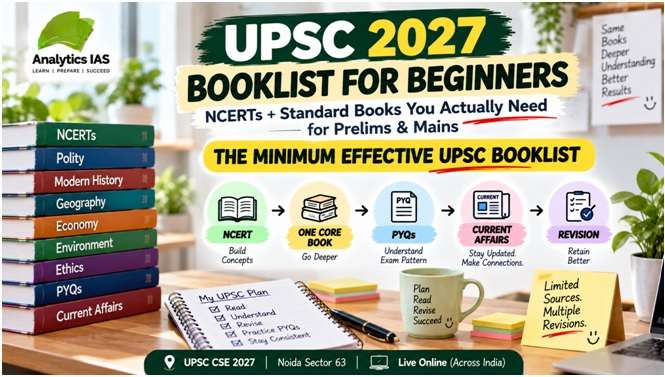
UPSC 2027 Booklist: What Does a Beginner Actually Need?
Quick answer: A beginner does not need dozens of UPSC books. Start with the official syllabus and PYQs, use NCERTs selectively for concepts, choose one dependable core source for each major GS subject, add current affairs from limited reliable sources, and revise the same material repeatedly.
NCERT → ONE CORE SOURCE → PYQs → CURRENT AFFAIRS → REVISION
The internet is full of long “must-read” lists. But a 40- or 50-book list is not a preparation strategy. UPSC rewards understanding, recall, application and repeated revision. A source is useful only if you can finish the relevant portions, connect them with the syllabus and PYQs, revise them and apply the content in questions.
If you are starting from zero, first read our complete UPSC preparation guide for beginners 2027–2029.
For a dedicated NCERT method, read How to Read NCERTs for UPSC: Beginner’s Strategy.
Before Buying Any Book: Start with These 3 Resources
- UPSC syllabus — defines the boundaries and language of the examination.
- Previous Year Questions (PYQs) — show how UPSC converts syllabus themes into questions.
- NCERT textbooks — build conceptual foundations where your basics are weak.
Use the official UPSC website for notifications and previous papers, and the official NCERT textbook portal for NCERT e-books.
The Minimum Effective UPSC 2027 Booklist — Subject Wise
This list is deliberately selective. Use the latest available edition where relevant, and let the syllabus and PYQs determine how deeply you read.
1. Indian Polity & Governance
NCERT/Foundation: Political Science NCERTs, especially Constitution at Work and relevant senior-secondary chapters.
One Core Source: M. Laxmikanth — Indian Polity.
PYQ Practice: Prelims Polity + GS-II PYQs.
Current Affairs Link: Constitutional developments, Parliament, judiciary, federalism, governance and rights.
What NOT to Buy: Multiple competing Polity manuals before revising one core source.
2. Modern Indian History
NCERT/Foundation: Relevant History NCERT themes for chronology and context.
One Core Source: A Brief History of Modern India (Spectrum).
PYQ Practice: Prelims Modern History + GS-I PYQs.
Current Affairs Link: Selective heritage/anniversary developments.
What NOT to Buy: Several parallel freedom-struggle books at the beginning.
3. Ancient & Medieval India + Art & Culture
NCERT/Foundation: Relevant History NCERTs + Fine Arts material.
One Core Source: One concise Art & Culture reference/notes source.
PYQ Practice: Prelims + GS-I PYQs.
Current Affairs Link: Archaeology, heritage, GI/culture and UNESCO developments.
What NOT to Buy: Encyclopaedic culture compilations before understanding PYQs.
4. Geography
NCERT/Foundation: Relevant NCERTs, especially Class XI–XII physical and Indian geography.
One Core Source: G.C. Leong for physical geography + one good atlas.
PYQ Practice: Prelims Geography + GS-I PYQs.
Current Affairs Link: Maps, places in news, disasters, climate, resources and agriculture.
What NOT to Buy: Multiple atlases and overlapping basic texts.
5. Indian Economy
NCERT/Foundation: Senior-secondary Economics NCERTs if basics are weak.
One Core Source: ONE current, beginner-friendly Indian Economy text or structured class notes.
PYQ Practice: Prelims Economy + GS-III PYQs.
Current Affairs Link: Budget, Economic Survey, RBI, inflation, growth, banking, fiscal/monetary policy and external sector.
What NOT to Buy: Several economy guides explaining the same concepts.
6. Environment & Ecology
NCERT/Foundation: Relevant Biology/Geography NCERT chapters.
One Core Source: Shankar IAS Environment, used selectively with the syllabus.
PYQ Practice: Prelims Environment + GS-III PYQs.
Current Affairs Link: Species, protected areas, climate agreements, pollution and conservation.
What NOT to Buy: Separate bulky books for every environment subtopic.
7. Science & Technology
NCERT/Foundation: Basic school science only where fundamentals need strengthening.
One Core Source: Concise foundation notes + current developments.
PYQ Practice: PYQs to understand expected depth.
Current Affairs Link: Space, biotech, health tech, AI, semiconductors, quantum and other policy-relevant developments.
What NOT to Buy: Technical encyclopaedias.
8. Indian Society
NCERT/Foundation: Relevant Sociology/social-science NCERTs.
One Core Source: Syllabus-based concise notes + examples.
PYQ Practice: GS-I Society PYQs.
Current Affairs Link: Women, population, urbanisation, poverty, empowerment and social change.
What NOT to Buy: Multiple generic society manuals.
9. Governance, Social Justice & IR
NCERT/Foundation: Polity basics first.
One Core Source: Concise GS-II notes + official/current sources.
PYQ Practice: GS-II PYQs.
Current Affairs Link: Schemes, institutions, health, education, bilateral/multilateral relations.
What NOT to Buy: Large separate books for every GS-II subsection.
10. Ethics, Integrity & Aptitude
NCERT/Foundation: Start with syllabus terminology.
One Core Source: One concise Ethics reference or reliable class notes.
PYQ Practice: GS-IV PYQs + case studies.
Current Affairs Link: Build an examples bank from public life and administration.
What NOT to Buy: Multiple ethics manuals.
11. CSAT
NCERT/Foundation: Diagnostic test first.
One Core Source: One practice source matched to your weak areas.
PYQ Practice: CSAT PYQs under timed conditions.
Current Affairs Link: Regular practice if needed.
What NOT to Buy: Buying several aptitude books before diagnosing weakness.
UPSC 2027 Booklist — Quick Reference
| Subject | Foundation | Core Source | Avoid |
| Indian Polity & Governance | Political Science NCERTs, especially Constitution at Work and relevant senior-secondary chapters | M. Laxmikanth — Indian Polity | Multiple competing Polity manuals before revising one core source |
| Modern Indian History | Relevant History NCERT themes for chronology and context | A Brief History of Modern India (Spectrum) | Several parallel freedom-struggle books at the beginning |
| Ancient & Medieval India + Art & Culture | Relevant History NCERTs + Fine Arts material | One concise Art & Culture reference/notes source | Encyclopaedic culture compilations before understanding PYQs |
| Geography | Relevant NCERTs, especially Class XI–XII physical and Indian geography | G.C. Leong for physical geography + one good atlas | Multiple atlases and overlapping basic texts |
| Indian Economy | Senior-secondary Economics NCERTs if basics are weak | ONE current, beginner-friendly Indian Economy text or structured class notes | Several economy guides explaining the same concepts |
| Environment & Ecology | Relevant Biology/Geography NCERT chapters | Shankar IAS Environment, used selectively with the syllabus | Separate bulky books for every environment subtopic |
| Science & Technology | Basic school science only where fundamentals need strengthening | Concise foundation notes + current developments | Technical encyclopaedias |
| Indian Society | Relevant Sociology/social-science NCERTs | Syllabus-based concise notes + examples | Multiple generic society manuals |
Which NCERT Books Should a UPSC Beginner Read?
Do not interpret “read NCERTs” as “read every textbook from Class 6 to 12 cover to cover.” Your NCERT list should depend on your educational background and conceptual gaps. Beginners commonly benefit most from selected History, Geography, Political Science, Economics, Society and relevant Science/Biology chapters.
For reading order, note-making and revision, use our detailed NCERT Strategy for UPSC Beginners.
What Should You Use for Current Affairs?
- One quality newspaper: The Hindu OR The Indian Express—choose one rather than compulsorily reading both.
- Official sources when needed: PIB, PRS, RBI, ministries, Budget/Economic Survey and relevant reports.
- One monthly consolidation source if it genuinely improves revision.
- Short subject-wise additions to your static notes instead of huge daily notebooks.
Avoid multiple newspapers, several monthly magazines and dozens of unreviewed PDFs. The objective is to connect current developments to the syllabus and revise them.
How to Use PYQs with Every Book
Do not save PYQs for the end. Before starting a subject, scan previous questions. While reading, identify recurring concepts. After completing a section, solve relevant questions and analyse why each option or argument is right or wrong.
LET PYQs GUIDE WHAT YOU READ—not merely test what you remember.
The Revision Rule: Why a Smaller Booklist Wins
- First reading: understand concepts; highlight selectively.
- Second reading: connect with syllabus and PYQs; make concise notes.
- Third reading onward: compress, recall, solve questions and revisit weak areas.
If a source is so large that you cannot realistically revise it, reconsider whether it deserves to be your primary source.
If I Am Joining a UPSC Foundation Course, Which Books Should I Still Buy?
Do not buy the entire internet-recommended list before classes begin. A structured Foundation Course may already provide notes, reading sequences, tests and subject-specific guidance. Buying duplicates creates clutter.
Keep essential references you will repeatedly revise—such as a standard Polity source, a Modern History source, one atlas and selected NCERTs—then add subject resources only when you know how they fit into your preparation.
Before choosing a program, read Why Join a UPSC Foundation Course 2027? and our UPSC CSE 2027 Foundation Roadmap.
Common Book-Buying Mistakes
- Buying every book recommended by different toppers.
- Using two or three core books for the same subject before revising one.
- Reading without the syllabus beside you.
- Postponing PYQs until syllabus completion.
- Making notes almost as long as the original book.
- Changing sources every few weeks.
- Buying advanced Mains books before building basic concepts.
- Collecting current-affairs PDFs you will never revise.
UPSC 2027 Booklist FAQs
How many books are enough for UPSC 2027?
There is no magic number. Aim for selected NCERTs, roughly one primary source per major subject where a standard book is useful, PYQs and controlled current affairs.
Should I read NCERTs from Class 6 to 12?
Not necessarily every textbook. Read selectively according to your background and gaps; senior-secondary NCERTs are especially useful in several subjects.
Is Laxmikanth enough for Polity?
It is a widely used core reference, but no single book is the entire preparation. Use it with the syllabus, PYQs and relevant current developments.
Is Spectrum enough for Modern History?
It is a common core source, but use NCERT-level context, PYQs and selective supplementation where a genuine gap exists.
Do I need a separate book for current affairs?
Not necessarily. One newspaper, official sources and one revision-friendly consolidation system can be enough.
Should I buy separate books for Prelims and Mains?
Not for every subject. Many GS concepts overlap; supplement a common foundation with Mains-specific notes, examples, PYQs and answer writing.
Should I buy all books before joining coaching?
No. First understand what the course provides and what faculty expects you to use. Buy only resources you will actually read and revise.
Can I prepare with NCERTs only?
NCERTs are a foundation, not complete preparation. UPSC also requires standard sources, PYQs, current affairs, revision and stage-specific practice.
For UPSC CSE 2027 Aspirants
The right UPSC 2027 booklist should reduce confusion—not increase it. Analytics IAS Academy’s GS Foundation approach focuses on concepts, limited sources, PYQs, integrated Prelims–Mains preparation, current affairs, answer writing, tests, revision and mentorship.
Explore the UPSC GS Foundation Course 2027 in Noida or GS Foundation Course 2027 overview.
Final Takeaway
The best UPSC 2027 booklist is not the longest list. It is the smallest set of reliable sources that covers the syllabus, makes sense to you, can be revised repeatedly and helps you solve PYQs and write better answers. Start with the syllabus. Build concepts through NCERTs. Choose one core source where needed. Use PYQs from the beginning. Integrate current affairs. Revise repeatedly.
LIMITED SOURCES. MULTIPLE REVISIONS. BETTER APPLICATION.
Read More
- How to Read NCERTs for UPSC: Beginner’s Strategy
- How to Start UPSC Preparation from Zero: Complete Beginner’s Study Plan
- UPSC CSE 2027 Preparation: Complete Foundation Roadmap
- UPSC 2027 Preparation Strategy: What to Do in Your First 90 Days
- Why Join a UPSC Foundation Course 2027?
- UPSC GS Foundation Course 2027 in Noida
