
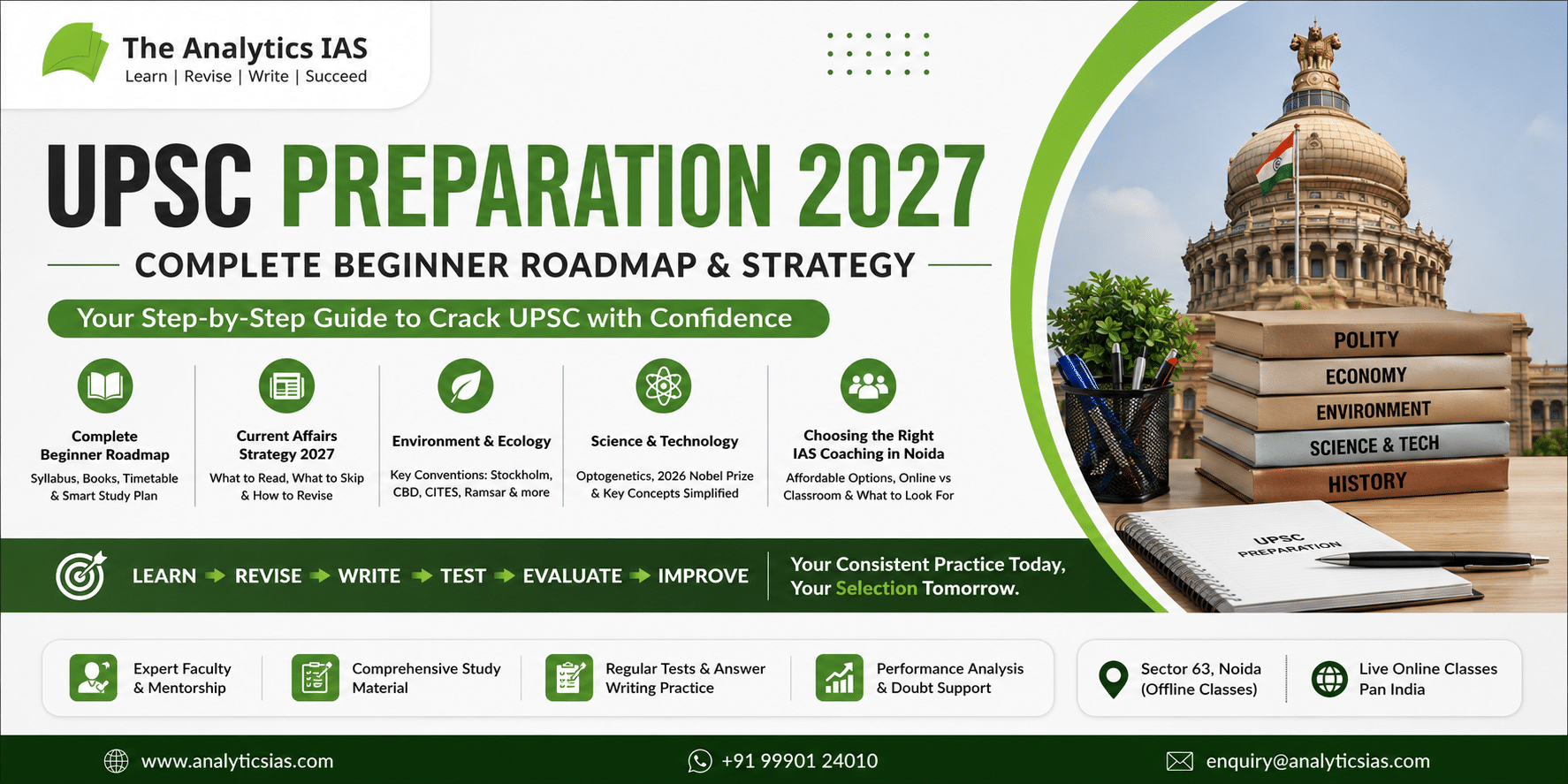
Preparing for UPSC Civil Services Examination 2027 requires more than reading newspapers and completing books. Aspirants need a structured study plan, a clear understanding of the syllabus, regular revision, answer-writing practice, mock tests and the ability to connect current affairs with static General Studies subjects.
For beginners, the preparation journey can feel overwhelming. There are numerous books, online lectures, newspaper articles, government reports and coaching options. The challenge is not simply finding more study material; it is deciding what to study, what to revise, what to practise and how to measure progress.
A practical UPSC preparation strategy brings these activities together. It connects static subjects with current developments, uses previous years’ question papers to identify important themes, and follows a continuous cycle of learning, revision, writing, testing, evaluation and improvement.
This comprehensive guide explains how aspirants can begin preparing for UPSC 2027, develop an effective current affairs strategy, study Environment and Science & Technology, build a sustainable timetable, and evaluate online or classroom IAS coaching options in Noida.
1. Understand the UPSC Civil Services Examination Before You Begin
The first step in UPSC preparation is understanding the examination structure. Aspirants who begin studying without understanding the syllabus may spend months collecting information without building the knowledge and skills required for the examination.
The Civil Services Examination broadly involves three stages: Preliminary Examination, Main Examination and Personality Test.
UPSC Prelims: Building Conceptual Clarity and Accuracy
The Preliminary Examination includes General Studies Paper I and General Studies Paper II, commonly called CSAT. Both papers require dedicated preparation.
General Studies Paper I covers subjects such as history, geography, polity, economy, environment, science and technology, and current events of national and international importance.
CSAT assesses areas such as comprehension, logical reasoning, analytical ability, decision-making and basic numeracy. Candidates should not postpone CSAT preparation until the final weeks, particularly if mathematics or reading comprehension is challenging for them.
Prelims preparation requires three complementary activities:
- Understanding concepts through reliable books and study material.
- Revising important facts and concepts multiple times.
- Solving previous years’ questions and practising timed mock tests.
Candidates should learn to eliminate incorrect options using conceptual understanding rather than relying entirely on memorisation or guesswork.
UPSC Mains: Developing Analytical and Answer-Writing Skills
The Main Examination evaluates a candidate’s ability to explain issues, analyse causes and consequences, compare perspectives and present balanced arguments.
Preparation includes Essay, General Studies Papers I to IV, qualifying language papers and the optional subject papers. The Personality Test follows the written stages according to the official examination process.
Mains preparation should not be treated as an activity that begins only after Prelims. Aspirants can develop answer-writing skills alongside their regular studies by preparing short notes, analysing contemporary issues and practising structured responses.
A useful answer generally contains a relevant introduction, logically organised arguments, appropriate examples and a conclusion that directly addresses the question.
Candidates should consult the official UPSC syllabus, examination notifications and previous years’ question papers before finalising their study plans.
Official resource: UPSC Examination Website
2. UPSC Preparation for Beginners: Start with a Clear Roadmap
For a beginner targeting UPSC 2027, the biggest initial challenge is deciding where to start. Reading several books simultaneously, switching between multiple teachers and following every current affairs update can create confusion.
A better approach is to build preparation around a limited number of reliable resources and measurable weekly targets.
Step 1: Read the Syllabus and Previous Years’ Questions
Print or save the official syllabus and divide it into manageable topics. For example, Polity can be divided into the Constitution, Fundamental Rights, Parliament, Executive, Judiciary, federalism, constitutional bodies and local government.
Next, examine previous years’ questions related to these topics. This helps aspirants understand how the UPSC tests conceptual understanding and applies knowledge to unfamiliar situations.
Previous years’ questions should be used throughout preparation, not merely during the final revision period.
Step 2: Build Strong Foundations in Static Subjects
Beginners should establish a foundation in the major General Studies subjects before attempting to cover every current affairs topic.
A practical starting sequence is:
- Indian Polity and the Constitution.
- Modern Indian History.
- Geography and basic map work.
- Economy and fundamental economic concepts.
- Environment and Ecology.
- Science and Technology.
- Current Affairs integrated with all relevant subjects.
This sequence is flexible. Candidates can adjust it according to their existing knowledge, available time and areas of difficulty.
The objective is to understand the basic concepts well enough to apply them when unfamiliar questions appear.
Step 3: Limit Your Sources
Using too many resources can reduce the time available for revision. If three books explain the same concept, repeatedly reading all three may not improve retention.
Choose one primary resource for each subject, supplement it with reliable explanations where necessary, and maintain concise revision notes.
For current affairs, follow a consistent newspaper or news-analysis source and use official government publications to verify important developments.
Step 4: Begin Revision from the First Week
Revision should be part of the original timetable.
After completing a topic, revise it briefly within the next day or two. Revisit it again at the end of the week and include it in a monthly revision cycle.
Use short notes, flashcards, concept maps and practice questions to identify gaps in understanding.
Aspirants should measure progress by what they can recall and apply, rather than by the number of pages they have read.
3. UPSC Current Affairs Strategy 2027: What to Read, What to Skip and How to Revise
Current affairs connect classroom concepts with real-world developments. They help candidates understand government policies, constitutional issues, economic changes, international relations, environmental challenges and scientific developments.
However, attempting to remember every newspaper article is neither practical nor necessary.
The objective of an effective UPSC current affairs strategy is to identify relevant issues, understand their background, connect them with the syllabus and revise them repeatedly.
Read the News Through the UPSC Syllabus
Before making notes on a major news development, ask four questions:
- Which syllabus topic does this development relate to?
- What is its constitutional, economic, environmental, scientific or international context?
- Why is it important for governance or public policy?
- What facts and concepts may be useful for Prelims or Mains?
For example, a report about a new environmental conservation initiative may be relevant to biodiversity, protected areas, international environmental agreements and sustainable development.
Instead of writing a long summary of the entire report, extract the information that improves your understanding of these topics.
What Should UPSC Aspirants Read?
A balanced current affairs routine can include:
National news: Major government policies, constitutional developments, parliamentary proceedings, important court judgments and significant administrative reforms.
Economy: Inflation, monetary policy, employment, fiscal policy, trade, banking, infrastructure and government economic initiatives.
International relations: Important diplomatic agreements, international organisations, regional conflicts, strategic partnerships and multilateral cooperation.
Environment: Biodiversity, climate change, conservation programmes, pollution, environmental conventions and ecosystem management.
Science and Technology: Important research developments, space missions, biotechnology, artificial intelligence, cybersecurity, healthcare technology and emerging scientific applications.
Social issues: Education, public health, gender equality, poverty, welfare delivery, demographic changes and human development.
Candidates should prioritise developments with clear links to the syllabus instead of giving equal attention to every headline.
What Can You Skip?
Routine political statements, repetitive breaking-news updates, celebrity news, unverified social media claims and highly technical details with little relevance to the examination generally do not deserve extensive note-making.
This does not mean that political or international developments are automatically irrelevant. Their importance depends on their constitutional, economic, diplomatic or governance implications.
The correct question is not whether a topic is popular in the news. It is whether understanding it contributes to preparation for the examination.
Use PIB and Official Government Sources Effectively
The Press Information Bureau (PIB) publishes official government announcements, policy updates and information about important initiatives.
Its PRiSM e-booklets can also be considered as a supplementary source for reviewing selected government developments. Aspirants should verify the publication date and identify the underlying facts relevant to the syllabus instead of treating every item as equally important.
Official source: Press Information Bureau
For example, when studying a government programme, candidates can organise their notes under the following headings:
- Ministry or implementing institution.
- Objective and target beneficiaries.
- Major provisions and implementation mechanism.
- Significance for governance and development.
- Challenges, limitations and possible reforms.
- Relevant Prelims facts and Mains themes.
For factual information, prefer official documents and primary sources wherever possible. News articles can help explain the background, but key claims should be verified.
Daily, Weekly and Monthly Revision
An effective current affairs system operates at three levels.
Daily: Identify important developments, understand their context and make concise notes.
Weekly: Consolidate the week’s important issues, revise key facts and solve practice questions.
Monthly: Review the larger themes, remove repetitive notes, revisit weak areas and attempt a mixed current affairs test.
This system reduces the need to relearn the same material shortly before the examination.
4. Environment and Ecology: Connecting Static Knowledge with Current Affairs
Environment is an important part of General Studies preparation because questions can combine basic ecological concepts with international agreements, conservation initiatives, species, protected areas and environmental governance.
Aspirants should understand the underlying concepts before memorising the details of current developments.
Biodiversity and Ecosystem Fundamentals
Begin with ecosystems, food chains, food webs, ecological pyramids, energy flow, ecological succession, nutrient cycles and species interactions.
Next, understand biodiversity at the genetic, species and ecosystem levels. Learn the difference between endemic, native, exotic, invasive, vulnerable and endangered species.
These concepts provide the foundation for understanding conservation policies and environmental news.
For instance, a report about an invasive species may require knowledge of its ecological impact, competition with native species, spread mechanisms and possible management strategies.
Stockholm Conference and Global Environmental Governance
The 1972 United Nations Conference on the Human Environment, held in Stockholm, marked an important milestone in the development of international environmental governance.
Its significance can be understood through the growing recognition that environmental protection, human well-being and economic development are interconnected.
Aspirants should distinguish between conferences, declarations, conventions, protocols and legally binding agreements. These terms are related but do not mean the same thing.
When studying an international environmental event, identify its historical background, major outcomes, participating institutions and continuing relevance.
Convention on Biological Diversity (CBD)
The Convention on Biological Diversity is an international agreement focused on biodiversity conservation, the sustainable use of biological resources and the fair and equitable sharing of benefits arising from genetic resources.
For examination preparation, remember its three central objectives:
- Conservation of biological diversity.
- Sustainable use of its components.
- Fair and equitable sharing of benefits arising from genetic resources.
Candidates should also understand the relationship between biodiversity protection, local communities, traditional knowledge and sustainable development.
Questions may test the distinction between international objectives and their implementation through national laws, institutions and policies.
CITES: International Trade in Endangered Species
The Convention on International Trade in Endangered Species of Wild Fauna and Flora (CITES) regulates international trade in specimens of listed wild animals and plants to help ensure that such trade does not threaten their survival.
Aspirants should understand that CITES is concerned with international trade, rather than serving as a general prohibition on every form of wildlife trade.
Study its appendices at a conceptual level, understand the role of permits and certificates, and connect relevant species or trade developments with the convention.
For Prelims, carefully distinguish CITES from agreements that address biodiversity more broadly.
Ramsar Convention and Wetland Conservation
The Ramsar Convention is an international treaty concerning the conservation and wise use of wetlands.
Wetlands support biodiversity, help regulate water flows, store carbon in certain ecosystems, support livelihoods and provide important habitats for birds and other wildlife.
For UPSC preparation, study the ecological functions of wetlands, the threats they face and the importance of conservation and sustainable management.
When a wetland receives international recognition or is discussed in the news, note its location, ecological significance and any relevant conservation measures. Verify names and locations from authoritative sources rather than relying on unverified lists.
How to Revise Environment for Prelims
Create comparison tables for major conventions. Include their full names, primary objectives, broad scope and important distinctions.
Use maps to locate important wetlands, national parks, biosphere reserves and biodiversity-rich regions.
Finally, solve multiple-choice questions and maintain an error log. If you confuse two conventions, revise the specific difference instead of rereading the entire chapter.
This combination of static concepts, current affairs and targeted revision is more effective than memorising isolated facts.
5. Science and Technology: Understanding the 2026 Nobel Prize and Optogenetics
Science and Technology questions can appear difficult when aspirants encounter unfamiliar terminology. The solution is to understand the basic principle, the problem being addressed, the application and the limitations of a development.
An important example from October 2026 is the Nobel Prize in Physiology or Medicine awarded to Karl Deisseroth, Peter Hegemann and Georg Nagel for discoveries concerning light-gated ion channels and optogenetics.
The award provides a useful case study for understanding how fundamental scientific research can lead to new tools for studying the human brain.
What Is Optogenetics?
Optogenetics combines genetic techniques and light-based control to investigate the activity of selected cells, especially neurons.
Neurons communicate through electrical and chemical signals. Understanding how particular groups of neurons contribute to brain functions is a major challenge in neuroscience.
Optogenetics allows researchers to use light-sensitive proteins to influence the activity of genetically targeted cells. By activating or inhibiting selected cells under controlled conditions, researchers can investigate how specific neural circuits contribute to particular functions or behaviours.
This gives scientists a way to investigate causal relationships that can be difficult to establish through observation alone.
How Does the Technology Work?
The process can be understood in four broad steps:
- Researchers identify a suitable light-sensitive protein.
- Genetic techniques are used to make selected cells express the relevant protein.
- Light of an appropriate wavelength is delivered to the targeted cells.
- Researchers observe how the cells and associated neural circuits respond.
The underlying science involves ion channels and changes in cell membrane electrical activity. For UPSC, understanding this basic mechanism is more useful than memorising highly specialised laboratory details.
The Nobel-recognised research illustrates how discoveries involving light-sensitive proteins in single-celled algae helped enable the development of tools for studying neural activity.
Why Is Optogenetics Important?
Optogenetics has become a significant research tool in neuroscience. It helps researchers investigate neural circuits associated with sensory processing, movement, learning, memory and behaviour.
It may also contribute to research into neurological and psychiatric conditions. However, potential clinical applications must be distinguished from established treatments.
For example, research into light-based approaches for certain vision disorders has shown promising developments, but such findings should not be interpreted as proof that optogenetics is a routine cure for blindness or other neurological conditions.
Aspirants should understand the difference between a laboratory technique, an experimental therapy and an approved clinical treatment.
How to Prepare This Topic for UPSC
Organise the topic under five headings:
- Scientific principle: light-sensitive proteins and neural activity.
- Research background: discoveries concerning channelrhodopsins and light-gated ion channels.
- Applications: studying brain circuits and investigating disease mechanisms.
- Potential benefits: more precise investigation of selected cells.
- Limitations: technical complexity, safety considerations and the need for further clinical evidence.
This format makes the topic useful for both objective questions and analytical answers.
The broader lesson is that UPSC Science and Technology preparation should focus on scientific principles, real-world applications, ethical concerns and limitations rather than simply collecting lists of inventions and awards.
6. How to Connect Current Affairs with Static General Studies
One of the most valuable preparation skills is linking contemporary developments with concepts already studied.
Reading the news in isolation often produces fragmented knowledge. Connecting it with static subjects makes it easier to understand and revise.
Consider these examples:
| Current development | Static subject connection | Possible preparation focus |
| A new biodiversity initiative | Environment and Ecology | Ecosystems, conservation and governance |
| A government economic programme | Indian Economy | Objectives, implementation and fiscal implications |
| A major constitutional judgment | Indian Polity | Constitutional provisions and judicial review |
| A scientific research breakthrough | Science and Technology | Scientific principle, applications and limitations |
| An international environmental meeting | Environment and International Relations | Convention objectives and global cooperation |
| A public health initiative | Social Issues and Governance | Access, implementation and public policy |
For each major development, write a short summary of the issue, its background, the relevant syllabus topic and two or three points worth remembering.
This process helps aspirants move beyond collecting headlines and develop a connected understanding of General Studies.
7. Prelims and Mains Preparation Should Work Together
Prelims and Mains have different requirements, but their preparation can reinforce one another.
Prelims requires conceptual clarity, factual awareness, elimination skills and accuracy under time pressure. Mains requires structured writing, analysis, examples and balanced arguments.
Aspirants should therefore avoid preparing for the two stages as completely separate examinations.
After studying a topic, attempt a few objective questions and prepare a short analytical note. For example, after studying wetland conservation, practise questions about ecological concepts and prepare a Mains outline covering the importance of wetlands, threats, conservation measures and implementation challenges.
Begin Answer Writing Early
Beginners do not need to start by writing full-length answers every day. They can begin with short exercises.
First, practise explaining a concept in 100–150 words. Next, learn to structure an answer around the demand of the question. Gradually introduce timed practice and full-length answers.
For every answer, check whether it directly addresses the question, uses relevant concepts, follows a logical structure and includes appropriate examples.
Avoid adding unrelated facts merely to increase word count. A focused answer is generally more useful than a long response that does not address the question.
Use Mock Tests as Diagnostic Tools
Mock tests should identify weaknesses rather than simply produce a score.
After every test, categorise mistakes into conceptual gaps, forgotten facts, misreading of questions, incorrect elimination and time-management problems.
Prepare an error log and revisit it during revision.
For Mains, ask a similar question: Was the answer incomplete because of weak content, poor structure, lack of examples or misunderstanding of the question?
This makes practice a learning process rather than a repetitive activity.
8. A Practical UPSC 2027 Study Timetable
A timetable should reflect the candidate’s available time, existing preparation level and responsibilities. A schedule that cannot be followed consistently is less useful than a realistic plan.
The following example can be adapted by full-time aspirants and working candidates.
| Study activity | Illustrative daily time |
| Static General Studies | 2 hours |
| Current affairs and note-making | 45 minutes |
| Revision of previous topics | 45 minutes |
| MCQs or answer writing | 1 hour |
| Optional subject or additional study | 1 hour |
| Total focused study time | 5 hours 30 minutes |
These timings are illustrative, not a universal requirement. Aspirants with less time can reduce the number of activities while retaining the core cycle of study, revision and practice.
Weekly Planning
At the beginning of each week, select a manageable set of syllabus topics. Allocate time for learning new material, revising previous topics and solving questions.
At the end of the week, evaluate what was completed and identify the concepts that remain unclear.
Do not automatically carry every unfinished task into the next week. Prioritise essential syllabus coverage and revise the timetable where necessary.
Month-by-Month Direction
For an aspirant beginning in October 2026, the broad direction can be organised as follows:
October–November 2026: Establish the syllabus-based timetable, strengthen core concepts, select study resources and begin daily current affairs notes.
December 2026–January 2027: Expand syllabus coverage, increase topic-wise MCQ practice, develop short revision notes and build regular answer-writing habits.
February–March 2027: Consolidate important subjects, practise mixed questions, revise current affairs and identify weak areas through mock tests.
April 2027 onwards: Adjust the timetable according to the official examination schedule and the candidate’s preparation status. If Prelims is approaching, prioritise revision, practice tests and accuracy while maintaining a realistic plan for the subsequent stages.
This is a broad planning framework, not an official examination calendar. Candidates must verify the relevant UPSC notification and examination dates before finalising their individual schedules.
9. Choosing Affordable IAS Coaching in Noida
Self-study is an important part of UPSC preparation, but some aspirants benefit from structured classes, mentorship, scheduled tests and regular academic feedback.
The right decision depends on the student’s needs, learning style, budget and current preparation level. No coaching institute can guarantee selection, and aspirants should evaluate claims carefully.
For students searching for UPSC coaching in Noida, the key question is whether a programme provides a useful structure for consistent preparation.
What Should You Evaluate Before Enrolling?
Faculty and teaching methodology: Check whether classes explain concepts clearly, follow the syllabus and connect static subjects with relevant current affairs.
Course structure: Review the syllabus coverage, timetable, planned revision and balance between Prelims and Mains preparation.
Test series: Find out whether the programme includes topic-wise tests, full-length practice and meaningful feedback.
Answer-writing support: Ask whether students receive guidance on answer structure, content quality and improvement.
Study material: Assess whether material is organised, updated when necessary and suitable for revision rather than simply extensive.
Mentorship: Determine whether students can discuss doubts, identify weak areas and receive guidance on their study plans.
Accessibility: Consider classroom location, travel time, class timings and the availability of online support.
Fees and transparency: Compare the total fee, included services, payment terms and any additional charges before making a decision.
Classroom Coaching or Online UPSC Preparation?
Classroom coaching can provide a fixed schedule, direct interaction with teachers, peer discussion and a dedicated study environment. It may suit candidates who need external structure and regular classroom engagement.
Online preparation can offer flexibility, recorded lectures and reduced commuting requirements. It may be suitable for working candidates, students living outside major coaching hubs and aspirants who prefer studying at their own pace.
A hybrid approach can combine online resources with classroom guidance, mentorship or test practice where available.
There is no single format that guarantees better results for every candidate. The most appropriate option is the one that supports consistent study, revision and performance improvement.
Why Consider UPSC Coaching in Sector 63, Noida?
Sector 63, Noida, is one location aspirants may consider when evaluating classroom learning options in the city. Students should check the actual commute, class schedule, course structure and facilities before enrolling.
Analytics IAS offers UPSC preparation options for aspirants considering structured guidance in Noida and online learning. Interested students can review the available programmes, ask questions about the curriculum and assess whether the teaching format matches their requirements.
For anyone comparing affordable IAS coaching in Noida, affordability should be considered alongside academic support, course coverage, testing and accessibility. The lowest fee is not automatically the best value, just as a higher fee does not guarantee a better outcome.
10. How Analytics IAS Can Support a Structured Preparation Routine
A structured learning programme can help aspirants organise the different components of UPSC preparation.
Analytics IAS focuses on UPSC preparation through classroom and online learning options. Aspirants exploring its programmes should review the current course details and understand which services are included before making a decision.
A useful preparation framework should connect the following activities.
LEARN: Understand the syllabus and develop conceptual clarity through classes, textbooks and reliable resources.
REVISE: Consolidate learning through short notes, topic summaries and repeated review.
WRITE: Practise expressing ideas clearly and answering questions according to their requirements.
TEST: Use objective questions and written practice to assess preparation.
EVALUATE: Identify conceptual gaps, factual errors, weak arguments and time-management problems.
IMPROVE: Use feedback and test analysis to modify the study plan and address weaknesses.
This sequence is useful whether a candidate studies independently, attends classroom coaching or follows an online programme.
Students should ask prospective coaching providers how their courses support these activities and how progress is assessed.
11. Common UPSC Preparation Mistakes and How to Avoid Them
Even committed aspirants can lose time through ineffective study habits. Recognising these mistakes early can make preparation more manageable.
Collecting Too Many Books and Courses
More resources do not automatically produce better preparation. Repeatedly changing teachers and study materials can leave important topics incomplete.
Choose dependable resources and focus on completing, understanding and revising them.
Ignoring Revision
Reading a chapter once does not guarantee long-term retention. Schedule regular revision and use questions to test whether the material can be recalled.
Making Excessively Long Current Affairs Notes
Newspaper notes should not reproduce entire articles. Focus on the syllabus connection, key facts, background and analytical relevance.
Delaying Mock Tests
Waiting until the end of syllabus coverage to practise questions can leave weaknesses undiscovered. Begin topic-wise practice early and increase the difficulty gradually.
Neglecting CSAT
CSAT should receive sufficient attention according to the candidate’s current ability. Practise comprehension, reasoning and numeracy rather than assuming the paper will be easy.
Studying Without Performance Review
Hours spent studying do not always reflect actual progress. Evaluate retention, question accuracy, answer quality and consistency.
Treating Coaching as a Substitute for Self-Study
Classes can explain concepts and provide structure, but candidates still need independent revision, practice and analysis.
A successful routine combines guided learning where useful with consistent individual effort.
12. How to Use Digital Resources Without Losing Focus
Digital resources can make UPSC preparation more accessible, but unrestricted browsing can consume valuable study time.
Use official portals for notifications, reports and policy documents. Save relevant resources in a structured folder and maintain a short list of trusted reference websites.
Avoid opening every link associated with a topic. First identify the question you need to answer, then consult the most relevant source.
For example, if a current affairs issue concerns an environmental convention, read the relevant official background material and use a reliable explanation to clarify difficult concepts. Then prepare a short note and solve practice questions.
The purpose of digital research is to improve understanding, not to accumulate an unlimited collection of PDFs.
Aspirants should also distinguish between confirmed facts, research findings, policy proposals and speculation. This is especially important for Science and Technology, where promising experiments may receive attention before their practical applications are established.
13. Building a Sustainable and Consistent Study Routine
UPSC preparation is a long-term process, so sustainability matters.
Aspirants should set realistic daily targets, take appropriate breaks and maintain a routine that can be followed over months. When a study session is missed, return to the plan rather than abandoning the entire schedule.
Track a small number of meaningful indicators:
- Syllabus topics completed and revised.
- Accuracy in topic-wise and mixed practice questions.
- Recurring mistakes identified and corrected.
- Answer-writing quality and completion within the allotted time.
- Weekly consistency and progress against planned targets.
These indicators provide a clearer picture of preparation than the number of hours spent sitting at a desk.
Students should also remember that progress varies by subject. A difficult topic may require more time, while a familiar topic may need only revision and practice.
The objective is not to maintain a perfect timetable every day. It is to keep moving forward through consistent, measurable improvement.
14. Frequently Asked Questions About UPSC Preparation 2027
When should beginners start preparing for UPSC 2027?
Candidates should begin with the official syllabus, previous years’ questions and a realistic study plan. Aspirants starting in October 2026 can organise their remaining preparation time around core subjects, current affairs, revision and regular practice, adjusting the schedule to the official examination calendar.
How many hours should I study daily for UPSC?
There is no universal number of hours that guarantees success. The appropriate schedule depends on the candidate’s background, available time and preparation level. Focused study, revision and practice are more meaningful than an arbitrary daily target.
How should I prepare current affairs for UPSC Prelims 2027?
Read relevant news, connect it with the syllabus, verify important facts through reliable sources, prepare concise notes and revise regularly. Practise questions to identify factual gaps and misunderstandings.
Is Environment important for UPSC preparation?
Environment and Ecology are important components of General Studies preparation. Candidates should study ecological fundamentals, biodiversity, conservation, environmental governance and relevant international agreements, linking current developments with static concepts.
How should I prepare Science and Technology current affairs?
Understand the scientific principle, practical applications, potential benefits, limitations and ethical concerns. For unfamiliar developments such as optogenetics, focus on how the technology works and why the research matters rather than memorising excessive technical details.
Is online or classroom IAS coaching better?
The answer depends on the student’s learning preferences, schedule, location and need for academic support. Classroom learning may offer a fixed routine and direct interaction, while online learning may offer greater flexibility. Compare course structure, faculty, tests, feedback and total cost before enrolling.
How can I choose affordable IAS coaching in Noida?
Compare the complete fee structure, syllabus coverage, faculty, test series, answer-writing feedback, mentorship, class schedule and accessibility. Ask for clear information about what the programme includes and avoid relying solely on promotional claims.
Does completing more books guarantee UPSC success?
No. Effective preparation requires conceptual understanding, revision, question practice and the ability to apply knowledge. A smaller set of reliable resources used thoroughly may be more useful than many resources studied superficially.
Conclusion: Prepare for UPSC 2027 with Structure, Revision and Continuous Improvement
Preparing for UPSC Civil Services Examination 2027 requires a balanced approach to static subjects, current affairs, Environment, Science and Technology, Prelims practice and Mains answer writing.
Beginners should start with the syllabus and previous years’ questions, build a manageable set of study resources and establish regular revision from the beginning. Current affairs should be filtered through the syllabus and connected with static concepts rather than treated as an endless list of headlines.
Topics such as the Convention on Biological Diversity, CITES, the Ramsar Convention and the 2026 Nobel-recognised work on optogenetics demonstrate why conceptual understanding is essential. Aspirants need to understand the background, scientific or policy principles, applications and limitations of developments that appear in the news.
A realistic timetable, consistent practice and honest performance analysis can help candidates identify weaknesses and improve their preparation over time.
For students who need structured academic support, evaluating UPSC coaching in Noida can be one part of the planning process. Compare classroom and online options carefully, understand the services included and choose an approach that fits your learning needs and budget.
Analytics IAS encourages aspirants to approach preparation systematically: LEARN, REVISE, WRITE, TEST, EVALUATE and IMPROVE. By following a consistent process and focusing on genuine understanding rather than simply accumulating material, candidates can build a stronger foundation for their UPSC journey.
Explore UPSC preparation options with Analytics IAS: https://analyticsias.com/
Visit the Noida coaching information page: Affordable IAS Coaching in Noida for UPSC 2027–2028
Read the current affairs preparation guide: UPSC Current Affairs Strategy 2027
Note: Candidates should always verify examination dates, eligibility, syllabus updates and official announcements through the UPSC website.
