
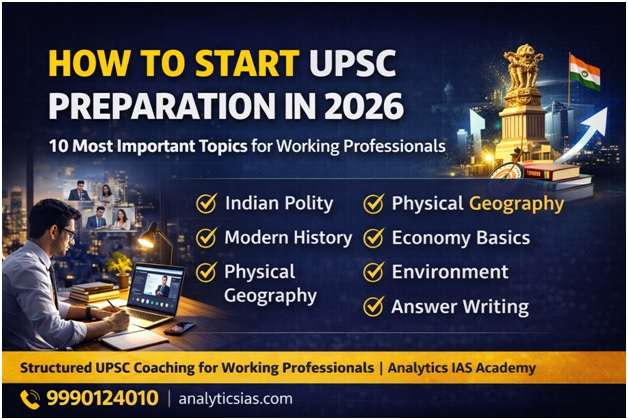
If you are a working professional preparing for UPSC CSE 2026 or 2027, the biggest challenge is not lack of intelligence — it is confusion about where to begin.
Most UPSC preparation strategies online are designed for full-time students. But job holders, IT professionals, corporate employees, engineers, doctors and government staff require a different starting blueprint.
If you start with the wrong subjects, you may waste 3–6 months before realizing your mistake.
This guide explains the 10 most important topics to start UPSC preparation in 2026, specifically curated for working professionals.
Why Starting Order Matters in UPSC Preparation
UPSC Civil Services Examination is vast. But not all topics should be started first.
Working professionals must prioritize:
✔ High weightage topics
✔ Static subjects with overlap
✔ Concept-building areas
✔ Integrated Prelims + Mains subjects
✔ Manageable workload
Starting randomly leads to burnout and inconsistency.
10 Most Important Topics to Start UPSC Preparation (2026–27)
- Indian Polity – Constitutional Foundations
Start with:
- Preamble
- Fundamental Rights
- DPSP
- Parliament
- President & Prime Minister
- Supreme Court
Why start here?
Indian Polity has consistently high weightage in UPSC Prelims and is crucial for GS Paper 2 in Mains. It builds conceptual clarity and confidence.
Time frame: 3–4 weeks.
- Modern Indian History (1757–1947)
Focus on:
- Revolt of 1857
- Congress sessions
- Gandhian movements
- Constitutional reforms
Why?
Modern history questions are predictable and scoring. The narrative style also makes it manageable after work hours.
- Physical Geography Basics
Cover:
- Earth structure
- Plate tectonics
- Monsoons
- Ocean currents
Why?
Geography concepts support environment and disaster management topics. It creates analytical depth.
- Indian Economy – Basic Concepts
Do not start with advanced macroeconomics.
Instead begin with:
- GDP
- Inflation
- Monetary policy
- Fiscal deficit
- Banking structure
These basics help decode current affairs and budget discussions.
- Environment & Ecology
Study:
- Biodiversity
- Ecosystem concepts
- National parks
- Climate agreements
- Environmental conventions
Environment has high Prelims weightage and moderate Mains importance.
- Current Affairs – Structured Approach
Avoid random reading.
Categorize into:
- Polity-related
- Economy-related
- International Relations
- Environment
Integrate static and dynamic topics.
- Ethics (GS Paper 4 Foundation)
Begin with:
- Ethics definitions
- Values and attitude
- Emotional intelligence
- Basic thinkers
- Case study framework
Working professionals often score well in Ethics due to practical exposure.
- Answer Writing Practice
Start early.
Even 1 answer per day builds articulation.
UPSC is a writing examination. Delaying answer writing is a common mistake.
- CSAT Preparation (Weekly Practice)
Many aspirants ignore CSAT and fail.
Practice weekly:
- Reading comprehension
- Logical reasoning
- Basic numeracy
Minimum 1–2 hours per week.
- Optional Subject Familiarization
Do not delay optional selection beyond 2–3 months.
Understand:
- Syllabus
- Overlap with GS
- Interest level
- Scoring trends
Optional carries 500 marks — equal to GS weightage.
First 3 Months UPSC Starter Plan (Working Professionals)
Month 1:
Indian Polity + Modern History
Month 2:
Geography + Economy Basics
Month 3:
Environment + Ethics + CSAT
Parallel:
Daily current affairs + weekly answer writing
This structure ensures:
✔ Strong foundation
✔ No overload
✔ Balanced progress
Common Mistakes Working Professionals Must Avoid
❌ Starting optional too early
❌ Reading newspapers randomly without integration
❌ Ignoring CSAT
❌ Delaying revision
❌ Copying full-time student schedules
❌ Studying without a completion timeline
Why Structured Online Coaching Helps Working Professionals
A structured online UPSC coaching program for working professionals should provide:
✔ Flexible recorded + live classes
✔ Integrated Prelims + Mains coverage
✔ Timeline-based syllabus completion
✔ Revision architecture
✔ Mentorship checkpoints
✔ Output-based evaluation
FAQs – UPSC Preparation for Working Professionals
Q1. Can I crack UPSC while working full-time?
Yes. With structured preparation and disciplined time management.
Q2. How many hours should a working professional study?
3–4 focused hours daily with weekly revision.
Q3. Should I start with optional subject first?
No. Build GS foundation first.
Q4. Is online UPSC coaching effective for job holders?
Yes, if flexible and structured.
Q5. When should I start answer writing?
From the first month itself.
Final Advice
If you are preparing for UPSC 2026–27 while working full-time:
Do not start everything.
Start strategically.
Momentum builds confidence.
Structure builds consistency.
Consistency builds rank.
🎯 Admissions Open
Structured Online UPSC Coaching for Working Professionals
Analytics IAS Academy
📞 9990124010
🌐https://analyticsias.com/best-ias-coaching-in-noida-delhi/