
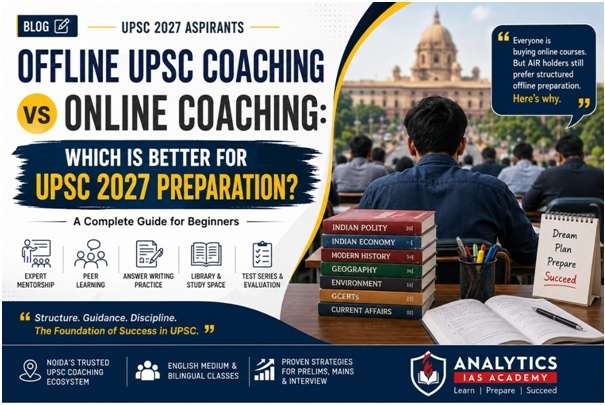
Preparing for the Civil Services Examination conducted by the Union Public Service Commission is one of the most demanding academic journeys in India. Every year, lakhs of aspirants begin their preparation with the same question:
Should I prepare through an online course or join an offline UPSC coaching institute?
The answer is not as simple as declaring one mode universally better than the other. Online learning has transformed education by making quality lectures accessible across the country. At the same time, offline coaching continues to produce a large number of successful candidates because it offers something that technology alone cannot fully replace—structured mentorship, discipline, accountability, peer learning, and a competitive ecosystem.
For a beginner aiming for UPSC 2027, the decision made today can influence the next two years of preparation. Choosing the right learning environment often determines whether an aspirant builds a strong foundation or struggles with inconsistency.
This guide explains the strengths and limitations of both learning modes and helps you determine which approach aligns best with your preparation needs.
Why This Decision Matters More Than Ever
Over the last decade, online education has grown rapidly. Thousands of recorded lectures, live classes, mobile applications, digital notes, and test series are now available at affordable prices.
This has created a common perception that:
“Everything is available online, so why join an offline coaching institute?”
While this appears logical, UPSC preparation is much more than watching lectures.
The examination evaluates:
- Conceptual understanding
- Analytical thinking
- Writing ability
- Consistency
- Decision making
- Current affairs integration
- Time management
- Personality development
These competencies develop gradually through continuous practice, guidance, feedback, and disciplined preparation—not simply by consuming content.
The reality is that many aspirants already possess abundant study material. Their challenge lies in transforming that material into sustained preparation and exam-ready performance.
The Evolution of UPSC Preparation
Two decades ago, aspirants depended almost entirely on classroom coaching because quality resources were difficult to access outside major cities.
Today, the situation is very different.
A student can access:
- Recorded lectures
- Online current affairs
- Digital newspapers
- Mock tests
- PYQ discussions
- NCERT summaries
- Subject-specific videos
- AI-powered learning tools
This has significantly improved access to information.
However, information alone does not guarantee success.
Successful preparation requires:
- A structured study plan
- Regular revision
- Continuous answer writing
- Performance analysis
- Expert mentoring
- Motivation during difficult phases
- Peer discussion
- Consistent evaluation
These elements are where offline learning often offers a meaningful advantage.
Understanding Offline UPSC Coaching
Offline coaching refers to classroom-based preparation where students attend scheduled sessions at a coaching institute, interact directly with faculty, participate in discussions, write tests, and learn within a competitive peer environment.
A well-designed offline foundation programme generally includes:
- Comprehensive General Studies classes
- NCERT foundation
- Current affairs integration
- Daily classroom interaction
- Weekly tests
- Answer writing practice
- Faculty mentoring
- Doubt resolution
- Peer learning
- Library or study space
- Motivation and counselling
Rather than functioning as a lecture delivery mechanism, a good offline programme creates a complete preparation ecosystem.
Understanding Online UPSC Coaching
Online coaching provides flexibility and accessibility.
Students can learn from home through:
- Live classes
- Recorded sessions
- Mobile applications
- Digital notes
- Online test series
- Discussion forums
- Virtual doubt sessions
For many aspirants, especially those living far from coaching hubs, online education has opened opportunities that previously did not exist.
It is particularly valuable for learners who:
- Have strong self-discipline
- Can maintain a fixed routine independently
- Already understand the syllabus
- Need flexibility because of work or personal commitments
However, the effectiveness of online learning depends heavily on the learner’s ability to remain consistent without external accountability.
Content Is No Longer the Biggest Challenge
Many first-time aspirants spend months searching for:
- The best faculty
- The best notes
- The best YouTube channel
- The best current affairs source
- The best booklist
Ironically, these resources are widely available today.
The real challenge is not finding information—it is deciding:
- What to study
- What to skip
- How deeply to study
- When to revise
- How to integrate static and current affairs
- When to start answer writing
- How to measure progress
Without a structured plan, aspirants often accumulate more content than they can realistically revise.
This is one of the biggest reasons why many candidates feel busy throughout the year but struggle to perform effectively in the examination.
Why Offline Coaching Continues to Produce Strong Results
Offline coaching remains relevant because it addresses challenges that extend beyond academics.
A structured classroom environment naturally promotes:
- Discipline
- Routine
- Consistency
- Accountability
- Regular interaction
- Healthy competition
- Immediate feedback
When students attend classes daily, write weekly tests, and interact with mentors and peers, preparation becomes a habit rather than an occasional activity.
For many beginners, this structure reduces procrastination and helps maintain momentum over the long preparation cycle.
Offline Coaching Is Not Just About Teaching
One of the biggest misconceptions is that coaching institutes exist only to deliver lectures.
In reality, effective UPSC coaching also provides:
- Academic planning
- Personal mentoring
- Emotional support
- Performance tracking
- Continuous evaluation
- Exam strategy refinement
- Motivation during setbacks
These aspects are difficult to replicate through recorded lectures alone.
Why Offline UPSC Coaching Still Produces Better Results
The debate between offline and online coaching often revolves around one question:
If the same lectures are available online, why do many successful aspirants still choose structured offline coaching?
The answer lies in understanding what UPSC preparation truly demands.
The Civil Services Examination is not merely a test of knowledge—it is a test of discipline, consistency, analytical thinking, answer-writing ability, and emotional resilience over a preparation cycle that may last 18–24 months.
Offline coaching addresses these aspects through a structured ecosystem that extends beyond classroom teaching.
- Structured Routine Builds Long-Term Consistency
One of the biggest challenges faced by aspirants is maintaining consistency.
Most students begin their preparation with enthusiasm. They purchase books, subscribe to online courses, and create ambitious study schedules. However, after a few weeks, distractions, irregular routines, and information overload often disrupt their preparation.
Offline coaching helps establish a disciplined daily routine.
A typical classroom schedule naturally encourages students to:
- Wake up on time
- Attend regular classes
- Revise concepts daily
- Complete assignments
- Write periodic tests
- Follow a structured study plan
Over time, these habits become part of the preparation process.
Rather than deciding every morning what to study, students follow a planned curriculum that ensures systematic coverage of the syllabus.
For beginners, this structured environment significantly reduces procrastination.
- Mentorship: The Most Underrated Success Factor
Every successful aspirant studies standard books such as NCERTs, Indian Polity, Indian Economy, and newspapers. What often differentiates successful candidates is not access to resources, but access to the right guidance.
A mentor helps students answer practical questions such as:
- Am I studying the right sources?
- Is my preparation on track?
- Am I over-preparing one subject while neglecting another?
- Should I focus more on prelims or mains?
- How should I improve my answer-writing skills?
- When should I begin revision?
These decisions cannot always be answered by recorded lectures.
In an offline classroom, mentors can observe a student’s progress over time, identify weaknesses, and provide personalised guidance.
This continuous feedback helps aspirants avoid common preparation mistakes.
- Immediate Doubt Resolution Improves Learning
UPSC preparation involves interconnected concepts from history, polity, economy, geography, ethics, environment, science, and international relations.
Students frequently encounter doubts while studying.
In an offline classroom, doubts can often be clarified immediately through interaction with faculty.
This has several advantages:
- Prevents conceptual gaps
- Improves classroom engagement
- Encourages analytical thinking
- Saves time that might otherwise be spent searching multiple online sources
Although online platforms also provide doubt sessions, immediate face-to-face interaction often leads to deeper conceptual understanding.
- Answer Writing Cannot Be Mastered by Watching Videos Alone
One of the most significant differences between average and high-performing candidates is answer-writing ability.
Many aspirants spend months watching lectures but postpone writing answers because they do not feel “fully prepared.”
This approach can be costly.
UPSC Mains rewards candidates who can:
- Understand the demand of the question
- Structure answers logically
- Present balanced arguments
- Integrate current affairs
- Draw simple diagrams or flowcharts where appropriate
- Write within strict time limits
Offline coaching programmes generally integrate answer-writing practice from the early stages of preparation.
Students receive:
- Regular answer-writing assignments
- Faculty evaluation
- Individual feedback
- Discussion of model approaches
- Opportunities to compare their performance with peers
This continuous practice helps develop writing speed, clarity, and analytical thinking.
- Peer Learning Creates Healthy Competition
UPSC preparation is often described as an individual journey, but learning alongside serious aspirants offers significant advantages.
In an offline classroom, students interact with peers who:
- Discuss current affairs
- Exchange notes
- Debate issues
- Solve doubts together
- Share preparation strategies
- Motivate one another
Such interactions expose students to diverse perspectives, which is particularly valuable for Mains answer writing and the Personality Test.
Healthy competition also encourages aspirants to maintain consistency.
Observing classmates complete revisions, perform well in tests, or improve over time often motivates others to strengthen their own preparation.
- Classroom Discussions Improve Analytical Thinking
Unlike many competitive examinations that rely heavily on factual recall, UPSC increasingly tests analytical ability.
Questions require candidates to:
- Examine issues from multiple perspectives
- Evaluate policies
- Suggest balanced solutions
- Connect static concepts with current developments
Classroom discussions naturally promote analytical thinking.
Faculty members often encourage students to debate constitutional issues, economic reforms, environmental challenges, governance models, and international developments.
Listening to different viewpoints broadens understanding and prepares students for descriptive examinations.
- Test Series Become More Effective with Faculty Feedback
Taking mock tests is essential, but merely attempting tests is not enough.
Performance improves only when students understand:
- Why marks were lost
- Which topics require revision
- Whether mistakes are conceptual or careless
- How time was managed
- Whether elimination techniques were applied correctly
Offline test discussions allow faculty to analyse student performance in detail.
Students receive personalised suggestions that help improve future performance rather than simply reviewing answer keys independently.
- Beginners Benefit Most from Classroom Guidance
For first-time aspirants, the biggest challenge is not studying—it is understanding where to begin.
Many beginners spend months:
- Collecting book lists
- Following multiple YouTube channels
- Downloading PDFs
- Changing strategies repeatedly
This often leads to confusion instead of progress.
A structured offline foundation programme provides clarity by answering fundamental questions:
- Which books should I read?
- How many times should I revise?
- When should I begin current affairs?
- How should I prepare for Prelims and Mains together?
- How do optional subjects fit into the preparation plan?
Instead of experimenting with multiple strategies, students follow a systematic roadmap from the beginning.
- Offline Coaching Can Also Work Well for Working Professionals
It is commonly believed that only online coaching suits working professionals.
In reality, many professionals prefer offline weekend or evening batches because they offer:
- Fixed schedules that promote discipline
- Direct interaction with faculty
- Dedicated study time away from workplace distractions
- Immediate doubt resolution
- Regular progress monitoring
After spending an entire day at work, many learners find it difficult to remain focused while watching recorded lectures at home.
Attending structured classes can improve concentration and help separate work responsibilities from preparation time.
The ideal choice depends on individual circumstances, but offline learning should not be dismissed simply because a candidate is employed.
- English Medium and Bilingual Learning
UPSC attracts aspirants from diverse educational backgrounds.
Some students have completed their education entirely in English, while others are more comfortable with Hindi or bilingual instruction.
An effective offline classroom accommodates this diversity by:
- Explaining complex concepts in simple language
- Using bilingual explanations where appropriate
- Improving English academic vocabulary gradually
- Helping students develop answer-writing skills in their chosen medium
For many aspirants transitioning from regional-language education, bilingual teaching reduces hesitation and builds confidence without compromising conceptual understanding.
Beyond the Classroom: Why the Learning Environment Matters
Many aspirants compare offline and online coaching only on the basis of lectures.
However, lectures constitute only one component of UPSC preparation.
A successful preparation ecosystem also includes:
- A distraction-free study environment
- Regular revision
- Access to mentors
- Peer discussions
- Daily accountability
- Continuous testing
- Timely guidance
- Mental resilience
These elements often determine whether an aspirant remains consistent over the long preparation journey.
- A Dedicated Library and Study Environment Improves Productivity
One of the biggest challenges faced by students preparing from home is maintaining concentration.
Mobile notifications, household responsibilities, social media, and an unstructured routine frequently interrupt study sessions.
An offline coaching ecosystem often provides access to a dedicated study space or library where aspirants can:
- Study without distractions
- Follow a fixed timetable
- Revise immediately after classes
- Discuss doubts with peers
- Maintain daily consistency
Research in educational psychology consistently shows that a structured learning environment can improve focus and habit formation. For many aspirants, simply being surrounded by others who are studying seriously creates a sense of accountability that is difficult to replicate at home.
- Consistent Test Series Build Exam Readiness
Many students delay taking mock tests until they have “completed the syllabus.” This often results in inadequate exam practice.
A well-designed offline foundation programme integrates testing throughout the preparation cycle.
This includes:
- Topic-wise tests
- Sectional tests
- Full-length Prelims mock tests
- Mains answer-writing tests
- Performance reviews
- Revision-based assessments
Regular testing helps aspirants:
- Identify weak areas early
- Improve time management
- Develop examination temperament
- Build confidence under pressure
Equally important is the discussion that follows each test. Understanding why an answer was incorrect is often more valuable than simply knowing the correct option.
- Learning from Peers Accelerates Growth
Preparing for UPSC can sometimes feel isolating.
Offline classrooms provide opportunities to interact with aspirants from diverse academic and professional backgrounds.
Peer learning offers several benefits:
- Exposure to different perspectives
- Discussion on current affairs
- Group revision
- Exchange of answer-writing approaches
- Healthy academic competition
For example, an engineer, a law graduate, and a humanities student may approach the same question differently. Such discussions broaden analytical thinking and improve answer quality.
Many aspirants also find long-term study partners in classroom settings, which helps maintain motivation over months of preparation.
- Personality Development Begins Long Before the Interview
The UPSC Personality Test evaluates far more than factual knowledge.
It assesses qualities such as:
- Clarity of thought
- Communication skills
- Balanced judgement
- Confidence
- Awareness of national and international issues
These attributes develop gradually through classroom interaction, presentations, discussions, and regular communication with mentors and peers.
Students who participate actively in classroom discussions often become more confident in expressing their ideas, a skill that benefits both the Mains examination and the interview stage.
- The Noida Ecosystem: A Practical Advantage for Aspirants
For students in the National Capital Region, Noida has emerged as a convenient destination for UPSC and PCS preparation.
Some practical advantages include:
Excellent Connectivity
Noida is well connected to Delhi, Ghaziabad, Greater Noida, Indirapuram, Vaishali, and other parts of NCR through metro and road networks, making daily commuting feasible for many students.
Affordable Living
Compared with many traditional coaching hubs, several areas in Noida offer comparatively affordable accommodation and living options, which can reduce the financial burden of long-term preparation.
Growing Academic Environment
Noida hosts educational institutions, libraries, study spaces, and coaching centres that support competitive examination preparation.
Suitable for Working Professionals
Professionals employed in Noida, Greater Noida, or East Delhi often find it easier to attend evening or weekend classroom sessions without relocating.
For many aspirants, this combination of accessibility and academic infrastructure creates a practical learning environment.
Who Should Choose Offline UPSC Coaching?
Offline coaching may be particularly suitable for aspirants who:
- Are beginning UPSC preparation for the first time.
- Need a structured daily routine.
- Learn better through classroom interaction.
- Benefit from regular mentoring and feedback.
- Want systematic answer-writing practice.
- Prefer direct doubt resolution.
- Thrive in a competitive peer environment.
- Are preparing in English or bilingual mode and value classroom explanations.
- Can attend regular classes without major logistical challenges.
For such candidates, a structured offline programme often reduces confusion and provides a clear roadmap.
Who Might Prefer Online Coaching?
Online coaching can be an excellent option for aspirants who:
- Live far from quality coaching institutes.
- Have irregular work schedules that prevent classroom attendance.
- Are highly self-disciplined and can follow a study plan independently.
- Have already completed one cycle of preparation and require selective guidance rather than a full foundation programme.
- Prefer learning at their own pace through recorded lectures.
Online learning is not inherently inferior. Its effectiveness depends largely on the learner’s ability to remain consistent without external accountability.
Hybrid Learning: The Best of Both Worlds?
Many aspirants today adopt a hybrid approach.
For example:
- Attend offline classes for foundation subjects.
- Use online platforms for revision and supplementary lectures.
- Watch recorded sessions when revisiting difficult topics.
- Attempt online mock tests while participating in offline answer-writing discussions.
This blended strategy combines the flexibility of digital resources with the discipline and mentorship of classroom learning.
The key is to ensure that online resources support the preparation plan rather than becoming a source of distraction or information overload.
Common Myths About Offline Coaching
Myth 1: “Everything is available on YouTube.”
While a vast amount of content is freely available, UPSC preparation requires selecting reliable resources, studying them in the correct sequence, revising consistently, and receiving feedback. Access to information alone does not ensure success.
Myth 2: “Coaching guarantees selection.”
No coaching institute can guarantee success.
Selection ultimately depends on the aspirant’s dedication, disciplined study, revision, practice, and performance in the examination.
A good coaching programme provides guidance, structure, and mentorship—but the effort must come from the student.
Myth 3: “Offline coaching is only for full-time students.”
Many institutes now offer flexible schedules, including evening and weekend batches, making classroom learning accessible to working professionals as well.
Myth 4: “Online coaching is always cheaper.”
The course fee is only one aspect of cost.
If lack of discipline leads to repeated attempts, delayed preparation, or poor performance, the overall cost—both financial and emotional—may be significantly higher.
The right learning mode is the one that helps you prepare consistently and effectively.
How to Decide Which Mode Is Right for You
Before choosing between offline and online coaching, ask yourself these questions:
- Do I need external discipline to maintain consistency?
- Am I comfortable studying independently for 18–24 months?
- Do I benefit from classroom interaction and peer discussions?
- Will I regularly practise answer writing without external accountability?
- Can I attend offline classes conveniently?
- Do I require personalised mentoring?
Your answers will help determine which learning environment is more likely to support your success.
Frequently Asked Questions (FAQs)
- Is offline UPSC coaching better than online coaching?
There is no universal answer. The better option depends on your learning style, discipline, and preparation needs.
Offline coaching is generally more suitable for aspirants who benefit from:
- Structured classroom learning
- Regular mentoring
- Face-to-face doubt resolution
- Answer-writing evaluation
- Peer learning
- Consistent study routines
Online coaching is often suitable for aspirants who are highly self-disciplined, have limited access to quality coaching, or need greater flexibility due to work or personal commitments.
- Can I crack UPSC without coaching?
Yes.
Every year, candidates clear UPSC through self-study.
However, self-study requires:
- Excellent planning
- Strong discipline
- Reliable study resources
- Regular answer writing
- Continuous self-evaluation
Many aspirants choose coaching not because coaching is mandatory, but because structured guidance helps reduce confusion, improve consistency, and avoid common preparation mistakes.
- Is offline coaching useful for beginners?
Yes.
Beginners often benefit from offline coaching because it provides:
- A structured roadmap
- Subject sequencing
- Regular mentoring
- Immediate doubt resolution
- Classroom discussions
- Test series
- Accountability
Instead of spending months deciding what to study, beginners can focus on learning systematically.
- Is offline coaching suitable for working professionals?
Yes.
Many coaching institutes now offer evening or weekend batches that allow working professionals to balance employment with preparation.
For professionals who struggle with self-discipline after work, attending scheduled classes can improve consistency and reduce procrastination.
- Which is better for English medium aspirants?
English medium aspirants should choose an institute that emphasizes:
- Conceptual clarity
- Academic writing
- Essay practice
- Answer-writing feedback
- Current affairs integration
The quality of teaching and mentorship is more important than the medium alone.
- Are bilingual classes useful?
Yes.
Bilingual classes can help aspirants who understand concepts more comfortably in Hindi while gradually improving their English comprehension.
They are particularly useful for students transitioning from Hindi-medium or regional-language educational backgrounds.
- Why is answer writing so important?
UPSC Mains is a descriptive examination.
Selection depends not only on knowledge but also on the ability to:
- Analyse questions
- Present balanced arguments
- Organise ideas logically
- Write within time limits
Regular answer-writing practice with constructive feedback helps develop these skills over time.
- Does classroom competition really help?
Healthy competition often motivates aspirants to:
- Stay consistent
- Complete revisions
- Perform better in tests
- Learn from peers
- Improve answer quality
The goal is not to compete with others, but to maintain steady progress through a supportive academic environment.
Final Thoughts
The debate between offline and online coaching is often presented as though one must completely replace the other.
In reality, both modes have strengths.
Online education has made quality resources more accessible than ever before.
Offline coaching continues to offer structured learning, mentorship, discipline, answer-writing practice, and peer interaction—elements that remain valuable for many aspirants.
The right choice depends on your:
- Learning style
- Discipline
- Experience level
- Work commitments
- Need for guidance
- Preparation strategy
For many first-time aspirants, a structured offline foundation programme can provide clarity, consistency, and an organised approach to one of India’s most demanding examinations.
Ultimately, coaching is only one component of success.
Selection depends on sustained effort, intelligent planning, regular revision, answer-writing practice, and continuous improvement.
Why Many Aspirants Prefer a Structured Offline Foundation Programme
If you are planning to prepare for UPSC 2027, 2028, or 2029, ask yourself:
- Do I have a clear preparation roadmap?
- Can I remain disciplined for the next 18–24 months?
- Am I writing answers regularly?
- Do I receive constructive feedback on my performance?
- Am I revising consistently?
If the answer to most of these questions is “No,” then a structured learning environment may help you prepare more effectively.
Why Choose Analytics IAS Academy, Noida?
At Analytics IAS Academy, we have designed our Offline UPSC Foundation Programme keeping the needs of modern aspirants in mind.
Our approach focuses on:
✅ Structured General Studies Foundation
✅ English Medium & Bilingual Classroom Teaching
✅ Beginner-Friendly Curriculum
✅ Dedicated Mentorship
✅ Regular Answer Writing Practice
✅ Integrated Test Series
✅ Small Batch Learning
✅ Personal Doubt Resolution
✅ Guidance for Working Professionals
✅ Affordable Fee Structure with FlexiPay Options
Located in Sector 63, Noida, the academy is easily accessible from Greater Noida, Noida Extension, Ghaziabad, Indirapuram, Vaishali, Vasundhara, and East Delhi, making it a convenient choice for aspirants across the NCR.
Whether you are beginning your UPSC journey or looking for a structured preparation environment, choosing the right guidance at the right time can make your preparation more organised and focused.
Book a Free Career Counselling Session
Still unsure whether offline coaching is the right choice for you?
We invite you to visit Analytics IAS Academy, Sector 63, Noida, for a free one-to-one counselling session.
During the session, our mentors can help you:
- Understand the UPSC examination process
- Build a realistic preparation roadmap
- Decide between UPSC and State PCS
- Plan your study schedule
- Choose the learning mode that suits your needs
📍 Visit: Analytics IAS Academy, Sector 63, Noida
📞 Call/WhatsApp: 9990124010
🌐 Website: https://analyticsias.com
Take the first step towards your UPSC dream with clarity, confidence, and a structured preparation plan.