
UP Government Schemes.
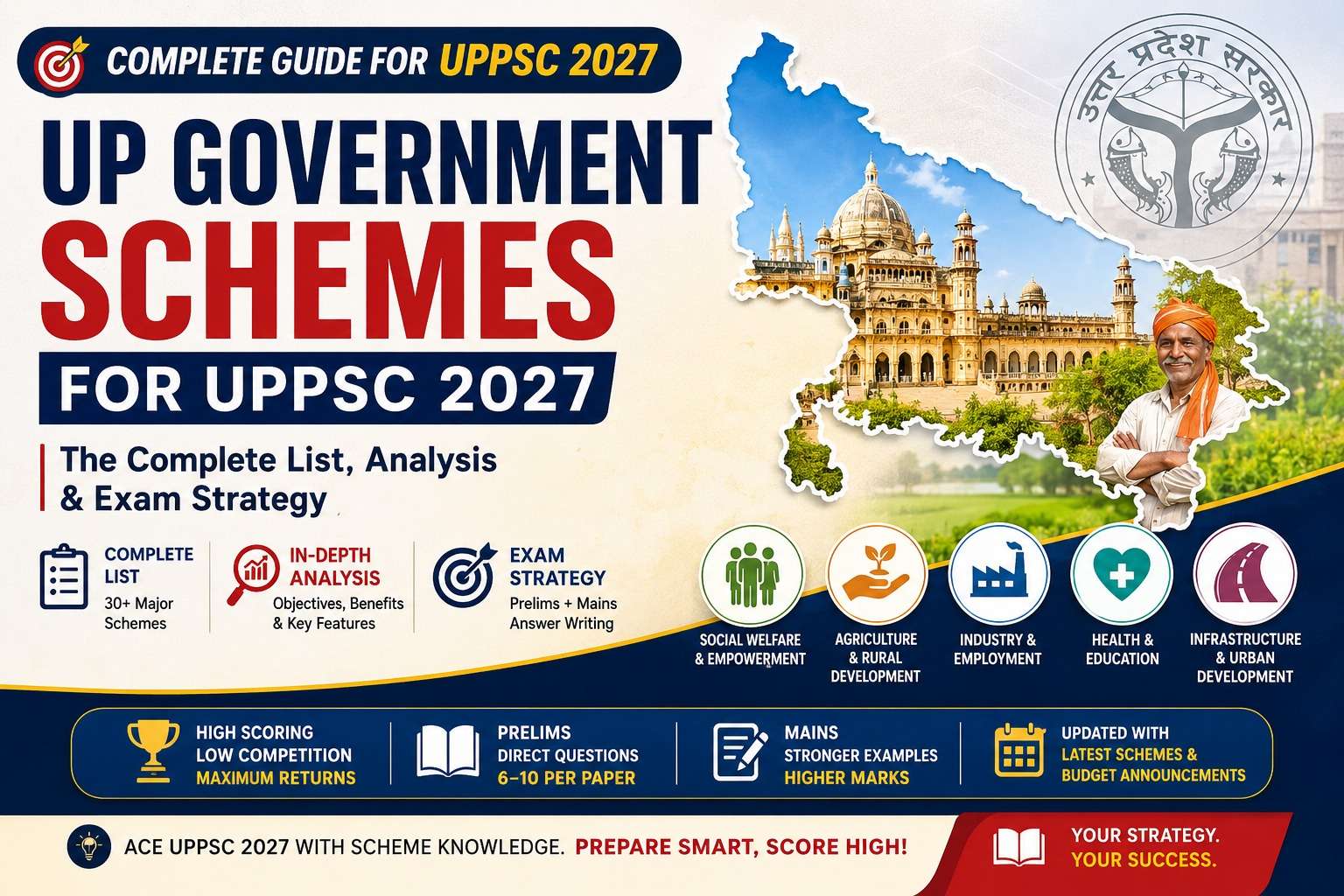
Here is why. In the last five UPPSC Prelims papers, government schemes — both central and UP state — have generated 6 to 10 direct questions per paper. Within this, UP-specific schemes contribute 4 to 6 questions that most aspirants, preparing on national-level content, simply cannot answer.
In Mains, UP government schemes are expected as examples inside every GS Paper II (Governance) and GS Paper III (Economy and Agriculture) answer — and answers that cite current, specific UP scheme data score measurably higher than generic answers.
The competitive advantage here is stark: the aspirant who knows UP government schemes thoroughly is scoring 6 to 10 marks that the majority of the competition leaves on the table. Every attempt.
This guide gives you the complete UP Government Schemes list for UPPSC 2027 — organised by sector, exam-relevant details for each scheme, the most frequently tested schemes in UPPSC history, how to use scheme knowledge in Mains answers, and a study system that covers this category without making it a separate subject.
📌 Part of our Complete UPPSC 2027 Series:
- UPPSC Current Affairs 2027 — Blog #1
- UP Special Current Affairs — Blog #2
- UPPSC Preparation Strategy 2027 — Blog #3
- UPPSC CSAT Preparation 2027 — Blog #4
- UPPSC Booklist 2027– Blog#5
Why UP Government Schemes Are the Highest-ROI Content in UPPSC
Before the scheme list, understand the strategic argument for prioritising this content:
Reason 1 — Direct Prelims marks with low effort Each scheme can be covered in 5 to 10 minutes — name, objective, beneficiary, nodal department, launch year, key feature. That’s enough for a Prelims question. Compared to the hours needed to cover a History chapter, the marks-per-hour return on schemes is exceptional.
Reason 2 — Almost no competition National coaching institutes cover central government schemes adequately. Almost none cover UP state schemes with the specificity UPPSC demands. Most aspirants from national-level coaching programmes cannot answer questions like “Which UP scheme provides free electricity to SC/ST families?” or “What is the ODOP target for 2025?” You can — with this guide.
Reason 3 — Mains answer differentiation A Mains answer on “challenges in rural development in UP” that cites the Mukhyamantri Khet Sadak Yojana with specific coverage data scores differently from an answer that uses only generic terms. Scheme-specific knowledge transforms average answers into high-scoring ones.
Reason 4 — Schemes are updated and tested fresh New schemes announced in each UP Budget are potential Prelims questions for the next exam. An aspirant who tracks schemes actively always has a fresh advantage over those relying on old notes.
How to Study UP Government Schemes: The 4-Field Method
Before the list, here is the study system. For every scheme, capture exactly four fields — nothing more, nothing less for Prelims:
- Name — exact official name (Hindi and English both where relevant)
- Objective — one line: what problem does it solve
- Beneficiary — who gets the benefit (farmers, women, SC/ST, youth, etc.)
- Nodal Department — which UP government department runs it
For Mains, add two more fields: 5. Key achievement/target — any specific number, coverage figure, or recent milestone 6. Mains linkage — which GS paper and topic this scheme connects to
Maintaining a scheme tracker with these six fields for every scheme — updated every time a new scheme is announced or an existing scheme gets a budget revision — is the most efficient schemes preparation system possible.
SECTION 1: UP Social Welfare & Women Empowerment Schemes
These schemes are among the most frequently tested in UPPSC Prelims and appear consistently as Mains examples in gender, social justice, and governance questions.
- Mukhyamantri Kanya Sumangala Yojana
Objective: Financial support for girl child from birth to higher education — to promote girl child birth, education, and reduce gender discrimination. Beneficiary: Girls from families with annual income up to ₹3 lakh Nodal Department: Department of Women and Child Development, UP Key Feature: Benefit provided in 6 instalments at different life stages — birth, vaccination, Class I admission, Class VI, Class IX, and graduation/diploma Mains Linkage: GS Paper II — Gender equality, social welfare, girl child education
Why exam-relevant: This scheme is one of CM Yogi Adityanath’s flagship social welfare initiatives and has appeared directly in UPPSC questions. The 6-instalment structure is a frequently tested specific detail.
- UP Bhagya Lakshmi Yojana
Objective: Financial assistance at birth of girl child to families below poverty line — to discourage female foeticide and support girl child welfare Beneficiary: BPL families with a girl child born after 2006 Nodal Department: Department of Women and Child Development, UP Key Feature: ₹50,000 bond given at birth; mother receives ₹5,100 as nutrition support Mains Linkage: GS Paper II — Women empowerment, social security, BPL welfare
- Mukhyamantri Bal Seva Yojana
Objective: Support for children orphaned due to COVID-19 — education, nutrition, and financial support Beneficiary: Children who lost both parents or primary earning member due to COVID-19 Nodal Department: Department of Women and Child Development, UP Key Feature: ₹4,000 per month financial assistance; free education up to Class 12; tablets/laptops provided Mains Linkage: GS Paper II — Child welfare, COVID response, social security
- UP Mahila Samarthya Yojana
Objective: Promote women’s economic self-reliance through Self-Help Groups and skill development Beneficiary: Women from rural and urban areas of UP Nodal Department: Department of Women and Child Development, UP Key Feature: Formation of Women Welfare Centres (Mahila Kalyan Kendras) at district level; integrated with national SHG programmes Mains Linkage: GS Paper II — Women empowerment, SHG, economic participation
- Rani Laxmibai Mahila Evam Bal Samman Kosh
Objective: Provide immediate financial assistance to women victims of crime and violence Beneficiary: Women victims of rape, domestic violence, acid attack, trafficking Nodal Department: Home Department, UP Key Feature: Named after Rani Laxmibai — carries strong symbolic value in UP’s historical and cultural context Mains Linkage: GS Paper II — Women safety, crime against women, victim compensation
SECTION 2: UP Agriculture and Farmer Welfare Schemes
Agriculture is UP’s economic backbone and generates consistent UPPSC questions on both farmer welfare and economic development.
- Mukhyamantri Khet Sadak Yojana
Objective: Connecting agricultural fields to main roads — last-mile rural road connectivity for farmers Beneficiary: Farmers in villages; improves crop transportation and reduces post-harvest losses Nodal Department: Rural Development Department, UP Key Feature: Construction of pucca roads connecting farms to mandis; reduces post-harvest losses estimated at 20–30% Mains Linkage: GS Paper III — Agriculture infrastructure, rural development, UP economic growth
- UP Krishi Yantra Sahayata Yojana (Farm Mechanisation)
Objective: Subsidised farm equipment for small and marginal farmers — to modernise UP agriculture Beneficiary: Small and marginal farmers (up to 2 hectares land holding) Nodal Department: Agriculture Department, UP Key Feature: 40–80% subsidy on tractors, threshers, seed drills, and other agricultural equipment; SC/ST farmers get higher subsidy Mains Linkage: GS Paper III — Agricultural modernisation, farmer income, mechanisation
- UP Paramparagat Krishi Vikas Yojana (Organic Farming)
Objective: Promotion of organic farming in UP — reduce chemical use, improve soil health, premium prices for farmers Beneficiary: Farmer clusters in UP’s organic farming zones Nodal Department: Agriculture Department, UP Key Feature: Cluster-based approach — 50-acre clusters; certification support; direct marketing linkage Mains Linkage: GS Paper III — Sustainable agriculture, organic farming, farmer income diversification
- UP Kisan Karj Rahat Yojana
Objective: Loan waiver for UP’s small and marginal farmers — agricultural debt relief Beneficiary: Small and marginal farmers with crop loans up to ₹1 lakh (later extended) Nodal Department: Cooperative Department, UP Key Feature: One of the largest loan waivers in UP history — approximately 86 lakh farmers benefited Mains Linkage: GS Paper III — Farm credit, agricultural distress, rural economy
- Mukhyamantri Krishak Durghatna Kalyan Yojana
Objective: Compensation to farmers’ families in case of accidental death or permanent disability Beneficiary: All farmers and agricultural labourers of UP Nodal Department: Revenue Department, UP Key Feature: ₹5 lakh compensation for death; ₹2 lakh for permanent disability — no premium required Mains Linkage: GS Paper III — Farmer welfare, social security, agricultural labour
SECTION 3: UP Economic Development & Employment Schemes
These schemes directly link to UP’s economic growth narrative and are heavily tested in Economy and Governance questions.
- One District One Product (ODOP) Scheme
Objective: Promote unique local products of each of UP’s 75 districts — boost MSMEs, create employment, preserve traditional crafts Beneficiary: Local artisans, weavers, MSME units, exporters Nodal Department: MSME and Export Promotion Department, UP Key Feature: 75 districts — 75 unique products; branding, packaging, market linkage support; integrated with export promotion Most Important: This is UP’s most celebrated economic scheme and a flagship initiative under CM Yogi. It has become a national model and has appeared in UPPSC papers multiple times.
Examples of ODOP products:
- Lucknow — Chikankari
- Varanasi — Silk Sarees
- Moradabad — Brassware
- Agra — Leather
- Firozabad — Glass Bangles
- Aligarh — Locks
- Bareilly — Zardozi
- Kanpur — Leather goods
Mains Linkage: GS Paper III — MSME development, employment generation, export promotion, rural economy
- UP Mukhyamantri Swarojgar Yojana
Objective: Self-employment support through loans and subsidies for starting small businesses — reduce youth unemployment Beneficiary: Unemployed youth of UP aged 18–40 Nodal Department: Khadi and Village Industries Department, UP Key Feature: Loans from ₹25,000 to ₹25 lakh; margin money subsidy 25% (35% for SC/ST/women); bank linkage Mains Linkage: GS Paper II/III — Youth employment, entrepreneurship, skill development
- UP Vishwakarma Shram Samman Yojana
Objective: Skill development and economic empowerment of traditional artisans and craftspeople Beneficiary: Artisans in traditional crafts — carpenters, blacksmiths, pottery workers, weavers, etc. Nodal Department: MSME Department, UP Key Feature: 6-day skill training; toolkit worth ₹10,000; loan support up to ₹10 lakh with 5% interest Mains Linkage: GS Paper III — Artisan welfare, traditional industries, skill development
- UP Startup Policy and Startup Hub
Objective: Build a startup ecosystem in UP — innovation, technology entrepreneurship, job creation Beneficiary: Tech startups, student entrepreneurs, innovators Nodal Department: IT and Electronics Department, UP Key Feature: UP has become India’s 2nd largest startup ecosystem; startup hub in Lucknow; incubation support Mains Linkage: GS Paper III — Innovation economy, startup ecosystem, technology development
- UP Nivesh Mitra (Single Window Portal)
Objective: Single-window clearance for industrial investment in UP — ease of doing business Beneficiary: Domestic and foreign investors in UP Nodal Department: Infrastructure and Industrial Development Department, UP Key Feature: Online portal for all investment clearances; UP jumped 8 ranks in Ease of Doing Business Index Mains Linkage: GS Paper III — Investment climate, ease of doing business, industrial development
SECTION 4: UP Health and Education Schemes
- Mukhyamantri Jan Arogya Yojana
Objective: Health insurance coverage for UP’s poor — extend Ayushman Bharat to additional beneficiaries not covered under central scheme Beneficiary: Families not covered under Ayushman Bharat PM-JAY but below income threshold Nodal Department: Health Department, UP Key Feature: Coverage up to ₹5 lakh per family per year; cashless treatment at empanelled hospitals Mains Linkage: GS Paper II — Health coverage, social security, universal health access
- UP Mukhyamantri Abhyudaya Yojana
Objective: Free coaching for competitive exams — UPSC, UPPSC, NDA, SSC, JEE, NEET — for underprivileged youth Beneficiary: Youth from economically weaker sections of UP Nodal Department: Planning Department (coordinated by Chief Minister’s Office) Key Feature: District-level coaching centres; faculty from IITs, IIMs, state universities; online and offline both Most Relevant: This scheme directly competes with coaching institutes — very relevant for UPPSC aspirants to know. Has appeared in questions on e-governance and education policy. Mains Linkage: GS Paper II — Education policy, equal opportunity, competitive exam access
- UP Skill Development Mission
Objective: Vocational training and skill certification for UP’s youth — improve employability Beneficiary: Youth aged 14–35 across UP Nodal Department: Vocational Education and Skill Development Department, UP Key Feature: Training in 283 trades; 1.5 crore+ trained; linkage with placement drives Mains Linkage: GS Paper II/III — Skill development, unemployment, human capital
- UP Muft Bijli Yojana (Free Electricity)
Objective: Free electricity for BPL households and SC/ST families — energy poverty reduction Beneficiary: BPL families and Scheduled Caste/Scheduled Tribe households Nodal Department: Energy Department, UP Key Feature: Free electricity up to 100 units per month for eligible households Mains Linkage: GS Paper II/III — Energy access, welfare schemes, inclusive growth
- Mission Shakti (UP)
Objective: Comprehensive women safety and empowerment programme — covers education, health, self-defence, legal awareness Beneficiary: All women and girls of Uttar Pradesh Nodal Department: Home Department + Women and Child Development, UP Key Feature: Multi-phase campaign; pink booths at police stations; Shakti app; self-defence training; legal aid cells Most Important: One of the most widely publicised UP government initiatives. Has appeared directly in UPPSC questions. The multi-department coordination model is frequently cited in Mains governance answers. Mains Linkage: GS Paper II — Women safety, policing reforms, governance
SECTION 5: UP Infrastructure & Urban Development Schemes
- UP Expressway Programme
Objective: Connectivity infrastructure to boost economic development across UP regions Key Expressways: Purvanchal Expressway (341 km), Bundelkhand Expressway (296 km), Gorakhpur Link Expressway, Ganga Expressway (594 km — longest in India when completed) Nodal Department: UP Expressways Industrial Development Authority (UPEIDA) Mains Linkage: GS Paper III — Infrastructure, regional development, investment attraction
- UP Defence Industrial Corridor
Objective: Establish defence manufacturing cluster in UP — attract investment, create employment, boost defence production Nodes: Aligarh, Agra, Jhansi, Kanpur, Lucknow, Chitrakoot Nodal Department: Infrastructure and Industrial Development Corporation of UP (PICUP/UPEIDA) Key Feature: Target investment of ₹50,000 crore; 100+ defence companies signed MoUs Mains Linkage: GS Paper III — Defence manufacturing, Make in India, industrial corridors
- Purvanchal Vikas Board Schemes
Objective: Targeted development of economically backward Purvanchal region of UP Beneficiary: Districts of eastern UP — historically under-developed Key Feature: Road connectivity, irrigation, healthcare, and skill development specifically for Purvanchal districts Mains Linkage: GS Paper III — Regional imbalance, inclusive development, UP economy
SECTION 6: UP Rural Development Schemes
- UP Mukhyamantri Awas Yojana (Grameen)
Objective: Permanent housing for rural BPL families not covered under PM Awas Yojana Gramin Beneficiary: Homeless and kutcha house-dwelling families in UP rural areas Nodal Department: Rural Development Department, UP Key Feature: State-funded supplement to central PMAY; ensures complete coverage of housing need Mains Linkage: GS Paper II/III — Rural development, housing, welfare schemes
- Saryu Nahar National Project
Objective: Irrigation of 14.14 lakh hectares of agricultural land across eastern UP through canals Beneficiary: Farmers in Bahraich, Shravasti, Balrampur, Gonda, Basti, Sant Kabir Nagar, Gorakhpur, Maharajganj Nodal Department: Irrigation Department, UP Key Feature: Inaugurated by PM Modi in December 2021; covers 29 lakh farmers; canal network across eastern districts Mains Linkage: GS Paper III — Irrigation, water resource management, eastern UP development
The 10 Most Exam-Critical UP Schemes (Must Know Everything)
Based on UPPSC PYQ analysis and current exam trends, these 10 schemes have the highest probability of appearing in UPPSC 2027:
| Rank | Scheme | Why Critical |
| 1 | One District One Product (ODOP) | Flagship scheme, national model, multiple previous appearances |
| 2 | Mission Shakti | High visibility, multi-department, gender governance angle |
| 3 | Mukhyamantri Kanya Sumangala Yojana | Girl child, direct welfare, 6-stage structure frequently tested |
| 4 | Mukhyamantri Abhyudaya Yojana | Competitive exam coaching, governance innovation |
| 5 | UP Expressways (especially Ganga Expressway) | Infrastructure, records, regional development |
| 6 | Defence Industrial Corridor | Defence manufacturing, Make in India, UP economy |
| 7 | Mukhyamantri Jan Arogya Yojana | Health coverage, social security |
| 8 | UP Vishwakarma Shram Samman Yojana | Artisan welfare, traditional crafts |
| 9 | Saryu Nahar Project | Irrigation, eastern UP, completed infrastructure |
| 10 | UP Startup Policy | New economy, innovation, UP’s startup ranking |
How to Use UP Schemes in UPPSC Mains Answers
Knowing schemes is half the battle. Using them effectively in Mains answers is the other half.
The scheme-integration formula for Mains:
When a question touches governance, social welfare, economy, or agriculture — follow this structure:
- State the challenge — what problem exists in UP
- Cite the scheme — name it correctly, state its objective in one line
- Add a specific detail — a coverage number, target, or recent achievement
- Analyse effectiveness — what has improved, what gaps remain
- Suggest the way forward — how implementation can be strengthened
Example application:
Question: “Examine the measures taken by the UP government to address rural poverty and improve farmer income.”
A weak answer: “The government has taken various measures for rural development and farmer welfare.”
A high-scoring answer: “The UP government has implemented a multi-pronged approach. The Mukhyamantri Khet Sadak Yojana has improved last-mile connectivity for farmers, reducing post-harvest losses. The UP Krishi Yantra Sahayata Yojana provides 40–80% subsidy on farm equipment, enabling mechanisation for small and marginal farmers. The Saryu Nahar National Project, inaugurated in 2021, extends irrigation to 14.14 lakh hectares in eastern UP — a region historically dependent on erratic monsoon. However, implementation gaps persist in credit access and cold chain infrastructure…”
The second answer cites three specific UP schemes with data — and scores proportionally higher.
How to Stay Updated on New UP Schemes
UPPSC tests the latest schemes — not just historical ones. Here is your live tracking system:
Primary sources:
- UP Budget Speech — every scheme with new allocation or modification is announced here; download from UP Finance Department website annually
- UP government press releases — up.gov.in/en/press-releases; cabinet decisions and new scheme launches
- PIB Lucknow Regional Bureau — central schemes with UP-specific data
- CM’s official social media — new initiatives are announced here first, often before official government notifications
Tracking frequency:
- Monthly: Scan UP government press releases for new schemes
- Quarterly: Review budget allocation updates
- Annually: Full reading of UP Budget and Economic Survey for scheme additions and modifications
How Analytics IAS Academy Covers UP Government Schemes
At Analytics IAS Academy, Sector 63, Noida, UP Government Schemes are not an afterthought — they are a dedicated, structured module in our UPPSC Foundation Course.
What our UP Schemes module includes:
✅ Complete scheme tracker — maintained and updated by faculty; covers all active UP government schemes with exam-relevant details in the 4-field format; new schemes added within 2 weeks of announcement
✅ Sector-wise organisation — schemes organised by sector (social welfare, agriculture, economy, health, infrastructure) for both learning and revision efficiency
✅ Mains integration training — dedicated sessions on how to cite schemes inside GS Paper II, III, and IV answers; model answers with scheme integration demonstrated
✅ Monthly scheme updates — as part of our UP Special Current Affairs module, newly announced schemes are covered in the monthly current affairs class
✅ Mock test questions on schemes — our UPPSC-pattern mock tests include 4 to 6 scheme-based questions per paper — matching actual UPPSC paper composition
✅ Available online and offline — our complete UP Schemes module is accessible to both online live batch students and offline classroom students at Sector 63, Noida
Frequently Asked Questions
Q1. How many UP government schemes should I study for UPPSC 2027?
Focus on 30 to 40 active, major UP government schemes across all sectors. For each scheme, cover the 4-field system: name, objective, beneficiary, and nodal department. For the 10 most exam-critical schemes, add coverage data and Mains linkage. Depth on fewer schemes outperforms superficial knowledge of 100+ schemes.
Q2. Are central government schemes also important for UPPSC 2027?
Yes — both central and UP state schemes are tested in UPPSC. Central schemes like PM Awas Yojana, Ayushman Bharat, MGNREGA, PM Kisan, and PM Fasal Bima are consistently tested. However, UP-specific schemes give you a competitive advantage because most aspirants cover central schemes but skip UP state schemes.
Q3. How do I stay updated on new UP government schemes?
The most reliable sources are the UP government official portal (up.gov.in), UP Budget Speech (released annually), and PIB Lucknow Bureau. Also monitor the Chief Minister’s official communications for new initiative announcements. Our Foundation Course includes monthly scheme updates as part of the UP Special Current Affairs module.
Q4. Are UP government schemes asked in UPPSC Mains or only Prelims?
Both. In Prelims, schemes appear as direct factual questions — scheme name, objective, beneficiary, nodal department. In Mains, schemes are expected as concrete examples inside GS Paper II (Governance) and GS Paper III (Economy and Agriculture) answers. An answer that cites specific UP scheme data scores significantly higher than a generic answer.
Q5. What is the most important UP scheme for UPPSC 2027?
One District One Product (ODOP) is the single most exam-critical UP scheme — it has appeared in multiple previous UPPSC papers, is a national model for MSME development, and has Prelims, Mains, and Essay paper relevance. Mission Shakti and Mukhyamantri Kanya Sumangala Yojana are close seconds for gender-governance angles.
Q6. Does Analytics IAS Academy provide a UP schemes tracker for UPPSC students?
Yes. Our UPPSC Foundation Course includes a complete, faculty-maintained UP Government Schemes tracker with exam-relevant details, updated within weeks of new scheme announcements. Both online and offline batch students receive this material. Visit analyticsias.com or call for current batch details.
UP Government Schemes: Your Highest-ROI Preparation Investment
In an examination where every mark counts and competition is intense, UP Government Schemes represent the clearest, most actionable scoring opportunity available.
The preparation effort is defined — 30 to 40 schemes, four fields each, active tracking of new announcements. The exam return is consistent — 6 to 10 direct Prelims marks, plus improved Mains answer quality across multiple papers.
The only question is whether you will prepare this category thoroughly enough to capture these marks — or whether you will be the aspirant who reads a generic question about the Ganga Expressway and realises in the exam hall that you prepared for UPPSC but didn’t know UP.
At Analytics IAS Academy, Sector 63, Noida, our UPPSC Foundation Course is built to ensure that never happens.
New batches starting soon — online and offline. Limited seats.
📍 Visit: analyticsias.com
🎥 Watch our UPPSC series: Analytics IAS YouTube Channel
📞 Call nowv for your FREE counselling session