
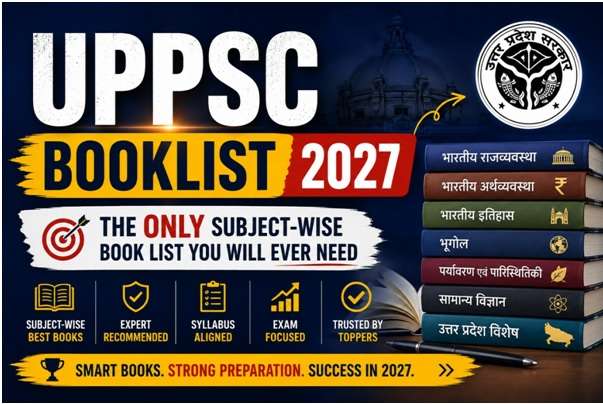
Every UPPSC aspirant has been there.
You search “best books for UPPSC 2027” and get 47 different answers, 12 different YouTube videos recommending contradictory booklists, and a growing pile of books that would take five years to read — let alone revise.
The book problem is real. And it costs aspirants more time and money than almost any other preparation mistake.
The truth about UPPSC preparation books is this: you need far fewer books than you think, and the ones you need are well-known, proven, and consistently recommended by toppers across decades. The challenge is not finding the right books — it is having the discipline to stick with a short, focused list and cover those books thoroughly rather than accumulating an impressive collection that never gets finished.
This guide gives you the complete, curated UPPSC Booklist for 2027 — subject-wise, stage-wise (Prelims and Mains), and with clear guidance on what to prioritise, what to skip, and the UP-specific resources that most generic booklists miss entirely.
This is the exact reading list we use with our students at Analytics IAS Academy, Sector 63, Noida in our online and offline UPPSC Foundation Courses.
📌 Part of our UPPSC 2027 Complete Preparation Series:
- UPPSC Current Affairs 2027 — Blog #1
- UP Special Current Affairs — Blog #2
- UPPSC Preparation Strategy 2027 — Blog #3
- UPPSC CSAT Preparation 2027 — Blog #4
Before the Booklist: 3 Rules That Decide If Books Help or Hurt You
Rule 1: One Book Per Subject — Read Thoroughly
The single most damaging booklist habit is reading three different books on the same subject superficially, hoping the combination will be comprehensive. It will not be. One thoroughly read, actively noted, and regularly revised book is worth more than four partially-covered books. Every subject in this list has one primary book. Treat it as sacred.
Rule 2: NCERT First — Always
Before any standard reference book, NCERT textbooks from Class 6 to 12 must form the foundation. They are conceptually clear, factually reliable, and used as the benchmark for UPPSC question framing. Aspirants who skip NCERTs and jump to standard books consistently struggle with conceptual clarity in Mains answers. NCERTs come first. No exceptions.
Rule 3: UP-Specific Resources Are Not Optional
The single biggest gap in most UPPSC booklists available online is the complete absence of UP-specific resources. UPPSC tests UP History, UP Geography, UP Polity, UP Economy, and UP Culture alongside national-level content. Generic national booklists — even excellent ones — do not cover this. This list includes the UP-specific layer explicitly.
UPPSC Booklist 2027: Complete Subject-Wise List
📚 HISTORY
| Book | Class | Focus Area |
| Our Pasts I, II, III | 6, 7, 8 | Ancient and Medieval India |
| India and the Contemporary World I, II | 9, 10 | Modern History basics |
| Themes in Indian History I, II, III | 11, 12 | Advanced Historical themes |
Standard Reference Books
Ancient and Medieval India:
- Ancient India by R.S. Sharma (Old NCERT) — foundational text for Ancient India; concise, exam-relevant
- Medieval India by Satish Chandra (Old NCERT) — standard reference for Medieval period
Modern India:
- A Brief History of Modern India by Rajiv Ahir (Spectrum) — the single most important Modern History book for UPPSC; covers Freedom Struggle, social reforms, press, and education comprehensively; revised annually
Indian Art and Culture:
- Indian Art and Culture by Nitin Singhania — standard reference for culture questions in both Prelims and Mains; covers architecture, music, dance, painting, literature, religion
UP-Specific History Resources
- UP Art and Culture module — dedicated state-level notes covering Awadhi culture, Braj culture, Buddhist heritage, Mughal period in UP, freedom movement contributions from UP, classical arts of Uttar Pradesh
- UP Tourism Department publications on heritage sites — available free online; highly exam-relevant
What to skip: Do not buy thick volumes like Romila Thapar’s Ancient India for UPPSC — the depth far exceeds what is tested. Spectrum + NCERTs is sufficient for Ancient and Medieval.
📚 GEOGRAPHY
NCERT Foundation (Mandatory)
| Book | Class | Focus Area |
| The Earth: Our Habitat | 6 | Basic physical geography |
| Our Environment | 7 | Natural systems |
| Resource and Development | 8 | Economic geography basics |
| Contemporary India I, II | 9, 10 | Indian Geography |
| Fundamentals of Physical Geography | 11 | Physical geography advanced |
| India: Physical Environment | 11 | Indian physical geography |
| Fundamentals of Human Geography | 12 | Human geography |
| India: People and Economy | 12 | Economic and population geography |
Standard Reference Books
- Certificate Physical and Human Geography by G.C. Leong — for physical geography conceptual clarity; use selectively — Chapters 1–12 and 27–35 are most relevant for UPPSC
- Geography of India by Majid Husain — comprehensive Indian geography reference; covers physical, economic, and human geography with UP-relevant content
UP-Specific Geography Resources
- UP Geography notes — covering UP’s location and boundaries, river systems (Ganga, Yamuna, Ghaghra, Rapti, Betwa, Ken, Gomti), agro-climatic zones (9 zones), soil types, minerals, major crops, wildlife sanctuaries and national parks in UP, UP population geography (density, sex ratio, literacy district-wise)
- Census data for UP — available from Census India website; focus on UP-specific demographic data
What to skip: Atlas purchases can wait until Month 3. Orient Blackswan School Atlas is sufficient if needed. Do not spend on expensive GIS or advanced geography books — UPPSC does not test that depth.
📚 POLITY AND GOVERNANCE
NCERT Foundation (Mandatory)
| Book | Class | Focus Area |
| Social and Political Life I, II, III | 6, 7, 8 | Democratic basics |
| Democratic Politics I, II | 9, 10 | Indian democracy |
| Indian Constitution at Work | 11 | Constitutional framework |
| Politics in India Since Independence | 12 | Post-independence polity |
Standard Reference Books
- Indian Polity by M. Laxmikanth — the single most important Polity book for UPPSC; covers Constitutional provisions, Articles, Schedules, Parliament, State Legislature, Executive, Judiciary, local bodies; read every chapter; make your own notes from this book alone
UP-Specific Polity Resources
- UP Legislature — UP Vidhan Sabha (403 members) and UP Vidhan Parishad (100 members) — structure, powers, sessions, special provisions
- Local Self Government in UP — three-tier Panchayati Raj institutions, urban local bodies, District Planning Committees, State Election Commission
- UP Governor’s role and powers — special provisions applicable to UP
- Government of UP official portal (up.gov.in) — for current legislative developments
What to skip: Do not buy additional Polity books like D.D. Basu for UPPSC. Laxmikanth alone is comprehensive enough. Buying multiple Polity books is one of the most common and costly booklist mistakes.
📚 ECONOMY
NCERT Foundation (Mandatory)
| Book | Class | Focus Area |
| Social Science — Economic Development | 10 | Development economics basics |
| Indian Economic Development | 11 | Planning, agriculture, industry |
| Macroeconomics | 12 | Monetary policy, national income, banking |
Standard Reference Books
- Indian Economy by Ramesh Singh — comprehensive standard reference for Indian Economy; covers planning, agriculture, industry, monetary policy, banking, external sector, government schemes; updated annually — buy the latest edition
Government Documents (Mandatory — Free to Download)
- Economic Survey of India (latest edition) — Ministry of Finance; summary chapters are sufficient; focus on Chapter 1 (State of Economy) and sector-specific chapters
- Union Budget Highlights — revenue, expenditure, fiscal deficit, key allocations
- UP Economic Survey — UP Finance Department; UPPSC-specific; covers UP GSDP, sectoral data, major UP schemes, budget allocations
Important: The UP Economic Survey is available free from the UP Finance Department website every year. It is mandatory reading for UPPSC. Most aspirants never read it. This single document can contribute 3–5 direct Prelims marks.
📚 ENVIRONMENT AND ECOLOGY
Standard Reference Books
- Environment by Shankar IAS Academy — the standard reference for environment preparation; covers biodiversity, climate change, environment laws, international agreements, pollution, sustainable development; updated annually
Government Documents and Reports
- Ministry of Environment, Forest and Climate Change (MoEF) annual reports — for current notifications
- PIB environment-related press releases — for current affairs linkage
- Environment Impact Assessment (EIA) notifications — for governance angle in Mains
UP-Specific Environment Resources
- UP Wildlife sanctuaries and national parks — Dudhwa National Park, Pilibhit Tiger Reserve, Sohagi Barwa Wildlife Sanctuary, Nawabganj Bird Sanctuary, Okhla Bird Sanctuary
- Namami Gange — UP-specific implementation data; Ganga rejuvenation projects in UP
- UP Renewable Energy Development Agency (UPNEDA) — UP solar policy, renewable energy targets
📚 SCIENCE AND TECHNOLOGY
NCERT Foundation (Mandatory)
- Science textbooks Class 6–10 — for basic concepts in Physics, Chemistry, Biology; read once for conceptual clarity
Current Affairs Sources (Replace Books Here)
- PIB Science and Technology section — government science initiatives, ISRO missions, defence technology
- The Hindu Science page — current developments in science and technology
- Monthly current affairs compilations — for S&T current affairs integration
Key insight: Unlike History or Geography, Science and Technology for UPPSC is almost entirely current affairs-driven, not static book-driven. Spending money on S&T books is largely unnecessary. Invest the time in PIB and The Hindu S&T section instead.
📚 GENERAL HINDI (Paper I — Qualifying)
Reference Books
- Samanya Hindi by Dr. Vimal Agarwal — the standard reference for UPPSC General Hindi paper; covers Nibandh (essay writing), Patra (letter writing), Samasa, Sandhi, Vakya Shuddhi, Anuvad (translation), Muhavare and Lokoktiyan
- Manak Hindi Vyakaran — for grammar rules; use selectively — focus only on Samasa, Sandhi, and Vakya Shuddhi sections
Practice Resources
- Previous year UPPSC General Hindi papers — most important practice material; practise Nibandh writing monthly
- UP Board Hindi textbooks Class 10–12 — useful for language register and essay topics
Reminder: General Hindi requires 40% to qualify (60 out of 150). Start Hindi writing practice from Month 2 — 30 minutes per week minimum. Most aspirants discover they are weaker at formal Hindi writing than they expected.
📚 ESSAY (Paper II — 150 Marks)
Reference Books
- Essays for Civil Services by Pulkit Khare — structured essay writing guidance with examples; useful for understanding format and approach
- Editorial collections — The Hindu and Indian Express editorials are your best essay preparation material; read and analyse one editorial daily throughout your preparation
Practice Strategy (More Important Than Books)
- Write one complete essay (1000–1200 words) every week from Month 4 onwards
- Cover essay topics from past 10 years of UPPSC and UPSC Essay papers
- Get faculty evaluation — self-assessment of essays is less effective than external feedback
Essay preparation secret: The aspirants who score 120–130 out of 150 in UPPSC Essay are not necessarily better at writing. They are better at structuring arguments and using current examples. Both of these skills come from reading editorials and practicing regularly — not from buying more books.
📚 GENERAL STUDIES PAPER II (CSAT)
- Verbal and Non-Verbal Reasoning by R.S. Aggarwal — for Reasoning (use selective chapters: blood relations, directions, syllogisms, coding-decoding, series)
- Quantitative Aptitude by R.S. Aggarwal — for Maths (use selective chapters: percentage, ratio, profit-loss, interest, speed-time, averages, DI)
- NCERT Maths Class 8, 9, 10 — for concept revision only
- Previous year UPPSC CSAT papers — most important practice resource
📌 Read our complete UPPSC CSAT Preparation 2027 guide for the full section-wise strategy and 30-day schedule.
The Master UPPSC Booklist 2027 at a Glance
| Subject | NCERT | Standard Book | UP-Specific |
| History | Class 6–12 | Spectrum (Modern), RS Sharma (Ancient), Satish Chandra (Medieval) | UP Art & Culture notes |
| Geography | Class 6–12 | G.C. Leong, Majid Husain | UP Geography notes |
| Polity | Class 6–12 | Laxmikanth | UP Legislature + LG notes |
| Economy | Class 10–12 | Ramesh Singh | UP Economic Survey |
| Environment | — | Shankar IAS | UP Wildlife + Namami Gange |
| Science & Tech | Class 6–10 | PIB + The Hindu | UP Tech initiatives |
| General Hindi | — | Vimal Agarwal | Previous year papers |
| Essay | — | Pulkit Khare + Editorials | Current examples from UP |
| CSAT | Class 8–10 Maths | RS Aggarwal (both books) | Previous year CSAT papers |
| Current Affairs | — | Monthly compilation | UP Special CA — dedicated |
What NOT to Buy: The Overcrowded Booklist Trap
This section is as important as the list above.
Do not buy these for UPPSC:
- Any book with “Complete Guide to UPPSC” in the title that runs 1200+ pages — these are marketing products, not preparation tools
- Separate books for Ancient, Medieval and Modern History when you have NCERTs + Spectrum — redundant
- Multiple Polity books — Laxmikanth alone covers everything UPPSC tests
- Coaching institute printed material from institutes you are not enrolled in — quality and UP-relevance varies wildly
- Advanced books on Economy (like Dutt and Sundaram) — far beyond UPPSC depth
- UPSC-level books for topics UPPSC tests at a lower depth — common mistake for aspirants who also consider UPSC
The 5-book core that covers 80% of UPPSC syllabus:
- Spectrum — Modern History
- Laxmikanth — Indian Polity
- Ramesh Singh — Indian Economy
- Shankar IAS — Environment
- NCERTs (Class 6–12, all subjects)
Add UP-specific notes and current affairs, and your preparation framework is complete.
How Notes Complement Books — The Note-Making System
Buying the right books is step one. Using them correctly is step two.
The two-read system:
- First read: Read actively, mark important passages, note unfamiliar terms in the margin
- Second read: Convert marked content into concise, structured notes — maximum one A4 page per chapter
Note structure for UPPSC:
- Factual one-liners (for Prelims MCQs)
- Conceptual summaries (for Mains answer introduction)
- Current affairs hook (recent event linked to the topic)
- UP-specific example (for Mains answer body)
Notes made this way serve both Prelims and Mains simultaneously — which is the most time-efficient system for a 1200-mark exam.
UPPSC Booklist for Different Aspirant Types
For First-Time Aspirants (Starting Fresh)
Month 1–3: Only NCERTs — all subjects, all relevant classes. No standard books yet. Month 4 onwards: Standard books one by one, not simultaneously.
For Repeat Aspirants (Second or Third Attempt)
- Do not buy new books — the problem is almost never the books
- Revisit your existing notes, identify gaps, add UP-specific content
- Switch energy from reading to answer writing and test series
For Working Professionals (Limited Time)
- Prioritise: Laxmikanth, Spectrum, Ramesh Singh, NCERTs Class 10–12 only
- Replace full NCERT reading with NCERT summary notes (available online)
- Invest proportionally more in current affairs and UP Special — these have the highest marks-per-hour return
How Analytics IAS Academy Handles the Book Problem
At Analytics IAS Academy, Sector 63, Noida, we solve the booklist problem for our UPPSC Foundation Course students from Day 1.
What we provide:
✅ Structured reading plan — every book in this list is integrated into our monthly schedule with specific chapters assigned per week. No guessing about what to read next.
✅ UP-specific notes — professionally compiled, faculty-reviewed notes on UP History, UP Geography, UP Polity, UP Economy, and UP Culture — content that is simply not available in any standard book and takes months to compile independently.
✅ Current affairs integration — daily current affairs sessions that link news to your static syllabus topics, so every book topic gets a current dimension that helps in both Prelims and Mains.
✅ Monthly current affairs compilation — covering both national and UP Special content; eliminates the need for separately sourcing UP-specific material.
✅ Answer writing from Month 1 — faculty guides you on how to use your book-based knowledge inside Mains answers, which is a skill that no book teaches.
✅ Available online and offline — our complete study material, UP-specific notes, and monthly compilations are available to both online and offline batch students.
If you are clear on which books to read but want structured guidance on how to cover them, what pace to maintain, and how to use them inside answers — that is exactly what our Foundation Course provides.
Frequently Asked Questions
Q1. How many books are enough for UPPSC 2027 preparation?
The core UPPSC booklist has approximately 12–15 books including NCERTs. Many aspirants buy 30–40 books and cover none thoroughly. The quality of coverage matters far more than the quantity of books. Five thoroughly covered books outperform fifteen superficially read ones in every examination.
Q2. Should I read old NCERTs or new NCERTs for UPPSC 2027?
Both have value for different subjects. Old NCERTs — R.S. Sharma for Ancient India and Satish Chandra for Medieval India — are better for their respective subjects. New NCERTs are better for Geography, Polity, Economy, and Modern History (Class 9–12). Use the recommended combination in this list rather than committing entirely to one generation.
Q3. Is Laxmikanth enough for UPPSC Polity 2027?
Yes. Laxmikanth covers every Polity topic that UPPSC tests — constitutional provisions, Parliament, State Legislature, Executive, Judiciary, Federalism, Local Self Government, and more. Supplement with UP-specific Polity notes (UP Vidhan Sabha, UP Vidhan Parishad, UP local bodies) that are not in Laxmikanth but are tested in UPPSC.
Q4. What is the best book for UPPSC Current Affairs 2027?
No single book covers UPPSC Current Affairs adequately — especially UP Special Current Affairs. The recommended approach is: one national daily newspaper + UP-specific news source + a monthly compilation for revision. Analytics IAS Academy’s Foundation Course provides monthly UP Special Current Affairs compilations as part of the programme.
Q5. Do I need coaching if I have all the right books for UPPSC 2027?
Books give you content. Coaching gives you structure, feedback, UP-specific material, answer writing practice, and test series — things no book provides. Many aspirants have all the right books and still struggle because they lack a revision system, answer writing skill, and UP-specific content that coaching specifically addresses.
Q6. Is Spectrum Modern History enough for UPPSC 2027?
Yes — Spectrum’s A Brief History of Modern India is sufficient for UPPSC’s Modern History requirement. It covers the Freedom Struggle, socio-religious reform movements, press and education, and all other Modern History themes that UPPSC tests. Supplement with relevant NCERT chapters (Class 10 and 12) for complete coverage.
Q7. Does Analytics IAS Academy provide study material and notes for UPPSC 2027? Yes. Our UPPSC Foundation Course — available online and offline at Sector 63, Noida — includes structured study material, UP-specific notes for History, Geography, Polity and Economy, monthly current affairs compilations with UP Special content, and an integrated reading plan. Call us or visit analyticsias.com for current batch details.
The Right Books, The Right Sequence, The Right Guidance
UPPSC 2027 will be decided not by who owned the most books — but by who read the right ones most thoroughly, made the best notes, and revised most consistently.
This booklist is your starting point. What you do with it over the next 12 months is what determines your result.
At Analytics IAS Academy, Sector 63, Noida, our UPPSC Foundation Course takes this booklist and builds a complete, structured preparation system around it — with integrated UP-specific content, answer writing practice, test series, and faculty mentorship that transforms a reading list into a selection.
New batches starting soon — online and offline. Limited seats.
📍 Visit: analyticsias.com
🎥 Watch our UPPSC series: Analytics IAS YouTube Channel
📞 Call now for your FREE personalised counselling session
