
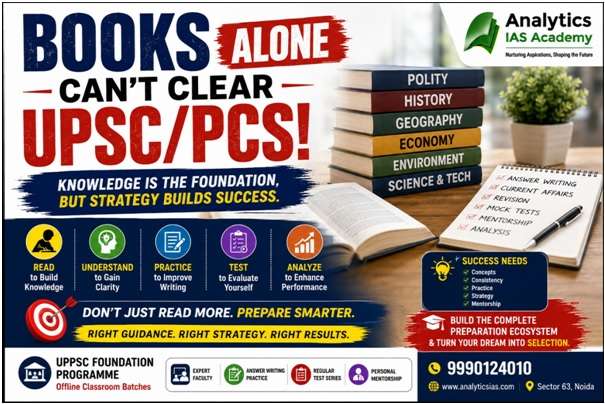
Walk into any bookstore before the UPPSC or UPSC examination, and you’ll notice something interesting.
Students buying piles of books.
NCERTs.
Laxmikanth.
Spectrum.
Economic Survey.
Current Affairs magazines.
Optional books.
Monthly compilations.
Coaching notes.
Many aspirants believe:
“If I finish all these books, I’ll clear the examination.”
Unfortunately, that’s one of the biggest misconceptions in competitive exam preparation.
Books are essential.
But books alone do not guarantee selection.
Every year, thousands of aspirants complete the same standard books.
Only a small percentage qualify.
Why?
Because success in UPPSC is not determined by how many books you read.
It is determined by how effectively you convert knowledge into performance during the examination.
This article explains why reading books is only the beginning of your preparation—and what separates successful candidates from the rest.
Why This Myth Exists
Most beginners begin their preparation by asking one question:
“Which books should I buy?”
This is an important question.
But it is not the most important one.
A better question would be:
“How should I study these books so that I can answer questions in the examination?”
There is a huge difference between:
Reading a chapter.
Understanding a concept.
Applying that concept.
Writing a quality answer.
Most aspirants stop after the first step.
Successful candidates complete all four.
Books Are the Foundation—Not the Entire Building
Think of preparation like constructing a house.
Books are the foundation.
Without a strong foundation, the building cannot stand.
But can a foundation alone become a complete house?
No.
Similarly, books provide:
- Knowledge
- Concepts
- Facts
- Definitions
- Context
But they do not automatically develop:
- Analytical thinking
- Answer writing skills
- Time management
- Decision-making
- Revision habits
- Exam temperament
These skills must be developed separately.
What Books Actually Do
Standard books remain the backbone of civil services preparation because they help students build conceptual clarity.
They explain:
- Indian Constitution
- Geography
- Economy
- History
- Environment
- Science
- Uttar Pradesh-specific topics
Without understanding these subjects, no aspirant can perform well.
Books provide the language of the examination.
However, they are not the examination itself.
The Difference Between Reading and Learning
Many aspirants proudly say:
“I completed the entire book.”
But completing a book does not necessarily mean learning it.
Ask yourself:
Can you explain the topic without looking at the book?
Can you solve MCQs based on it?
Can you connect it with current affairs?
Can you write a 200-word answer on the topic?
If the answer is “No,” then the book has been read—but not mastered.
Learning begins where passive reading ends.
Information Alone Does Not Win Competitive Exams
UPPSC is no longer a purely information-based examination.
The Commission increasingly expects aspirants to:
- Analyse issues.
- Connect concepts.
- Apply knowledge.
- Understand governance.
- Interpret policies.
- Evaluate solutions.
For example:
A book may explain the Directive Principles of State Policy.
But the examination may ask you to analyse their relevance in modern governance.
That requires understanding—not memorization.
Why Most Aspirants Read Too Many Books
One of the most common mistakes is resource accumulation.
Students often believe:
“More books mean better preparation.”
The opposite is usually true.
Too many books create:
- Confusion.
- Information overload.
- Incomplete revision.
- Poor retention.
Most successful candidates rely on:
- Limited standard books.
- Multiple revisions.
- PYQs.
- Mock tests.
- Current affairs.
Depth usually beats quantity.
Conceptual Clarity Is More Important Than Book Count
Civil services preparation rewards conceptual understanding.
Suppose two aspirants prepare Polity.
Student A reads five different books.
Student B studies one standard book thoroughly, revises it multiple times, practices MCQs, and connects it with current affairs.
Who is likely to perform better?
In many cases, Student B.
Why?
Because understanding creates confidence.
Confidence improves accuracy.
Accuracy improves scores.
Current Affairs Cannot Be Ignored
Books explain principles.
Current affairs explain how those principles work in real life.
For example:
Books explain:
- Parliament
- Judiciary
- Federalism
- Agriculture
- Environment
Current affairs show:
- Constitutional debates
- Supreme Court judgments
- New government policies
- Climate challenges
- Economic reforms
UPPSC increasingly integrates static knowledge with contemporary developments.
Reading books without following current affairs creates an incomplete preparation strategy.
The Shift from Memorization to Application
Competitive examinations have evolved.
Earlier, factual questions dominated.
Today, many questions require:
- Understanding.
- Logical thinking.
- Interdisciplinary connections.
- Real-life application.
Books provide raw material.
Application transforms raw material into examination-ready knowledge.
Why Understanding Matters More Than Completion
Many aspirants proudly maintain long reading lists.
However, interview toppers often share a different philosophy:
“Read less, understand more.”
Understanding allows you to:
- Eliminate incorrect MCQ options.
- Write analytical answers.
- Handle unexpected questions.
- Connect multiple subjects.
- Remember concepts for longer periods.
This is precisely what competitive examinations reward.
Books Cannot Teach Exam Temperament
Examinations involve more than knowledge.
Students must also manage:
- Time pressure.
- Negative marking.
- Stress.
- Decision-making.
- Prioritization.
These skills develop through:
- Practice.
- Mock tests.
- Revision.
- Self-evaluation.
No textbook can replace these experiences.
Prelims and Mains Demand Different Skills
Books are equally useful for both stages.
But the way you use them must change.
For Prelims
Books help build:
- Facts.
- Concepts.
- Objective understanding.
- MCQ accuracy.
For Mains
The same books become sources for:
- Arguments.
- Examples.
- Analysis.
- Case studies.
- Structured answers.
The examination tests not just what you know—but how effectively you communicate that knowledge.
The Real Goal Is Not Completing Books
The real objective should be:
✔ Understanding concepts
✔ Connecting current affairs
✔ Revising regularly
✔ Practicing MCQs
✔ Developing analytical thinking
Books are one component of this journey—not the destination.
Build Knowledge That You Can Use
Imagine two aspirants studying the same Economy chapter.
One memorizes definitions.
The other asks:
- Why does inflation happen?
- How does RBI respond?
- What is the impact on farmers?
- Why is this relevant for Uttar Pradesh?
- How might UPPSC ask this in Prelims or Mains?
The second aspirant is preparing for the examination.
The first is only preparing to finish a chapter.
That difference often determines the final result.
Books Alone Can’t Clear UPSC/UPPSC: What Every Serious Aspirant Must Know (Part 2)
In Part 1, we discussed why books are the foundation of preparation but cannot, by themselves, guarantee success in the UPPSC or UPSC examination.
Now let’s understand what transforms knowledge into selection.
Answer Writing Is the Bridge Between Knowledge and Marks
One of the biggest differences between successful and unsuccessful aspirants is not the number of books they read.
It is their ability to express what they know.
Many candidates understand a topic well but struggle to present it within:
- 150–250 words
- Limited time
- A structured format
UPPSC Mains rewards:
- Clear thinking
- Logical organization
- Balanced arguments
- Relevant examples
- Practical conclusions
These skills cannot be developed by reading books alone.
They require regular answer-writing practice.
Why Daily Answer Writing Matters
Suppose you study the Indian Constitution today.
Reading helps you understand Articles and provisions.
Writing helps you answer questions like:
- How does federalism strengthen Indian democracy?
- Discuss the significance of Fundamental Rights.
- Evaluate the role of constitutional bodies.
This shift from “knowing” to “explaining” is exactly what the Mains examination tests.
Even writing 2–3 answers daily can significantly improve:
- Speed
- Presentation
- Analytical ability
- Confidence
Revision Is the Real Secret Behind Selection
Many aspirants keep reading new books.
Very few revise old ones.
Unfortunately, the human brain forgets information rapidly unless it is revised.
A successful preparation strategy follows this cycle:
Study → Revise → Practice → Analyze → Revise Again
Instead of asking:
“Which new book should I buy?”
Ask:
“How many times have I revised the books I already own?”
Most toppers repeatedly emphasize that revision—not accumulation—creates retention.
Mock Tests Turn Preparation into Performance
Books teach concepts.
Mock tests teach execution.
Every mock test answers important questions:
- Which subjects are weak?
- Which mistakes are recurring?
- Am I managing time effectively?
- Am I attempting the right questions?
- What should I revise next?
Without testing yourself regularly, it is difficult to measure actual progress.
Mock tests also improve examination temperament by simulating real exam conditions.
Previous Year Questions Reveal the Examiner’s Mindset
One of the most valuable resources available to aspirants is the Previous Year Questions (PYQs).
PYQs help you understand:
- Frequently tested themes.
- Depth of questions.
- Conceptual focus.
- Changing trends.
- Important topics.
Before studying a subject, review its previous questions.
This helps you study with purpose rather than reading everything indiscriminately.
Current Affairs Give Life to Static Subjects
Imagine reading about:
- Parliament
- Agriculture
- Economy
- Environment
- Disaster Management
These topics become more meaningful when connected with current events.
For example:
Books explain inflation.
Current affairs explain recent RBI policies and their impact.
Books explain Panchayati Raj.
Current affairs explain rural development initiatives in Uttar Pradesh.
This integration is essential for both Prelims and Mains.
Mentorship Accelerates Preparation
Preparation often becomes confusing because students don’t know:
- Whether they’re studying correctly.
- Which mistakes to avoid.
- When to revise.
- Which books are enough.
An experienced mentor cannot replace your effort.
But a mentor can help you:
- Stay focused.
- Avoid common mistakes.
- Build realistic study plans.
- Evaluate answer writing.
- Maintain consistency.
Sometimes one good piece of guidance saves months of unnecessary effort.
Time Management Is More Valuable Than More Books
Every aspirant receives the same twenty-four hours.
Successful candidates use them differently.
Instead of constantly searching for new material, they prioritize:
- Revision
- Answer writing
- Current affairs
- Mock tests
- Weak areas
A limited number of quality resources, studied consistently, is usually more effective than a large collection of unread books.
Common Mistakes Aspirants Make
❌ Collecting Too Many Books
Buying books is easy.
Mastering them is difficult.
Choose standard resources and revise them repeatedly.
❌ Ignoring Answer Writing
Reading improves knowledge.
Writing improves marks.
Never postpone answer writing until “after completing the syllabus.”
❌ Skipping Mock Tests
Fear of low scores prevents many students from attempting tests.
Remember:
The purpose of mock tests is improvement—not perfection.
❌ Neglecting Revision
Reading without revision creates the illusion of learning.
Revision transforms information into memory.
❌ Studying Without the Syllabus
Every chapter should correspond to a topic in the official syllabus.
Studying beyond the syllabus often wastes valuable time.
Build a Complete Preparation Ecosystem
Books should remain the centre of your preparation—but they should not remain the only component.
An effective UPPSC preparation ecosystem includes:
📘 Standard Books
↓
📰 Current Affairs
↓
📝 Answer Writing
↓
📊 Mock Tests
↓
📖 Revision
↓
📈 Performance Analysis
↓
👨🏫 Mentorship
↓
🎯 Continuous Improvement
Each element supports the others.
Removing any one of them weakens the overall preparation.
Frequently Asked Questions (FAQs)
- Can books alone help me clear UPPSC?
No. Books provide conceptual knowledge, but success also requires answer writing, revision, mock tests, current affairs integration, and consistent practice.
- How many books should I read for UPPSC?
Focus on a limited set of trusted standard books and revise them multiple times instead of collecting numerous resources.
- When should I start answer writing?
Start as soon as you develop basic conceptual clarity. Regular practice is more beneficial than waiting for the entire syllabus to be completed.
- Are mock tests necessary?
Yes. Mock tests improve accuracy, time management, confidence, and help identify strengths and weaknesses before the actual examination.
- Why are Previous Year Questions important?
PYQs reveal the nature of questions asked by the commission and help aspirants focus on relevant concepts and recurring themes.
- Complete UPPSC Foundation Roadmap
- UPPSC Preparation from Zero
- Best Books for UPPSC Preparation
- Current Affairs Strategy for UPPSC
- Answer Writing Strategy
- Mock Test Strategy
- UPPSC Preparation While Working
- Evening Preparation Strategy
- Offline vs Online PCS Coaching
- Time Management for UPPSC Aspirants
Final Thoughts
Books remain the starting point of every successful UPPSC journey.
They build concepts, provide knowledge, and create the academic foundation required for competitive examinations.
But books alone cannot develop:
- Analytical thinking.
- Writing skills.
- Examination strategy.
- Time management.
- Confidence under pressure.
Those qualities emerge through consistent practice, thoughtful revision, mock tests, answer writing, and continuous self-improvement.
The question is no longer:
“Which books should I buy?”
The more important question is:
“How can I use these books to improve my performance in the examination?”
That shift in mindset often marks the beginning of serious preparation.
Remember:
Books give you knowledge.
Practice turns knowledge into marks.
Consistency turns marks into selection.
Build your preparation on more than just books.
Our programme combines:
✅ Concept-Based Classroom Teaching
✅ Current Affairs Integration
✅ Daily Answer Writing Practice
✅ Regular Mock Tests
✅ Personal Mentorship
✅ Performance Evaluation
✅ English Medium & Bilingual Batches
📍 Analytics IAS Academy
Sector 63, Noida
📞 Call / WhatsApp: 9990124010
Attend a demo class and experience a preparation system designed to help you understand, apply, revise, and perform—not just read.