
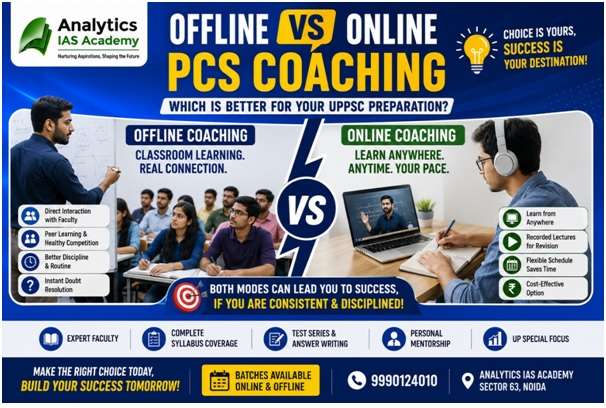
One of the biggest decisions every UPPSC aspirant makes before starting preparation is:
“Should I join Offline PCS Coaching or Online PCS Coaching?”
With the rapid growth of online education, AI-powered learning tools, recorded lectures, YouTube channels, digital notes, and mobile applications, aspirants have more choices than ever before.
At the same time, traditional classroom coaching continues to attract thousands of students because of structured learning, discipline, and mentorship.
This naturally creates confusion.
Some students believe offline coaching is outdated.
Others believe online coaching lacks accountability.
The truth lies somewhere in between.
The best learning mode depends on your goals, learning style, schedule, discipline, and preparation stage.
This guide will help you make an informed decision by comparing both approaches objectively.
Why Choosing the Right Coaching Mode Matters
UPPSC preparation is not just about reading books.
It involves:
- Understanding concepts.
- Developing analytical thinking.
- Building consistency.
- Practicing answer writing.
- Solving Previous Year Questions.
- Attempting mock tests.
- Receiving guidance and feedback.
The learning environment you choose influences all these aspects.
Selecting a coaching mode that matches your learning style can improve your preparation efficiency significantly.
What Is Offline PCS Coaching?
Offline coaching refers to traditional classroom learning where students attend physical classes at an institute.
Typical features include:
- Face-to-face interaction with faculty.
- Fixed classroom schedule.
- Physical classroom discussions.
- Peer learning.
- Immediate doubt resolution.
- Library facilities (where available).
- Classroom tests and assessments.
- Structured academic environment.
For many beginners, this environment provides discipline and routine.
What Is Online PCS Coaching?
Online coaching delivers learning through digital platforms.
Students attend live classes or recorded lectures from home.
Common features include:
- Live interactive classes.
- Recorded lecture access.
- Digital study material.
- Online tests.
- Mobile learning.
- Flexible study timings.
- Learning from any location.
This mode has become increasingly popular because of convenience and accessibility.
Offline vs Online PCS Coaching: A Detailed Comparison
- Learning Environment
Offline Coaching
The biggest strength of classroom coaching is the academic atmosphere.
Being surrounded by serious aspirants often improves concentration and motivation.
A dedicated classroom reduces distractions and encourages disciplined learning.
Students are more likely to remain focused during lectures.
Online Coaching
Online coaching provides flexibility but requires greater self-discipline.
Students study from home, where distractions such as social media, household responsibilities, and interruptions may affect consistency.
However, aspirants with strong self-management skills often perform exceptionally well through online learning.
Which Is Better?
For students who struggle with distractions, offline coaching often provides a more structured environment.
Students who are already disciplined may benefit greatly from online learning.
- Faculty Interaction
Offline Coaching
Students can interact directly with teachers during and after classes.
Body language, classroom discussions, and spontaneous questioning often enhance conceptual understanding.
Personal interaction also helps build confidence.
Online Coaching
Most quality online platforms now provide:
- Live doubt sessions.
- Chat support.
- Discussion forums.
- Digital mentorship.
Although interaction has improved significantly, it may still feel less personal than face-to-face communication.
Which Is Better?
For students who learn best through direct discussion, offline coaching has an advantage.
- Discipline and Consistency
Discipline is one of the strongest predictors of success in competitive examinations.
Offline Coaching
Regular class timings naturally create routine.
Students are expected to attend lectures consistently.
This external structure helps many beginners remain accountable.
Online Coaching
Online learning offers flexibility.
However, flexibility without discipline often becomes procrastination.
Students may postpone lectures repeatedly.
Recorded classes are valuable—but only when watched consistently.
Which Is Better?
If you require external accountability, offline coaching is generally more suitable.
If you can maintain a disciplined schedule independently, online coaching can be equally effective.
- Peer Learning
One of the most underrated aspects of preparation is learning from fellow aspirants.
Offline Coaching
Classroom discussions expose students to:
- Different perspectives.
- Better note-making techniques.
- Healthy competition.
- Group discussions.
- Collaborative learning.
Many aspirants improve simply by observing how others approach problems.
Online Coaching
Online communities, Telegram groups, discussion forums, and virtual study circles offer peer interaction.
However, digital engagement often lacks the spontaneity and depth of classroom discussions.
Which Is Better?
Offline classrooms generally provide a richer peer-learning experience.
- Doubt Resolution
Every aspirant faces conceptual doubts.
The speed and quality of clarification influence learning efficiency.
Offline Coaching
Students can ask questions immediately during class.
Faculty often explain concepts using additional examples and classroom discussions.
Immediate clarification prevents misconceptions.
Online Coaching
Modern online platforms provide doubt sessions and discussion groups.
Response quality depends on the institute’s support system.
Many reputed institutes now conduct dedicated doubt-clearing classes.
Which Is Better?
Both methods can be effective, but classroom interaction often enables faster clarification.
- Flexibility
This is where online coaching has a significant advantage.
Offline Coaching
Students must attend classes according to fixed schedules.
Travel time also becomes a factor.
Missing a class may result in learning gaps unless recordings are available.
Online Coaching
Students can:
- Learn from home.
- Rewatch lectures.
- Pause difficult concepts.
- Study according to their personal schedule.
This flexibility particularly benefits:
- Working professionals.
- College students.
- Aspirants living far from coaching hubs.
Which Is Better?
For flexibility, online coaching clearly has an advantage.
- Classroom Experience
Learning is influenced not only by content but also by the surrounding environment.
Offline Coaching
Whiteboard teaching.
Interactive discussions.
Faculty expressions.
Classroom energy.
Healthy competition.
These elements often improve engagement.
Online Coaching
Quality online teaching has improved considerably.
Smart boards.
Digital animations.
Recorded explanations.
Screen sharing.
Interactive quizzes.
These features make online learning increasingly effective.
Still, some learners continue to prefer the energy of physical classrooms.
Which Mode Suits Different Types of Aspirants?
The answer is not the same for everyone.
Beginners
Many beginners benefit from:
- Structured schedules.
- Regular classroom interaction.
- Faculty guidance.
- Peer learning.
- Discipline.
Offline coaching often provides these advantages.
Self-Disciplined Learners
Students who can manage their schedules independently may perform equally well through online coaching.
These learners value flexibility and efficient time management.
College Students
The ideal choice depends on college timings.
Students with rigid schedules may find online learning more convenient.
Those living near coaching centres may benefit from classroom teaching.
Working Professionals
Working professionals generally require:
- Flexible schedules.
- Recorded lectures.
- Weekend classes.
- Evening learning options.
Online coaching—or a hybrid approach—often aligns well with these needs.
Questions to Ask Before Choosing a Coaching Mode
Before enrolling, ask yourself:
- Am I self-disciplined?
- Do I learn better through classroom discussions?
- Can I maintain a fixed study schedule?
- How much travel time will classroom coaching require?
- Do I need recorded lectures for revision?
- Will I have enough time for self-study?
- Which mode fits my daily routine better?
Your answers are more important than popular opinions.
The Most Important Factor Isn’t Offline or Online
Many aspirants spend weeks debating coaching modes.
In reality, successful candidates focus on something else:
Consistency.
A disciplined student attending online classes regularly often performs better than an irregular classroom student.
Likewise, a committed classroom learner who revises consistently can outperform someone with access to unlimited digital resources.
The coaching mode supports your preparation.
It cannot replace your effort.
Cost Comparison: Offline vs Online PCS Coaching
For many aspirants, budget is an important factor.
However, coaching fees are only one part of the total cost.
Offline Coaching Costs
Apart from tuition fees, students may need to consider:
- Accommodation
- Food
- Transportation
- Library expenses
- Daily commuting
- Opportunity cost of relocation
For students moving to another city, the total investment can increase significantly.
Online Coaching Costs
Online learning usually eliminates:
- Travel expenses
- Hostel or rental costs
- Daily commuting
- Relocation costs
Students can prepare from their hometown while continuing college or employment.
Which is More Affordable?
For students already living near a coaching centre, the cost difference may be small.
For students relocating to another city, online coaching is often more economical.
However, affordability should never be the only deciding factor.
The best investment is one that improves your learning and consistency.
Time Management Comparison
Time is one of the most valuable resources during UPPSC preparation.
Offline Coaching
Advantages:
- Fixed study schedule
- Better routine
- Less procrastination
Challenges:
- Daily travel
- Fixed class timings
- Less flexibility
Online Coaching
Advantages:
- Learn anytime
- Recorded lectures
- Pause and revise difficult topics
- Suitable for irregular schedules
Challenges:
- Greater dependence on self-discipline
- Higher risk of distractions
Which Mode Is Better for Beginners?
Most beginners struggle with:
- Understanding the syllabus
- Choosing resources
- Developing discipline
- Building consistency
For these reasons, many beginners benefit from classroom learning because it provides:
- Structured guidance
- Faculty interaction
- Peer competition
- Fixed routine
However, motivated beginners with strong self-discipline can also perform exceptionally well through quality online programmes.
The key is consistency—not location.
Which Mode Is Better for Working Professionals?
Working professionals usually have:
- Limited study hours
- Office commitments
- Weekend availability
- Irregular schedules
For them, flexibility becomes extremely valuable.
Online coaching offers:
- Recorded lectures
- Weekend learning
- Evening study options
- Self-paced revision
If an institute also provides mentorship and regular assessments, online learning becomes even more effective.
Which Mode Is Better for College Students?
The answer depends on the student’s timetable.
If college timings are flexible and commuting is manageable, offline coaching can provide valuable classroom interaction.
If college schedules are demanding or travel is difficult, online coaching offers greater convenience.
Many students successfully combine college with online preparation.
Which Mode Is Better for Repeaters?
Repeat aspirants usually need:
- Better revision
- Test series
- Answer writing
- Mentorship
- Performance analysis
Instead of attending the same lectures again, repeaters often benefit more from targeted guidance, mock tests, and personalized feedback.
The ideal mode depends on the gaps identified in previous attempts.
The Rise of Hybrid Learning
Today’s preparation landscape is changing.
Many aspirants no longer view online and offline coaching as competing options.
Instead, they combine both.
A hybrid approach may include:
- Classroom learning for core subjects.
- Recorded lectures for revision.
- Online current affairs updates.
- Offline answer writing discussions.
- Digital mock tests.
- Personal mentorship.
This approach combines flexibility with structured guidance.
For many aspirants, hybrid learning offers the best balance.
Common Myths About Online Coaching
Myth 1
Online coaching is less effective.
Reality:
High-quality online programmes can be extremely effective when students remain disciplined.
Myth 2
Recorded lectures reduce seriousness.
Reality:
Recorded lectures allow multiple revisions, which often improve conceptual understanding.
The benefit depends on how consistently they are used.
Myth 3
Online students don’t clear competitive exams.
Reality:
Many successful candidates have prepared extensively using online resources.
The deciding factor remains preparation quality—not the delivery platform.
Common Myths About Offline Coaching
Myth 1
Joining classroom coaching guarantees selection.
Reality:
No coaching institute can replace self-study, revision, and consistent practice.
Myth 2
Offline students automatically remain disciplined.
Reality:
Class attendance alone does not ensure effective preparation.
Discipline outside the classroom matters equally.
Myth 3
More classroom hours mean better preparation.
Reality:
Learning requires revision, reflection, and practice—not just attendance.
Mistakes Students Make While Choosing a Coaching Institute
Instead of comparing only fees or advertisements, evaluate:
Faculty
- Experience
- Teaching methodology
- Conceptual clarity
Curriculum
Does it cover:
- Prelims
- Mains
- Current Affairs
- Answer Writing
- Test Series
Mentorship
Is personal guidance available?
Can students discuss preparation challenges?
Performance Evaluation
Does the institute conduct:
- Regular tests?
- Detailed feedback?
- Improvement tracking?
Learning Support
Look for:
- Doubt resolution
- Revision support
- Updated study material
- Academic consistency
Questions to Ask Before Joining Any Coaching
Before enrolling, ask yourself:
✔ Do I learn better in classrooms?
✔ Can I remain disciplined while studying online?
✔ How much travel time will I spend?
✔ Will I receive mentorship?
✔ Does the institute focus on concepts or only syllabus completion?
✔ Will I receive answer-writing guidance?
✔ Are mock tests integrated into the programme?
Choosing wisely today can save months of confusion later.
Frequently Asked Questions (FAQs)
- Is offline coaching better than online coaching for UPPSC?
Neither is universally better.
Offline coaching offers discipline and classroom interaction, while online coaching provides flexibility and accessibility.
The right choice depends on your learning style and circumstances.
- Can I crack UPPSC with online coaching?
Yes.
Many aspirants successfully prepare through online programmes when supported by disciplined study habits, regular revision, and mock tests.
- Which coaching mode is best for working professionals?
Online or hybrid learning generally suits working professionals because it offers flexibility and recorded lectures without requiring relocation or daily travel.
- Is classroom coaching necessary for beginners?
Many beginners benefit from structured classroom learning, but motivated students with a disciplined routine can also prepare effectively online.
- Should I relocate for PCS coaching?
Relocation may be helpful for some aspirants, but it is not essential.
Evaluate the quality of guidance, your budget, travel time, and your ability to study consistently before making this decision.
- Complete UPPSC Foundation Roadmap
- UPPSC Preparation from Zero
- UPPSC Preparation While Working
- Evening Preparation Strategy
- Time Management for UPPSC Aspirants
- Best Books for UPPSC Preparation
- Current Affairs Strategy for UPPSC
- UPPSC 120-Day Prelims Roadmap
- How to Choose the Right UPPSC Coaching
- UPPSC Answer Writing Strategy
Final Verdict
The debate should never be:
Offline vs Online
The real question is:
Which learning environment helps you stay consistent, disciplined, and focused over the long term?
If you thrive on classroom interaction, structured schedules, and peer learning, offline coaching may be the better fit.
If you value flexibility, recorded lectures, and location independence, online coaching may suit you better.
For many aspirants, a hybrid model—combining classroom guidance with digital revision and self-study—offers the strongest balance.
Ultimately, no coaching mode guarantees selection.
Selection depends on:
- Understanding the syllabus.
- Strong conceptual clarity.
- Regular revision.
- Mock test practice.
- Answer writing.
- Personal discipline.
- Consistent effort over time.
Choose the mode that aligns with your learning style—and then commit to it fully.
UPPSC Foundation Programme | Online + Offline
At Analytics IAS Academy, we believe every aspirant deserves a preparation model that fits their circumstances.
Whether you prefer offline classroom coaching, online learning, or a blended approach, our programmes are designed to provide:
What You’ll Receive
- ✅ Complete Prelims + Mains Coverage
- ✅ English Medium & Bilingual Batches
- ✅ Expert Faculty
- ✅ Personal Mentorship
- ✅ Daily Current Affairs
- ✅ Answer Writing Programme
- ✅ Chapter-wise & Full-Length Test Series
- ✅ Uttar Pradesh Special Preparation
📍 Analytics IAS Academy
Sector 63, Noida
📞 Call / WhatsApp: 9990124010
Book a counselling session, attend a demo class, and choose the learning path that matches your goals—not just the latest trend.