
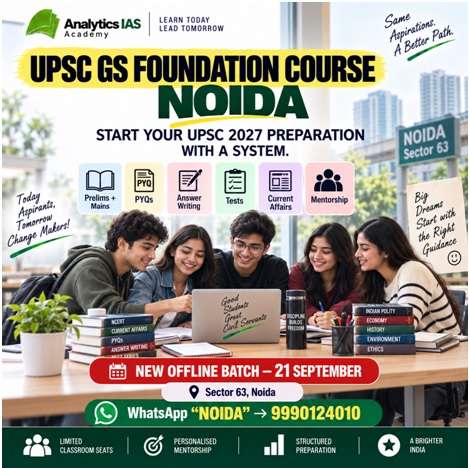
UPSC GS Foundation Course Noida: Complete Guide for UPSC CSE 2027 Aspirants
If you are searching for a UPSC GS Foundation Course Noida, the most useful question is not simply “Which coaching has the most classes?” A better question is: “Which preparation system will help me move from basic concepts to Prelims and Mains readiness?”
UPSC CSE preparation requires much more than syllabus coverage. Aspirants need conceptual clarity, understanding of previous-year questions (PYQs), objective practice for Prelims, analytical answer writing for Mains, current-affairs integration, revision, testing, evaluation and regular course correction.
For aspirants living in Noida and nearby NCR areas, an offline GS Foundation Course can also reduce avoidable commuting while providing a classroom environment, direct academic interaction and a structured preparation routine.
| A good UPSC GS Foundation Course in Noida should integrate General Studies fundamentals with Prelims and Mains preparation, PYQs, answer writing, regular tests, evaluation, current affairs, revision and mentorship. Beginners should also compare faculty access, batch environment, timetable, doubt resolution, fee transparency and commute before enrolling. |
What Is a UPSC GS Foundation Course?
A UPSC GS Foundation Course is a structured program intended to build the General Studies base required across the Civil Services Examination. Rather than treating each subject as an isolated lecture series, a well-designed foundation program should connect the UPSC syllabus with the way questions are actually asked.
For a beginner, the ideal progression is not “finish every book first and practise later.” A more exam-oriented cycle is:
| FOUNDATION PREPARATION CYCLE
SYLLABUS → CONCEPTS → PYQs → PRELIMS MCQs → MAINS ANSWER WRITING → TESTS → FEEDBACK → REVISION → IMPROVEMENT |
What Should a UPSC GS Foundation Course in Noida Include?
| Component | What it should achieve |
| GS conceptual foundation | Build clarity in core General Studies subjects from basics to exam-oriented application. |
| Integrated Prelims + Mains | Teach overlapping GS topics from both objective and analytical perspectives. |
| PYQ integration | Use previous-year questions to understand UPSC demand, depth and recurring themes. |
| Mains answer writing | Develop question interpretation, structure, relevance and time-bound writing. |
| Prelims practice | Build elimination, recall and objective problem-solving through MCQs. |
| Current affairs | Connect relevant contemporary developments with static GS subjects. |
| Tests + evaluation | Measure preparation and convert performance gaps into corrective action. |
| Revision | Create planned recall and consolidation checkpoints. |
| Mentorship | Help with prioritisation, progress review, resource discipline and course correction. |
| Doubt resolution | Prevent unresolved conceptual gaps from accumulating. |
Why Prelims and Mains Should Be Prepared in an Integrated Way
Prelims and Mains are different stages, but many General Studies topics overlap. Polity, Economy, History, Geography, Environment and other areas need both factual recall and analytical understanding.
For example, after learning a Polity concept, an aspirant should be able to recognise how it appears in Prelims MCQs, identify relevant PYQs, connect it with current developments and frame a concise Mains answer. This reduces duplication and helps build a single, usable knowledge base.
| ASK BEFORE JOINING
Does the classroom move from concept → MCQs → PYQs → Mains questions, or are Prelims and Mains treated as completely separate journeys? |
Why PYQs Should Be Part of Foundation Preparation
Previous-year questions are one of the clearest ways to understand what UPSC considers important. PYQs reveal how broad syllabus phrases are converted into actual questions, the depth expected, recurring themes and the distinction between merely knowing a topic and applying it.
A beginner should therefore not keep PYQs for the final months. They can be introduced alongside topics from the foundation stage so that preparation remains aligned with the examination.
When Should UPSC Mains Answer Writing Start?
Answer writing should begin progressively once a student has enough conceptual understanding to attempt a question. Waiting until the entire syllabus is over can postpone the development of a skill that requires repetition and feedback.
Early answer-writing practice can focus on basic question interpretation and structure. Over time, students can improve dimensions, examples, evidence, introductions, conclusions, presentation and time management.
| ANSWER-WRITING LOOP
LEARN → WRITE → EVALUATE → CORRECT → REWRITE → IMPROVE |
Tests Should Diagnose Gaps, Not Just Generate Marks
A test is valuable when it tells the aspirant what to change next. A low score may reflect weak recall, incomplete revision, conceptual gaps, poor question selection, time management or weak answer structure. Evaluation should help identify the cause.
| TESTING LOOP
TEST → FEEDBACK → IDENTIFY GAPS → CORRECTION → REVISION → RETEST |
How Current Affairs Should Connect With GS
Current affairs preparation can become overwhelming when it is treated as an endless stream of news. The more useful approach is to filter current developments through the UPSC syllabus and connect them with static subjects.
For example, a policy announcement may be relevant to Governance or Economy; a court judgment may enrich Polity; a climate development may connect Environment, Geography and international commitments. This integration makes current affairs usable in both Prelims and Mains.
Why Revision and Progress Tracking Matter
UPSC preparation is cumulative. Completing a topic once does not guarantee recall months later. A foundation program should therefore create revision checkpoints rather than only moving forward through the syllabus.
Progress tracking can be simple: what has been learned, revised, tested, evaluated and corrected. The purpose is not surveillance; it is to prevent silent backlogs from becoming unmanageable.
What Should Personal Mentorship Actually Do?
The word “mentorship” is common in coaching advertisements, so aspirants should ask what it means operationally. Useful academic mentorship should help a student make decisions and course-correct.
- Prioritise subjects and weekly tasks
- Reduce unnecessary resource switching
- Review test and answer-writing performance
- Identify recurring weak areas
- Plan revision and backlog recovery
- Resolve preparation-strategy confusion
- Maintain realistic academic targets
Is an Offline UPSC GS Foundation Course in Noida Right for You?
Offline coaching is not automatically better than online learning, and online learning is not automatically more flexible for every student. The right mode depends on how you learn and how consistently you can follow the program.
| Offline classroom may suit you if… | Online/self-directed learning may suit you if… |
| You benefit from a fixed routine and classroom environment. | You have strong self-discipline and need location flexibility. |
| You value direct faculty and peer interaction. | Your work/college schedule makes travel difficult. |
| You want regular in-person academic accountability. | You are comfortable asking doubts and practising independently online. |
| You live in Noida/NCR and can reach Sector 63 conveniently. | You live far from the centre or outside NCR. |
For Noida aspirants, commute should be treated as a practical preparation variable. Time saved is useful only if the academic quality and learning system are also strong.
Who Can Benefit From a GS Foundation Course for UPSC 2027?
Beginners starting UPSC preparation from zero
A structured sequence can reduce confusion about the syllabus, books, PYQs, current affairs and answer writing.
College students
Starting with a sustainable foundation can help build concepts before the preparation becomes exam-intensive.
Fresh graduates
A classroom system can create routine, measurable practice and regular feedback.
Self-study aspirants who feel stuck
If you have accumulated resources but lack a repeatable preparation cycle, structure may be more valuable than adding new material.
Aspirants postponing Mains practice
A program that introduces answer writing progressively can help build the skill before the Mains-specific phase.
Noida and nearby NCR aspirants
A Sector 63 classroom may be practical for students seeking to reduce long daily travel while retaining offline preparation.
10 Questions to Ask Before Joining Any UPSC Coaching in Noida
| Question | Why it matters |
| Are Prelims and Mains integrated from the foundation stage? | You need one coherent GS knowledge base with stage-specific practice. |
| How are PYQs used during teaching? | PYQs keep preparation aligned with actual UPSC demand. |
| When does answer writing begin? | Mains writing improves through repeated practice, not last-minute theory. |
| Are answers evaluated with actionable feedback? | Feedback should tell you what to improve. |
| How frequently are tests conducted and discussed? | Testing is useful when it drives revision and correction. |
| How is current affairs integrated with static GS? | This prevents current affairs from becoming disconnected material. |
| Is revision built into the academic calendar? | Retention requires planned repetition. |
| What exactly does mentorship include? | Ask for the mechanism, not the marketing label. |
| How are academic doubts resolved? | A clear doubt-resolution system prevents gaps from accumulating. |
| Can I understand the program before enrolling? | Counselling, course orientation or a centre visit can help assess fit. |
| Want a printable version of this 10-question checklist? WhatsApp “NOIDA” to 9990124010 and ask for the UPSC GS Foundation preparation plan. |
UPSC GS Foundation Course at Analytics IAS Academy, Noida
Analytics IAS Academy offers classroom UPSC preparation at Sector 63, Noida. Its current UPSC GS Foundation positioning includes integrated Prelims and Mains preparation, PYQ-oriented learning, answer-writing practice, tests and evaluation, current-affairs integration, mentorship and progress-focused guidance.
For the current campaign, the new offline UPSC GS Foundation classroom batch is scheduled to start on 21 September 2026.
| Batch detail | Current information |
| Course | UPSC GS Foundation Course |
| Target | UPSC CSE 2027 |
| Mode | Offline classroom |
| Location | Sector 63, Noida |
| New batch | 21 September 2026 |
| Contact / WhatsApp | 9990124010 |
| CTA keyword | NOIDA |
| Seat messaging | Limited Classroom Seats |
| GET THE COMPLETE PREPARATION PLAN
WhatsApp “NOIDA” → 9990124010. Ask about the course structure, Prelims–Mains integration, answer writing, tests, mentorship, current affairs and centre counselling before deciding. |
UPSC GS Foundation Course Noida: Frequently Asked Questions
What is a UPSC GS Foundation Course?
It is a structured General Studies preparation program designed to build the conceptual and examination-oriented base needed for UPSC CSE. A comprehensive course usually combines syllabus coverage with PYQs, Prelims practice, Mains answer writing, current affairs, tests, revision and guidance.
Which UPSC GS Foundation Course is suitable for beginners in Noida?
Beginners should compare academic structure rather than only brand or number of classes. Look for fundamentals, integrated Prelims and Mains preparation, PYQs, answer writing, tests, evaluation, revision, mentorship, doubt resolution and a manageable timetable.
Should UPSC Prelims and Mains be prepared together?
Many GS subjects overlap, so an integrated foundation can help students learn a topic once and practise its objective and analytical applications separately.
When should a UPSC 2027 beginner start answer writing?
A beginner can start gradually after gaining basic understanding of a topic. Early practice can focus on question interpretation and simple structure, then improve through evaluation and repetition.
Are PYQs important in a GS Foundation Course?
Yes. PYQs help aspirants understand the level, pattern, recurring themes and application expected by UPSC. They are useful from the foundation stage rather than only before the exam.
Is offline UPSC coaching in Noida useful?
It can be useful for aspirants who benefit from a fixed classroom routine, direct interaction and regular academic accountability. The final decision should also consider faculty, course structure, timetable, commute and personal learning style.
Where is Analytics IAS Academy in Noida?
The Noida classroom centre is in Sector 63, Noida. Aspirants should confirm current batch timings and visit details directly before travelling.
When does the new UPSC GS Foundation batch in Noida start?
The current campaign is for a new offline classroom batch starting 21 September 2026 at Sector 63, Noida.
How can I get the Analytics IAS UPSC GS Foundation Course details?
Call or WhatsApp 9990124010. For this campaign, send the word “NOIDA” to request the complete preparation plan and counselling details.
Final Takeaway
If you are searching for a UPSC GS Foundation Course Noida, compare the preparation system before comparing promotional claims. A strong foundation should help you understand the syllabus, learn core concepts, use PYQs intelligently, practise for Prelims, write for Mains, integrate current affairs, test yourself, receive feedback, revise and improve.
For aspirants who want to explore the current Analytics IAS Academy offline GS Foundation batch in Sector 63, Noida, the next step is to understand the academic structure and decide whether it fits your preparation needs.
| NEW OFFLINE BATCH — 21 SEPTEMBER 2026 |
