
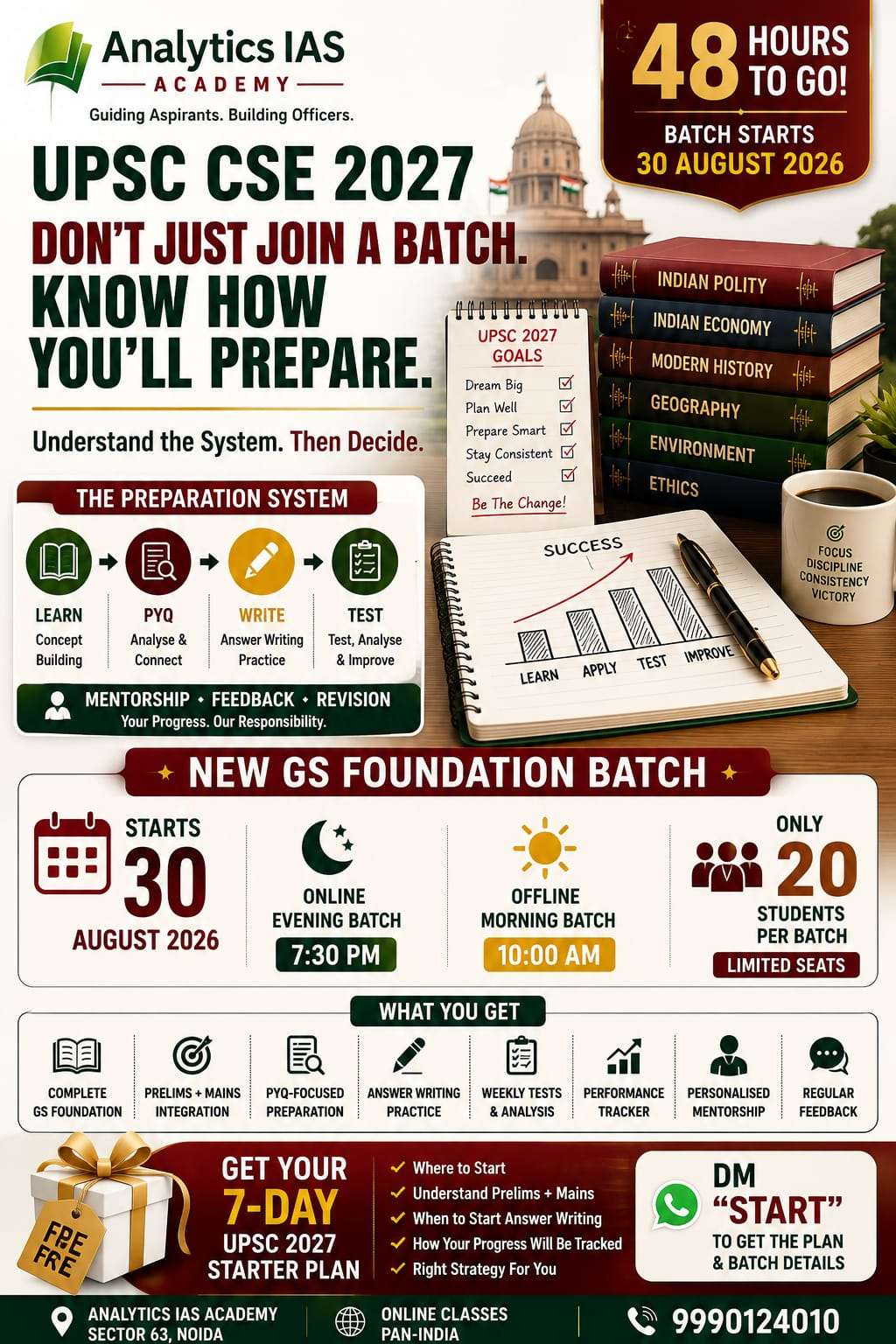
Starting your UPSC CSE 2027 preparation? Before joining a UPSC Foundation Course, do not evaluate it only by the number of classes, books, notes or study hours being offered. Ask a more important question: What happens after the class?
| LEARN → PYQ → WRITE → TEST → FEEDBACK → REVISE → IMPROVE |
1. Start With Concept Building, Not Resource Collection
One of the most common mistakes beginners make is collecting too many books, PDFs and strategy videos before understanding what UPSC actually demands. Your foundation preparation should first help you understand the syllabus and exam pattern, GS fundamentals, what to study and what to avoid, limited and reliable sources, and how to build a sustainable study and revision plan.
A strong foundation is not about studying everything. It is about learning what matters and studying it systematically.
2. Prepare Prelims + Mains Together
Prelims and Mains have different question formats, but much of the General Studies foundation overlaps. While studying Indian Polity, for example, Prelims preparation should focus on concepts, constitutional provisions, statements, distinctions and MCQs, while Mains preparation should develop analysis, arguments, examples and structured answers.
This helps a beginner develop an integrated UPSC preparation approach instead of treating Prelims and Mains as completely separate journeys.
3. Make PYQs Part of Your Preparation
UPSC Previous Year Questions (PYQs) should not be kept for the end of syllabus completion. After completing a topic, ask how UPSC has tested it before, which themes recur, what level of understanding is expected, and how the same topic may appear differently in Prelims and Mains.
Use a simple cycle: TOPIC → PYQ → UNDERSTAND DEMAND → REVISE BETTER. PYQs can help transform preparation from resource-oriented learning into examination-oriented learning.
4. Do Not Wait Too Long to Start Answer Writing
Many beginners think: “First I will complete the syllabus. Then I will start Mains answer writing.” Instead, begin gradually once your basic understanding develops.
Learn to identify: QUESTION DEMAND → INTRODUCTION → STRUCTURED BODY → ANALYSIS → EXAMPLES → CONCLUSION.
Your first answers do not need to be perfect. The objective is to gradually learn how to convert knowledge into a clear, relevant and structured UPSC Mains answer.
5. Weekly Tests Should Lead to Improvement
Simply taking more tests is not enough. After every test, identify conceptual gaps, revision gaps, repeated mistakes, weak subjects, question interpretation problems and answer-writing weaknesses. Then work specifically on those areas.
TEST → ANALYSE → CORRECT → REVISE → RETEST
This makes testing part of the learning process rather than merely a score-generating exercise.
6. Ask What “Mentorship” Actually Means
Almost every UPSC course may mention mentorship. Before joining, ask what that mentorship actually includes. Will someone help you understand where you are falling behind, which areas need revision, why test scores are not improving, which mistakes are recurring, whether your strategy is working, and what you should do next?
Useful mentorship should provide academic direction, feedback and course correction – not merely motivation.
UPSC CSE 2027 GS Foundation Course – New Batch
Analytics IAS Academy is starting a new 1-Year UPSC CSE 2027 GS Foundation Batch.
Batch Starts: 30 August 2026
- Complete GS Foundation
- Integrated Prelims + Mains Preparation
- PYQ-Focused Learning
- Answer Writing Practice
- Weekly Tests & Analysis
- Performance Tracking
- Personalised Mentorship
- Regular Feedback & Course Correction
Only 20 Students Per Batch
The limited batch size is designed to create greater scope for student interaction, doubt resolution, academic feedback and personalised attention.
Online + Offline Batch Options
Online Evening Batch – 7:30 PM
Suitable for college students, working professionals and UPSC CSE 2027 aspirants preparing from across India.
Offline Morning Batch – 10:00 AM
Classroom GS Foundation preparation at Analytics IAS Academy, Sector 63, Noida.
Who Can Consider This Batch?
- UPSC 2027 beginners starting from scratch
- College students beginning their preparation early
- Working professionals looking for an evening UPSC batch
- Self-study aspirants looking for structure and accountability
- Aspirants seeking regular tests, mentorship and feedback
Before You Join, Understand the System
Do not select a UPSC Foundation Course simply because an advertisement calls it the “best.” Ask: How will I learn? How will PYQs be integrated? When will I start answer writing? How will I be tested? How will my progress be tracked? Who will identify my mistakes? How will I know what to improve next?
A good preparation system should help you answer these questions clearly.
Get the Free 7-Day UPSC 2027 Starter Plan
Still confused about where to begin? Start by understanding how the first few days of your UPSC preparation can be structured.
- Where to start
- How to approach Prelims + Mains
- How to use PYQs
- When to begin answer writing
- How to test yourself
- How to track your progress
- How to build the right preparation strategy
DM “START” for the Starter Plan + Batch Details.
Batch at a Glance
| Course | UPSC CSE 2027 – 1-Year GS Foundation |
| Batch Starts | 30 August 2026 |
| Online Evening Batch | 7:30 PM |
| Offline Morning Batch | 10:00 AM |
| Batch Size | Only 20 Students |
| Offline Location | Analytics IAS Academy, Sector 63, Noida |
| Online Classes | Pan-India |
| Contact | 9990124010 |
Frequently Asked Questions
- Which UPSC Foundation Course is suitable for beginners?
A beginner should look for a structured course that combines GS fundamentals, Prelims and Mains preparation, PYQs, answer writing, tests, revision, mentorship and regular academic feedback.
- Should UPSC Prelims and Mains be prepared together?
An integrated approach can help aspirants connect the same GS concepts with both objective Prelims questions and analytical Mains requirements.
- When should beginners start solving UPSC PYQs?
PYQs can be introduced during the foundation stage itself. They help aspirants understand question patterns, recurring themes and the depth required for different topics.
- Should UPSC beginners start answer writing early?
Beginners can start gradually after developing basic conceptual understanding. Initially, the focus should be on understanding the demand of the question and learning proper answer structure.
- Is there an evening UPSC Foundation Course for working professionals?
Yes. The upcoming Analytics IAS Academy online GS Foundation batch is scheduled for 7:30 PM, making it a convenient option for many working professionals and college students.
- Is an offline UPSC Foundation batch available in Noida?
Yes. The offline morning GS Foundation batch is scheduled for 10:00 AM at Analytics IAS Academy, Sector 63, Noida.
- When does the new UPSC CSE 2027 GS Foundation batch start?
The new batch starts on 30 August 2026.
Final Takeaway
UPSC preparation is not simply: CLASS → NOTES → NEXT CLASS.
A stronger preparation cycle is: LEARN → UNDERSTAND → PYQ → APPLY → WRITE → TEST → GET FEEDBACK → REVISE → IMPROVE
Before choosing your UPSC Foundation Course for 2027, understand whether the program helps you complete this entire cycle.
DON’T JUST JOIN A BATCH. KNOW HOW YOU’LL PREPARE.
Analytics IAS Academy
UPSC CSE 2027 – 1-Year GS Foundation
New Batch Starting 30 August 2026
Sector 63, Noida | Online Pan-India
9990124010
