
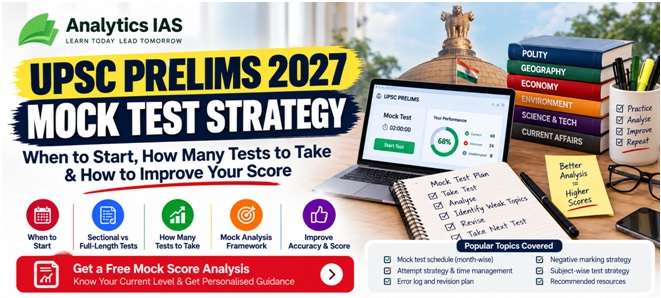
Quick answer: When should you start mock tests for UPSC Prelims 2027?
Start topic-wise practice as soon as you complete a chapter, sectional tests once you have covered a meaningful cluster of topics, and full-length mocks when you can review them productively. You do not need to wait until the entire syllabus is finished. For most aspirants preparing from October 2026, the best approach is to begin with low-stakes diagnostic and sectional practice now, then increase full-paper frequency closer to Prelims. The right number of tests depends on your baseline, time available and quality of review—not a universal target.
A mock test is a measurement tool, not a verdict on your chances. The real benefit comes from the sequence: attempt → analyse → repair knowledge gaps → revise → retest.
Build mock testing into your wider plan: UPSC Prelims 2027 preparation strategy
Why do aspirants take many mocks but still see no score improvement?
The usual problem is not a shortage of question papers. It is shallow review: checking the answer key, highlighting a few explanations, and moving to the next test. A score improves when you learn whether you lacked the concept, misread a statement, fell for a distractor, guessed badly or ran out of time.
Avoid treating mock-test rankings as a prediction of UPSC performance. Mock providers differ in difficulty, question design and cohort composition. Track your own accuracy, net marks and repeated mistakes across comparable tests.
Sectional tests vs full-length mocks: Which should you take?
| Format | Best use | Common mistake |
| Topic-wise MCQs | Immediately after a topic; test basic recall and application | Memorising answers without understanding options |
| Sectional tests | After a unit such as Polity or Economy; identify subject gaps | Overinterpreting a score from an unusually narrow topic mix |
| Full-length GS mocks | Practise question selection, endurance and time management | Taking too many without sufficient review |
| Full-length CSAT mocks | Check qualifying readiness and two-hour pacing | Ignoring CSAT because it is qualifying |
Keep GS Paper I and CSAT preparation distinct in your tracker. GS Paper I determines Prelims merit subject to the qualifying CSAT requirement under the current pattern.
A realistic mock-test schedule for UPSC Prelims 2027
| Preparation phase | Suggested frequency | Priority |
| Oct–Dec 2026 | Topic-wise questions 3–5 days/week; one sectional test every 1–2 weeks | Build concepts and start an error log |
| Jan–Feb 2027 | One sectional or mixed test weekly; periodic full-length diagnostic | Spot cross-subject gaps |
| Mar–Apr 2027 | Approximately one full GS mock/week, plus targeted sectional practice | Improve accuracy and time allocation |
| Final 6–8 weeks before exam | Approximately 1–2 full GS mocks/week if review time allows; regular timed CSAT papers | Stabilise performance, revise and avoid burnout |
These are planning ranges, not compulsory counts. Adjust after the official UPSC 2027 exam calendar and notification are confirmed. A candidate with weak basics may benefit more from focused revision than from adding another full mock.
How many mock tests should you take before UPSC Prelims 2027?
There is no evidence-based magic number such as 50 or 100. A better planning question is: “How many tests can I analyse properly?” For example, 20 carefully reviewed full mocks combined with sectional tests and PYQs may be more valuable than 60 hurried attempts. Choose a sustainable mix and track whether your performance is becoming more consistent.
Use a review-to-test ratio: reserve at least as much time for checking explanations, revisiting sources and updating the error log as you spend attempting a test. Hard tests or large knowledge gaps may need substantially longer review.
Understand marks, negative marking and accuracy
Under the current UPSC Civil Services Prelims GS Paper I pattern, there are 100 questions for 200 marks, with one-third of the marks assigned to a question deducted for an incorrect answer. Thus a correct GS Paper I answer earns 2 marks, an incorrect answer loses approximately 0.67 marks, and an unattempted question earns zero. Always verify the instructions in the applicable UPSC 2027 notification.
Net GS mock marks = (correct × 2) − (incorrect × 2 ÷ 3). Accuracy = correct ÷ attempted × 100.
| Example | Attempted | Correct | Wrong | Net marks |
| Candidate A | 80 | 55 | 25 | 93.33 |
| Candidate B | 70 | 55 | 15 | 100.00 |
| Candidate C | 75 | 50 | 25 | 83.33 |
These are illustrative calculations, not safe-score cutoffs. Candidate B scores more than A with the same number of correct answers because B makes fewer errors. “Attempt more” is therefore not always the right advice.
How to analyse a UPSC mock test: The 7-step method
1. Record the raw performance
Log net marks, attempted questions, correct/incorrect answers, accuracy, time remaining and your confidence on each answer.
2. Separate knowledge gaps from decision errors
Label mistakes as concept gap, factual gap, misreading, poor elimination, overconfidence, time pressure or careless marking.
3. Explain every option
For statement-based questions, check why each statement is right or wrong. Note qualifiers such as only, all and always, but never assume they are automatically false.
4. Map errors to micro-topics
Replace broad tags like “Economy” with specific tags such as inflation transmission, budget terminology or external-sector concepts.
5. Fix the source material
Return to your core notes, textbook or authoritative source. Add one short correction; avoid creating a second bulky notebook of copied solutions.
6. Retest the mistake
After a few days, attempt the same concept through a fresh question or without seeing the original answer.
7. Change your next week’s plan
Choose the two or three weaknesses costing you the most marks and prioritise them before the next test.
Benchmark your mock-test learning against actual examination questions: Official UPSC previous-year question papers
The mock-test error log you should maintain
| Question / micro-topic | Error type | One correction | Retest |
| Polity: constitutional vs statutory bodies | Concept confusion | Revise classification and legal basis | 3 days |
| Economy: monetary policy | Cause-effect overstatement | Review policy transmission | 7 days |
| Environment: protected areas | Factual classification | Compare categories and governing laws | 7 days |
| Geography: map-based question | Weak recall | Revise relevant map and location | Next sectional test |
The entries above are examples. Your tracker should be populated from your actual attempts, not from a generic “important topics” list.
How to decide which questions to attempt or skip
Practise a two-pass approach. First, answer questions you can solve confidently within a reasonable time. In the second pass, revisit questions where you can narrow options using genuine knowledge. Avoid blind guessing or applying a fixed “attempt 90 questions” rule. Test your personal accuracy at different confidence levels to understand when an extra attempt helps or hurts your net marks.
For a question with four options and one-third negative marking, random guessing has approximately zero expected marks under ideal equal probabilities; it still adds variance and can lower your score on the day. Elimination improves expected value only when it is grounded in reliable reasoning.
What to do when your mock scores are stuck
- If accuracy is low: reduce new test volume temporarily and repair the two weakest micro-topics.
- If accuracy is good but attempts are low: practise timed mixed sets and quicker skip decisions.
- If scores fluctuate sharply: compare test difficulty and check whether weak subjects are disproportionately represented.
- If you repeatedly forget facts: build short retrieval quizzes and scheduled revision.
- If CSAT is near the qualifying threshold: add separate timed CSAT practice and diagnose comprehension, numeracy and reasoning errors.
A seven-day score-improvement challenge
| Day | Action |
| 1 | Take one sectional or full mock under timed conditions |
| 2 | Analyse all incorrect answers and uncertain correct answers |
| 3 | Revise the two weakest micro-topics from core sources |
| 4 | Solve 25–30 new MCQs linked to those topics |
| 5 | Practise a timed mixed set; review attempt decisions |
| 6 | Retest previously missed concepts without notes |
| 7 | Compare accuracy and write three changes for next week |
Watch More: Analytics IAS Academy YouTube
Explore lessons from the official Analytics IAS channel relevant to MCQ preparation and PYQ analysis. The following channel-search links help locate videos without misidentifying a specific video or claiming an unverified title.
Analytics IAS videos on UPSC Prelims strategy
Analytics IAS videos on previous-year questions
Analytics IAS videos on mock tests and MCQ practice
Official Analytics IAS Academy YouTube channel
Read More: Related UPSC 2027 preparation resources
UPSC Prelims 2027 preparation strategy
UPSC 2027 preparation strategy: first 90 days
UPSC 2027 NCERT and standard-book list
UPSC GS Foundation Course 2027
Frequently asked questions
When should beginners start UPSC Prelims 2027 mock tests?
Start topic-wise questions as soon as you finish a chapter. Add sectional tests as topics accumulate, and full mocks when you can review them meaningfully.
How many full-length mocks are enough for UPSC Prelims 2027?
There is no fixed number. Choose a sustainable schedule based on your preparation stage, error rate and review capacity.
Should I take mocks before finishing the UPSC syllabus?
Yes, particularly topic-wise and sectional practice. Early diagnostic tests show what to study; they need not be treated as a prediction of final performance.
How do I improve mock-test accuracy?
Track why each error happened, revise the underlying concept, practise targeted questions and retest after a gap.
Is a low mock-test score a bad sign?
Not necessarily. Mock difficulty and syllabus coverage vary. A low score is useful when it produces a concrete correction plan.
How should I balance GS mocks and CSAT?
Practise both. GS Paper I is used for Prelims merit, while CSAT is qualifying under the current examination structure.
Should I attempt more questions to increase my marks?
Only when your additional attempts are supported by knowledge or effective elimination. More incorrect answers can reduce net marks.
Want personalised feedback on your UPSC mock scores?
If you are preparing for UPSC CSE 2027, a mock score is only the beginning. Analytics IAS Academy can help you discuss your current preparation, weak subjects and suitable GS Foundation learning options. Ask the academy whether a complimentary mock-score review or counselling slot is currently available; availability should be confirmed before publication.
Analytics IAS Academy | Sector 63, Noida | Classroom and live-online UPSC preparation | Call/WhatsApp: 9990124010
Explore UPSC GS Foundation Course 2027 and enquire
Your next mock-test goal: identify the three mistakes that cost you the most marks, fix them, and measure whether they recur. Share your biggest mock-test challenge in the comments: accuracy, time management, revision or negative marking.