
Introduction
One of the first pieces of advice every UPSC aspirant receives is:
“Read The Hindu daily.”
Sounds simple.
But within a few days, most beginners face the same challenges:
- The newspaper takes 2–3 hours to finish.
- They don’t know which pages to read.
- They highlight almost everything.
- They make lengthy notes they never revise.
- They still struggle to answer UPSC questions.
Eventually, many aspirants stop reading the newspaper altogether.
The problem isn’t The Hindu.
The problem is not having a structured strategy.
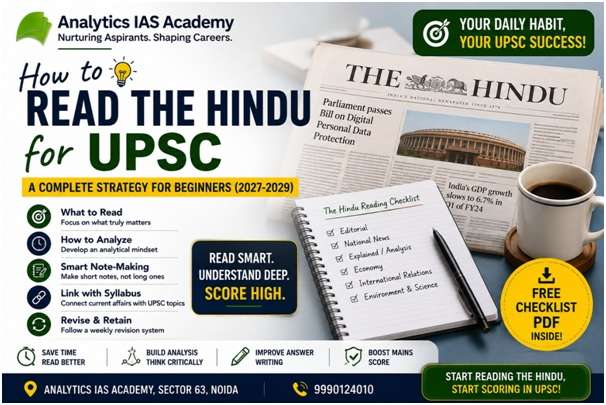
In this guide, you’ll learn how to read The Hindu for UPSC in 60–75 minutes, what to read, what to skip, how to make concise notes, and how to connect newspaper reading with the UPSC syllabus.
At the end, you can also download our FREE “The Hindu Reading Checklist PDF” to make your newspaper reading systematic and time-efficient.
Why The Hindu Is Important for UPSC
UPSC increasingly asks analytical questions rather than factual ones.
A good newspaper helps you:
- Understand governance and public policy.
- Improve answer-writing content.
- Build balanced opinions.
- Link current affairs with static subjects.
- Develop editorial analysis skills.
- Prepare for the Essay and Interview stages.
Reading The Hindu is not about memorising news—it’s about understanding issues.
Biggest Myth About Reading The Hindu
Many beginners believe:
“I have to read every page every day.”
This is the biggest mistake.
UPSC does not expect you to become a journalist.
Your goal is to become a civil servant who can:
- identify relevant issues,
- analyse them,
- and apply them in answers.
You should read selectively, not exhaustively.
The Biggest Mistakes Beginners Make
❌ Mistake 1: Reading Every Article
Not every article is useful.
Examples often skipped:
- Celebrity news
- Entertainment
- Crime reports (unless linked to policy or governance)
- Local political accusations
- Sports results
- Advertisements
- Share market fluctuations (unless policy-related)
❌ Mistake 2: Spending Three Hours Daily
Many aspirants believe longer newspaper reading means better preparation.
Wrong.
Ideally:
60–75 minutes
is enough for most beginners.
The remaining time should go towards:
- NCERTs
- Standard books
- PYQs
- Revision
- Answer writing
❌ Mistake 3: Making Huge Notes
Don’t rewrite entire editorials.
Instead, note:
- Issue
- Background
- Key facts
- Government initiatives
- Challenges
- Way forward
One page is usually enough.
❌ Mistake 4: Reading Without the UPSC Syllabus
Every article should answer one question:
“Which part of the UPSC syllabus does this belong to?”
Examples:
- Parliament → Polity
- Inflation → Economy
- Climate Summit → Environment
- India–US relations → International Relations
- Supreme Court judgments → Governance & Constitution
❌ Mistake 5: Memorising Instead of Understanding
UPSC rarely asks:
“What happened yesterday?”
It asks:
“Why did it happen?”
“What are its implications?”
“What reforms are needed?”
Think analytically.
What Should You Read in The Hindu?
- Front Page
Read only important national developments.
Ignore political statements and routine events.
- National News
Focus on:
- Parliament
- Government schemes
- Bills
- Policies
- Constitutional bodies
- Supreme Court judgments
- Election Commission
- Governance reforms
- Editorial Page (Most Important)
The editorial page builds:
- Analytical thinking
- Essay content
- Mains answer enrichment
Ask while reading:
- What is the issue?
- Why is it important?
- Different viewpoints?
- Possible solutions?
- Explained / Analysis Sections
These simplify complex topics.
Read carefully.
- Economy
Read about:
- Inflation
- RBI
- Budget
- Fiscal policy
- Monetary policy
- GDP
- Employment
- Agriculture
- Taxation
- International Relations
Focus on:
- India’s foreign policy
- G20
- BRICS
- QUAD
- BIMSTEC
- SCO
- India–China
- India–US
- India–Neighbourhood
- Environment & Science
Read about:
- Biodiversity
- Climate change
- Renewable energy
- ISRO
- Biotechnology
- AI
- Health policies
What Can You Skip?
Skip:
❌ Celebrity interviews
❌ Film reviews
❌ Sports scores
❌ Local crime
❌ Party politics
❌ Advertisements
❌ Obituaries (unless nationally significant)
Selective reading saves valuable preparation time.
The 7-Step The Hindu Strategy
Step 1: Open with the UPSC Syllabus
Know what you’re looking for.
Step 2: Scan Headlines
Identify relevant stories first.
Step 3: Read Editorials Actively
Ask:
- Why?
- How?
- Impact?
- Way forward?
Step 4: Make Short Notes
Keep notes in this format:
Topic
↓
Background
↓
Current issue
↓
Challenges
↓
Government response
↓
Way forward
Step 5: Link with Static Subjects
For example:
Water dispute
↓
Polity + Geography + Environment
Step 6: Revise Weekly
Don’t let notes pile up.
Every Sunday:
Revise the week’s issues.
Step 7: Solve PYQs
Search whether UPSC has asked similar questions before.
This develops exam-oriented thinking.
How Long Should Newspaper Reading Take?
Beginner
60–75 minutes
Intermediate
45–60 minutes
Experienced
30–40 minutes
Efficiency improves with practice.
Current Affairs Note-Making Strategy
Keep one digital or physical notebook with sections such as:
- Polity
- Economy
- IR
- Environment
- Society
- Science & Technology
- Ethics Examples
- Essay Examples
Avoid making separate notes for every article.
Organise by subject instead.
The Hindu Strategy for College Students
- Read one editorial daily.
- Make concise notes.
- Connect with NCERTs.
- Revise every weekend.
The Hindu Strategy for Working Professionals
Limited time?
Prioritise:
- Editorial
- Explained
- Economy
- National
- International Relations
Skip low-value content.
Common Beginner Mistakes
❌ Reading line by line
❌ Making lengthy notes
❌ No revision
❌ Ignoring editorials
❌ No syllabus linkage
❌ Not solving PYQs
Weekly Newspaper Routine
Monday–Saturday
- Read newspaper (60 minutes)
- Make brief notes
- Link with syllabus
Sunday
- Revise notes
- Update current affairs notebook
- Solve 5–10 related PYQs or Mains questions
Frequently Asked Questions
Is The Hindu enough for UPSC?
It is an excellent source for current affairs, but it should be complemented with standard books, revision, PYQs, and practice questions.
Should I make notes every day?
Yes—but keep them concise and topic-based, not article-based.
How many editorials should I read?
Usually one or two important editorials are enough.
Quality matters more than quantity.
Can I skip The Hindu and rely only on monthly magazines?
Monthly compilations are useful for revision, but regularly reading a quality newspaper helps build analytical thinking and issue-based understanding that compilations alone may not fully develop.
Final Thoughts
Reading The Hindu is not about finishing a newspaper.
It is about learning to think like a future civil servant.
Read selectively.
Understand deeply.
Make concise notes.
Revise consistently.
Connect every issue with the syllabus.
That approach will help your newspaper reading become one of the strongest parts of your UPSC preparation.
🎁 FREE Download: The Hindu Reading Checklist PDF
We’ve created a FREE “The Hindu Reading Checklist PDF” to help beginners build a consistent current affairs routine.
It includes:
✅ Daily Newspaper Checklist
✅ Editorial Analysis Template
✅ Current Affairs Note Format
✅ Weekly Revision Planner
✅ Monthly Current Affairs Tracker
✅ PYQ Linking Sheet
Need Guidance?
If you’re confused about current affairs, NCERTs, answer writing, or building a complete UPSC study plan, our mentors can help you create a structured preparation strategy.
📍 Analytics IAS Academy
Sector 63, Noida
📅 GS Foundation Batch Starts: 10 August
📅 Sociology Optional Batch Starts: 20 August
📞 Call/WhatsApp: 9990124010
💬 Comment “HINDU” to receive the FREE The Hindu Reading Checklist PDF and start reading the newspaper with a clear, exam-oriented strategy.