
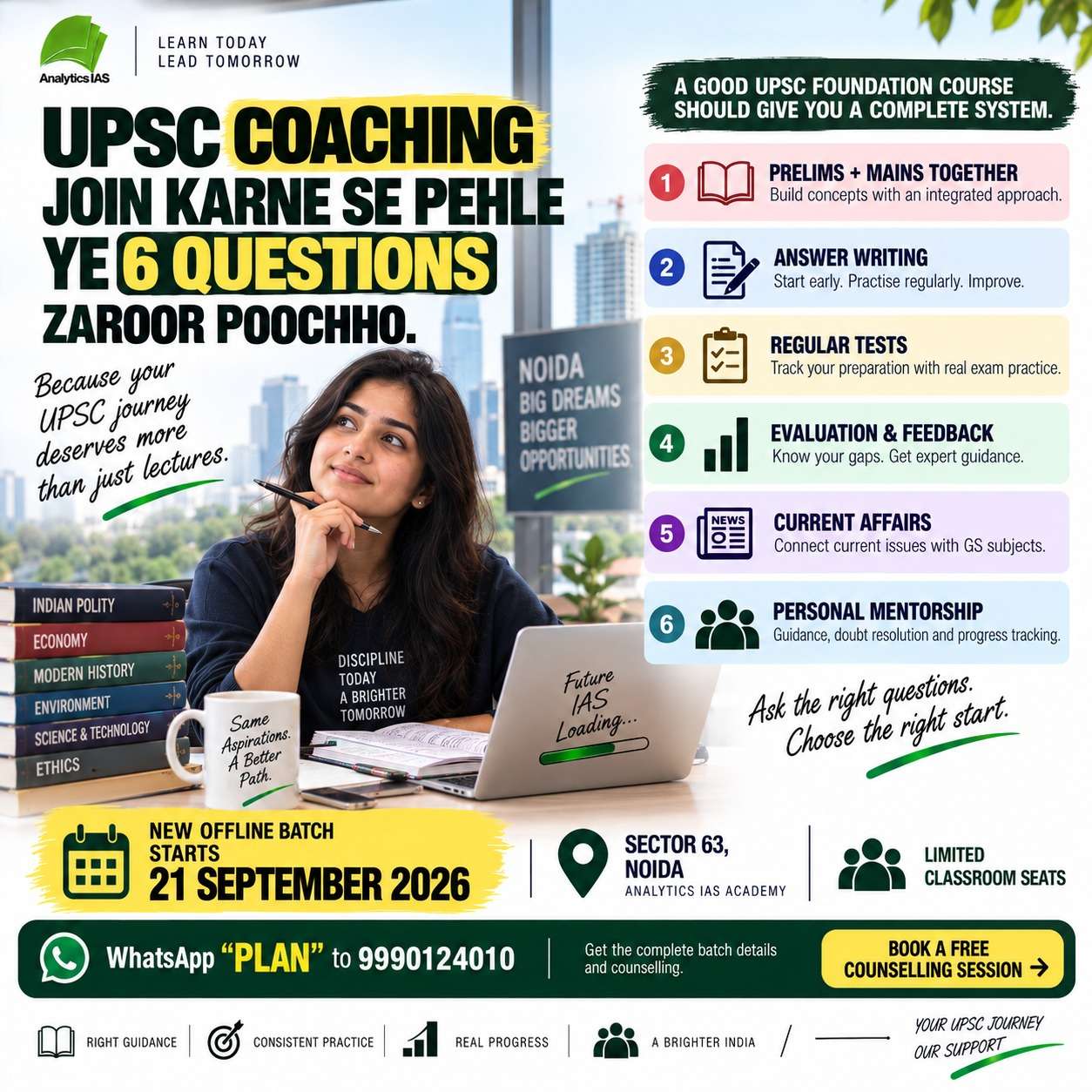
Searching for a UPSC Foundation Course in Noida can quickly become confusing. Almost every program promises syllabus coverage, study material, tests and guidance. But for a serious UPSC CSE 2027 aspirant, the real question is not how many features appear in a brochure. It is whether those features work together as a preparation system.
A foundation course should help a beginner move from basic understanding to examination-oriented preparation: syllabus awareness, conceptual clarity, PYQs, Prelims practice, Mains answer writing, revision, testing, feedback and course correction.
| BEFORE YOU JOIN
Do not ask only: “How many classes will I get?” Ask: “What preparation system will these classes create?” |
What Should a Good UPSC Foundation Course Include?
For most beginners, a comprehensive GS Foundation program should ideally include the following elements:
| Core component | What to look for |
| GS fundamentals | Clear syllabus-based teaching from basics to exam-level application |
| Prelims + Mains | Integrated preparation rather than two disconnected tracks |
| PYQs | Regular use of previous-year questions to understand UPSC demand |
| Answer writing | Progressive Mains practice from the foundation stage |
| Tests | Topic-wise and cumulative testing at planned intervals |
| Evaluation | Actionable feedback, not marks alone |
| Current affairs | Integration with static GS topics |
| Revision | Built-in revision checkpoints and consolidation |
| Mentorship | Progress review, prioritisation and course correction |
| Doubt resolution | A practical mechanism to clear academic doubts |
1. Does the Course Start With the UPSC Syllabus and PYQs?
A beginner can waste months studying good material in the wrong order. The syllabus defines the scope; previous-year questions reveal how UPSC tests that scope. A strong Foundation Course should repeatedly connect topics to both.
| GOOD PREPARATION FLOW
SYLLABUS → CONCEPT → PYQ → PRACTICE → REVISION → TEST |
2. Are Prelims and Mains Prepared Together?
Prelims and Mains require different forms of application, but much of the GS knowledge base overlaps. Teaching a topic only as facts for Prelims or only as descriptive material for Mains can create gaps.
For example, a Polity topic should progressively connect constitutional concepts, objective questions, PYQs, contemporary relevance and analytical Mains questions. This helps an aspirant build one integrated knowledge base.
3. When Does Mains Answer Writing Begin?
This is one of the most important questions to ask before joining UPSC coaching in Noida. Many beginners postpone answer writing until they believe the syllabus is complete. The problem is that answer writing is a skill, not merely a test of knowledge.
- Understanding the directive
- Identifying the exact demand
- Structuring introduction, body and conclusion
- Selecting relevant dimensions
- Using examples and evidence
- Writing within word and time limits
| ANSWER-WRITING LOOP
LEARN → WRITE → EVALUATE → CORRECT → REWRITE → IMPROVE |
4. Are Tests Followed by Analysis and Feedback?
A test becomes useful when it changes what you do next. Marks alone cannot tell you whether the problem is weak recall, conceptual confusion, poor question interpretation, lack of revision or ineffective answer structure.
| TESTING LOOP
TEST → ANALYSE → IDENTIFY GAPS → REVISE → RETEST |
5. How Is Current Affairs Integrated With Static GS?
Current affairs should not become a separate pile of monthly material. A good GS Foundation Course should help students connect relevant developments to Polity, Economy, Geography, Environment, International Relations, Governance, Society and other syllabus areas.
The objective is not to memorise every headline. It is to recognise what is relevant to the UPSC syllabus and how it can enrich Prelims and Mains preparation.
6. Is Revision Built Into the Course?
Syllabus completion without revision can create an illusion of progress. UPSC preparation requires repeated recall and consolidation. Before joining, ask whether the academic plan creates revision checkpoints or simply keeps moving to the next topic.
| A SIMPLE RULE
Completion tells you what you have studied. Revision and testing tell you what you can actually retrieve and apply. |
7. What Does ‘Personal Mentorship’ Actually Mean?
Mentorship is useful only when it is operational. It should help an aspirant review progress, identify weak areas, prioritise the next set of tasks and course-correct when preparation drifts.
- What should I prioritise this week?
- Where am I falling behind?
- Why are my test scores not improving?
- Am I using too many resources?
- What should I revise next?
- How should my preparation change after feedback?
8. Can Students Resolve Academic Doubts?
A Foundation Course is a long academic journey. Doubts accumulate across subjects, PYQs, current affairs and answer writing. Students should understand how doubts are handled: during class, through dedicated sessions, through mentor interaction or another defined mechanism.
9. Is the Program Suitable for a Beginner?
An aspirant starting from zero needs a different sequence from someone already writing full-length Mains tests. Beginners should look for gradual concept building, resource guidance, basic answer-writing development, revision support and realistic academic targets.
This is particularly relevant for college students, graduates beginning UPSC preparation and self-study aspirants who have collected resources but still lack a clear plan.
10. Does the Noida Classroom Fit Your Real Life?
Academic quality comes first, but location and timetable matter because UPSC preparation is sustained over months. For aspirants living in Noida, Indirapuram, Greater Noida or nearby NCR areas, calculate the weekly cost of commuting before choosing a centre.
A convenient classroom is valuable only when the academic system is strong. Evaluate both together.
| NOIDA ASPIRANTS: GET THE COMPLETE PLAN
Analytics IAS Academy is starting a new UPSC GS Foundation offline classroom batch on 21 September 2026 at Sector 63, Noida. To understand the program before deciding, WhatsApp “PLAN” to 9990124010 or book a counselling/centre visit. |
UPSC Foundation Course Checklist: Ask These Questions Before Paying Any Fee
| Question to ask | Why it matters |
| Is the course designed for UPSC 2027 beginners? | The academic pace and sequence should match your starting point. |
| Are Prelims and Mains integrated? | Reduces duplication and builds exam-oriented understanding. |
| Are PYQs used during teaching? | Keeps preparation aligned with UPSC demand. |
| When does answer writing start? | Writing skill needs time and repeated practice. |
| How often are tests conducted? | Creates measurable checkpoints. |
| Are tests and answers evaluated? | Feedback is needed for correction. |
| How are current affairs integrated? | Prevents current affairs from becoming disconnected material. |
| Is revision scheduled? | Improves retention and recall. |
| What exactly does mentorship include? | Clarifies whether guidance is actionable. |
| How are doubts resolved? | Prevents unresolved conceptual gaps. |
| Who teaches and how accessible are faculty? | Important for academic continuity. |
| Can I understand the program before enrolling? | A counselling session or centre visit can reduce a poor-fit decision. |
Who Should Consider an Offline UPSC Foundation Course in Noida?
UPSC CSE 2027 beginners
You need a clear starting sequence and integrated GS preparation.
College students
You want a disciplined foundation alongside your degree.
Self-study aspirants who feel stuck
You have resources but need structure, testing and feedback.
Aspirants postponing answer writing
You need regular practice and evaluation built into the plan.
Students who need accountability
You benefit from a timetable, checkpoints and progress review.
Noida/NCR aspirants losing time in commute
You want to evaluate whether serious classroom preparation is available closer to home.
What Should You Avoid When Choosing UPSC Coaching?
- Choosing only because of a large discount or urgency message.
- Assuming more study material automatically means better preparation.
- Joining without understanding who will teach and how the course is structured.
- Ignoring answer-writing and evaluation mechanisms.
- Treating mentorship as a slogan without asking what it includes.
- Choosing only on distance while ignoring academic quality.
- Believing any institute can guarantee a UPSC result.
UPSC Coaching in Noida vs Self-Study: Do You Need to Choose Only One?
No. Serious UPSC preparation always requires self-study. Classroom coaching can provide structure, teaching, practice, feedback and accountability, while the aspirant must still read, revise, write and test independently.
| A PRACTICAL MODEL
STRUCTURED GUIDANCE + SERIOUS SELF-STUDY + REGULAR PRACTICE + FEEDBACK |
UPSC GS Foundation Classroom Program in Noida – Batch Starts 21 September 2026
Analytics IAS Academy is opening a new offline UPSC GS Foundation classroom batch at Sector 63, Noida for aspirants seeking structured preparation.
- Complete GS Foundation
- Integrated Prelims + Mains preparation
- PYQ-oriented learning
- Mains answer writing
- Regular tests and evaluation
- Current affairs integration
- Personal mentorship
- Structured study material
| BATCH DETAILS
Starts: 21 September 2026 |
| LEAD CTA
Want to see the complete preparation structure before deciding? WhatsApp “PLAN” to 9990124010 and ask for the 21 September Noida GS Foundation batch details. |
Frequently Asked Questions
Which UPSC Foundation Course is suitable for beginners in Noida?
Look for a program that starts from GS fundamentals and integrates the UPSC syllabus, PYQs, Prelims practice, Mains answer writing, tests, revision, feedback and mentorship. Also check the batch environment, faculty access, timetable and commute before choosing.
What should a UPSC GS Foundation Course include?
A comprehensive GS Foundation Course should ideally include syllabus-based GS teaching, integrated Prelims and Mains preparation, PYQs, answer writing, tests, evaluation, current affairs, revision, doubt resolution and mentorship.
Is offline UPSC coaching in Noida useful for UPSC 2027?
It can be useful for 2027 aspirants who need classroom structure, direct interaction, regular practice and accountability. Whether it is the right choice depends on the quality of the academic system and the student’s learning needs.
When should a UPSC 2027 beginner start answer writing?
Answer writing can begin progressively once basic understanding of a topic is developed. Waiting for the entire GS syllabus to finish may delay development of Mains-specific skills.
Should Prelims and Mains be prepared together?
Because many GS topics overlap, integrated preparation can help aspirants understand the same topic from objective and analytical perspectives while still practising stage-specific skills.
How important are PYQs in a UPSC Foundation Course?
PYQs help reveal recurring themes, question framing, depth and the type of application UPSC expects. They should guide preparation rather than being left only for the end.
How do I compare UPSC coaching institutes in Noida?
Compare the academic roadmap, faculty, Prelims-Mains integration, answer writing, tests, evaluation, mentorship, doubt resolution, batch environment, fee transparency, timetable and commute. Do not rely on a single marketing claim.
Where is Analytics IAS Academy’s Noida classroom centre?
Analytics IAS Academy operates its Noida classroom centre in Sector 63, Noida. The current 21 September 2026 campaign is for an offline UPSC GS Foundation batch at this centre.
