Most aspirants ask:
“How many hours should I study?”
The better question is:
“How should my week be structured?”
This guide provides a complete UPSC timetable for working professionals.
Why Working Professionals Need a Structured Timetable
Balancing job and UPSC preparation requires:
✔ Predictable study blocks
✔ Revision cycles
✔ Integrated Prelims + Mains approach
✔ Optional subject rotation
✔ Mock discipline
Without timetable structure, preparation becomes inconsistent.
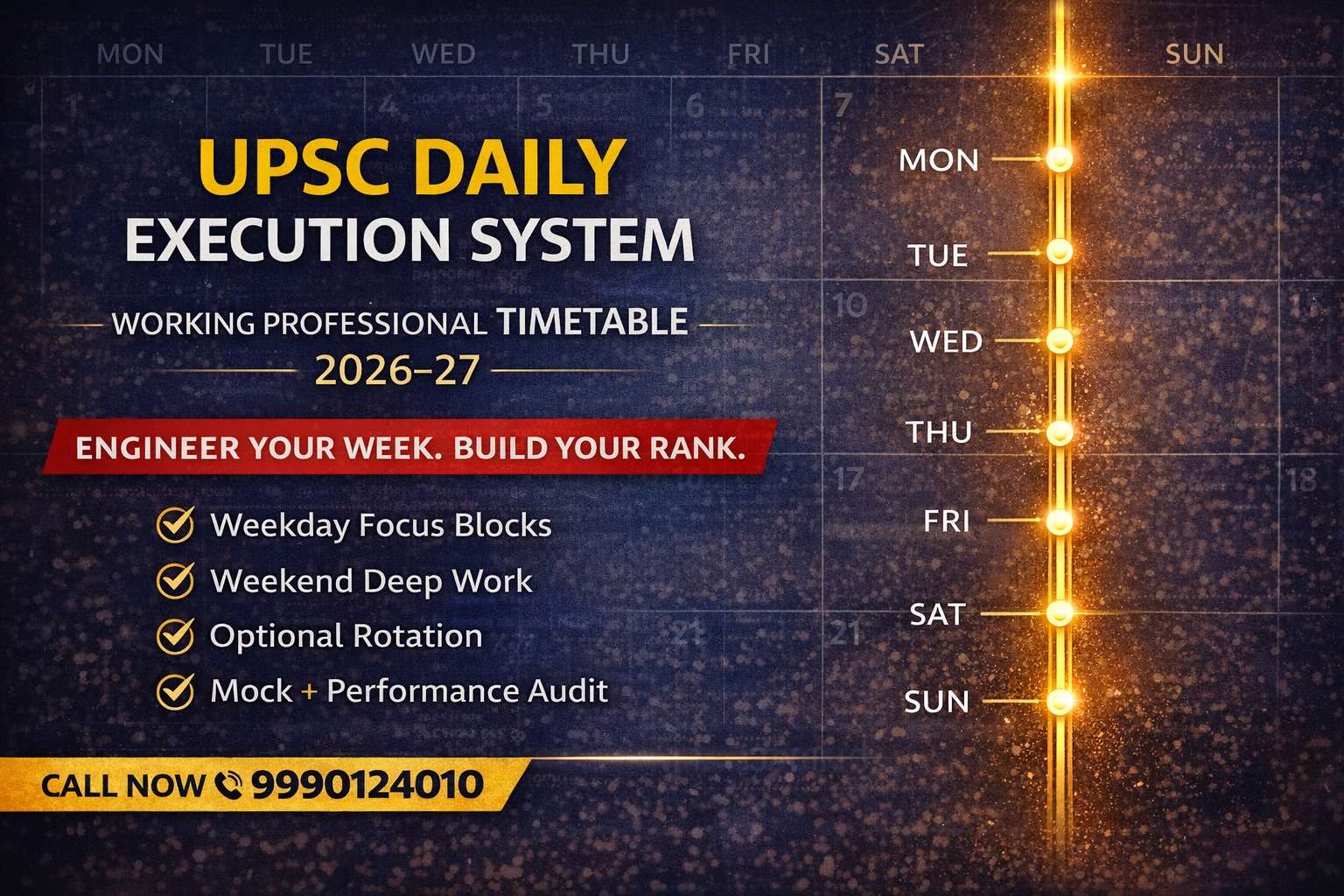
Monday–Friday Timetable Blueprint
Morning (if possible):
30 minutes revision
Evening (3–4 hours total):
- 2 hours – Core GS subject
• 1 hour – Current affairs integration
• 30 minutes – Revision
• 30 minutes – Answer writing / MCQs
Goal: Maintain momentum.
Saturday Plan
Morning:
Weekly GS revision (2–3 hrs)
Afternoon:
Optional subject (2–3 hrs)
Evening:
Answer writing practice
Goal: Strengthen depth.
Sunday Plan
Morning:
Mock test (Prelims or sectional)
Afternoon:
Deep analysis
Evening:
Weak area correction + next week planning
Goal: Performance improvement.
Integrated Prelims + Mains Execution
Do not separate preparation.
If studying Polity:
Solve MCQs + write one GS 2 answer.
Integration reduces time load.
Common Timetable Mistakes
❌ No revision block
❌ No answer writing
❌ No mock discipline
❌ Overloading weekends
❌ Ignoring optional
Who Should Follow This Timetable?
- IT professionals
• Corporate employees
• Bankers
• Government staff
• Married aspirants
• Engineers & Doctors
Why Structured Online Coaching Helps
Analytics IAS Academy offers structured online UPSC coaching for working professionals with:
✔ Defined timetable blueprint
✔ Integrated Prelims + Mains system
✔ Revision architecture
✔ Mock + analysis framework
✔ Mentorship checkpoints
FAQs
Q1. Can I crack UPSC with 3–4 hours daily?
Yes, if structured and consistent.
Q2. Should I study before or after office?
Prefer peak energy hours; consistency matters more.
Q3. How often should I take mocks?
Weekly sectional or full-length depending on stage.
Q4. How do I balance optional subject?
Allocate one focused weekend block.
Q5. Is online coaching effective for job holders?
Yes, if flexible and structured.
Final Message
UPSC 2026–27 success for working professionals depends on structure.
Your timetable is your discipline framework.
Admissions Open
Analytics IAS Academy
📞 9990124010
🌐 analyticsias.com