
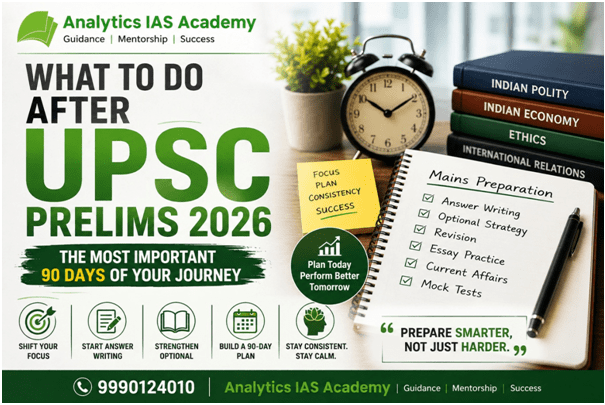
If You Are Serious About UPSC 2026, Read This Carefully
Every year, thousands of aspirants make the same mistake after the UPSC Prelims exam.
Some:
- keep calculating cutoff marks,
- keep watching “expected cutoff” videos,
- waste days discussing questions,
- mentally switch off after prelims,
- wait for the result before starting Mains preparation.
And by the time they realize the seriousness of the situation, they are already late.
The truth is:
The period immediately after UPSC Prelims is the most important phase of the entire UPSC preparation cycle.
This phase decides:
- whether you merely clear prelims,
- or actually become a serious Mains candidate.
At Analytics IAS Academy, we have observed one common pattern among serious aspirants and successful candidates:
They start preparing for Mains immediately after prelims — without waiting for results.
If you are targeting UPSC CSE 2026 seriously, this article may completely change the way you approach the next 90 days.
First Reality Check: Stop Waiting for the Result
This is the biggest mistake aspirants make.
Most students think:
“I will start after prelims result.”
This approach is dangerous.
Why?
Because:
- UPSC Mains is not an exam you can prepare for in 40–50 days.
- Answer writing cannot be developed overnight.
- Essay quality needs practice.
- Optional subject preparation takes consistency.
- Analytical thinking requires gradual improvement.
Serious aspirants understand this early.
That is why toppers often begin Mains-oriented preparation within 24–48 hours after prelims.
Step 1: Mentally Shift from Prelims Mode to Mains Mode
Prelims preparation is:
- fact-heavy,
- elimination-oriented,
- objective-based.
Mains preparation is completely different.
Mains requires:
- depth,
- articulation,
- analytical ability,
- answer structuring,
- multidimensional thinking,
- writing discipline.
The faster you shift mentally, the greater your advantage.
Do not remain emotionally stuck in prelims discussions for weeks.
One exam is over.
Now the real competition begins.
Step 2: Start Answer Writing Immediately
Many aspirants delay answer writing because:
- they feel underprepared,
- they lack confidence,
- they want to “complete content first.”
This is a trap.
UPSC Mains rewards:
- presentation,
- clarity,
- structure,
- relevance,
- balanced analysis.
These skills develop only through writing.
Even average content, when presented well, scores better than excellent content written poorly.
What You Should Do Now
Start with:
- 2 answers daily,
- one GS question,
- one optional question.
Focus initially on:
- structure,
- introductions,
- conclusions,
- flow.
Perfection is not required initially.
Consistency is.
Step 3: Prioritize Your Optional Subject
Your optional subject often becomes the difference-maker between selection and non-selection.
Yet many aspirants neglect it after prelims.
This is a serious mistake.
Especially for students choosing Sociology Optional, this is the ideal time to:
- strengthen thinkers,
- revise PYQs,
- practice answer framing,
- connect current affairs with sociological concepts.
At Analytics IAS Academy, we repeatedly emphasize:
Optional preparation should become stronger immediately after prelims.
Because:
- optional carries high weightage,
- improvement potential is massive,
- and consistency matters more than speed.
Step 4: Build a Realistic 90-Day Mains Plan
Most aspirants fail because their plans are unrealistic.
Avoid making:
- 16-hour schedules,
- impossible targets,
- over-ambitious revision plans.
Instead:
- make a practical schedule,
- divide subjects intelligently,
- include answer writing daily,
- reserve time for revision.
A good plan is not the hardest plan.
A good plan is the one you can sustain consistently.
Step 5: Reduce Information Overload
This is one of the biggest problems in UPSC preparation today.
After prelims, aspirants suddenly:
- join multiple Telegram groups,
- buy many courses,
- download hundreds of PDFs,
- consume endless strategy videos.
Result?
Mental confusion.
Remember:
More resources do not guarantee better preparation.
In fact, excessive resources destroy clarity.
Choose:
- limited sources,
- focused revision,
- guided preparation.
Depth matters more than quantity.
Step 6: Focus on Essay Preparation Early
Many aspirants underestimate Essay preparation.
This is risky.
Essay scores often create massive rank differences.
Aspirants who perform well in Essay usually:
- think clearly,
- structure ideas well,
- practice consistently,
- read multidimensional content.
Start:
- brainstorming topics,
- writing one essay weekly,
- improving introductions and conclusions,
- developing examples and case studies.
Essay improvement is gradual.
Start now.
Step 7: Protect Your Mental Stability
This phase becomes emotionally difficult for many aspirants.
Some experience:
- anxiety about cutoff,
- fear of failure,
- burnout,
- comparison,
- uncertainty.
This is normal.
But serious aspirants do not allow emotions to stop preparation.
Remember:
- uncertainty exists for everyone,
- discipline matters more than mood,
- consistency during uncertainty creates advantage.
The next few weeks require emotional maturity.
Step 8: Seek Proper Guidance and Mentorship
One of the biggest reasons aspirants waste attempts is lack of direction.
Many hardworking students fail not because they are incapable —
but because:
- preparation becomes directionless,
- mistakes remain uncorrected,
- nobody reviews their progress honestly.
This is where mentorship becomes important.
A serious mentorship environment helps aspirants:
- stay accountable,
- improve answer writing,
- maintain consistency,
- avoid confusion,
- save time and energy.
At Analytics IAS Academy, the focus remains on:
- structured preparation,
- personalized guidance,
- answer writing improvement,
- and realistic mentorship for serious aspirants.
Final Words: These 90 Days Can Change Everything
UPSC success is rarely about sudden brilliance.
It is usually about:
- consistency,
- direction,
- discipline,
- emotional control,
- and smart preparation during crucial phases.
The post-prelims period is one such crucial phase.
Do not waste it:
- waiting for results,
- overthinking cutoff,
- consuming random content,
- comparing yourself with others.
Instead:
- start writing,
- strengthen your optional,
- revise smartly,
- seek proper guidance,
- and build momentum.
Because serious aspirants are not waiting anymore.
They are already preparing for Mains.
Need Serious Guidance for UPSC 2026?
If you are looking for:
- structured mentorship,
- Sociology Optional guidance,
- answer writing improvement,
- post-prelims strategy support,
- or serious UPSC preparation direction,
you may connect with Analytics IAS Academy for a mentorship interaction and preparation review session.
Serious preparation begins with serious direction.