
How to Decide Between a 1-Year, 2-Year, or 3-Year UPSC Foundation Programme (Without Wasting Time)
Every year, thousands of aspirants ask the same question:
“Can I crack UPSC in one year?”
The honest answer is:
Yes—but only if one year is truly enough for your current level of preparation.
Many aspirants fail not because they study less, but because they choose the wrong preparation timeline. Some unnecessarily spend three years preparing, while others rush into a one-year plan despite having significant gaps.
The smarter question is not:
“Can UPSC be cracked in one year?”
It is:
“How much time do I realistically need?”
This guide helps you make that decision objectively.
The Biggest Mistake Aspirants Make
Most students choose a coaching programme because:
- Their friend joined it.
- It is popular on YouTube.
- It is heavily advertised.
- Someone told them one year is enough.
UPSC preparation is highly personal.
The ideal preparation duration depends on:
- Academic background
- Current knowledge
- Graduation status
- Time available daily
- Writing skills
- Language proficiency
- Optional subject preparation
- Consistency
There is no universal answer.
First Understand the UPSC Journey
A serious UPSC preparation involves multiple stages.
Stage 1
Build conceptual understanding through NCERTs and standard books.
Stage 2
Develop newspaper reading and current affairs integration.
Stage 3
Learn answer writing.
Stage 4
Practice Prelims MCQs.
Stage 5
Prepare Optional Subject.
Stage 6
Revise multiple times.
Stage 7
Attempt mock tests under exam conditions.
Trying to compress all these stages into an unrealistic timeline often leads to burnout.
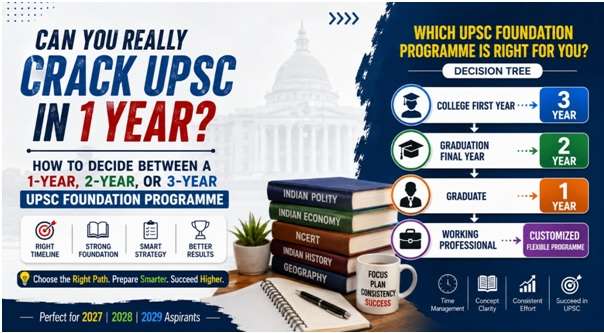
Decision Tree: Which UPSC Foundation Programme Should You Choose?
College First Year
│
▼
Choose a 3-Year Foundation Programme
Graduation Final Year
│
▼
Choose a 2-Year Foundation Programme
Graduate
│
▼
Choose a 1-Year Foundation Programme
Working Professional
│
▼
Choose a Customized Flexible Programme
Let’s understand why.
Scenario 1: You Are in College First Year
Recommended Timeline
3-Year Foundation Programme
This is probably the best time to begin UPSC preparation.
Why?
You have time to:
- Build strong fundamentals
- Read NCERTs carefully
- Improve writing
- Learn current affairs gradually
- Revise multiple times
- Develop answer writing without pressure
Instead of studying 12 hours a day later, you can study 2–3 hours consistently now.
Advantages
✔ Less stress
✔ Better retention
✔ More revision
✔ Higher conceptual clarity
✔ Balanced college life
Scenario 2: You Are in Graduation Final Year
Recommended Timeline
2-Year Foundation Programme
You now have limited time but still enough to prepare systematically.
Your first year can focus on:
- GS Foundation
- NCERTs
- Standard books
- Newspaper
- Current Affairs
- Optional Subject basics
The second year should focus on:
- Revision
- Test Series
- Answer Writing
- Prelims Practice
- Interview awareness
This is one of the most balanced approaches.
Scenario 3: You Have Already Graduated
Recommended Timeline
1-Year Intensive Foundation Programme
This option works well only if:
- You can study full-time.
- You have minimal distractions.
- You are disciplined.
- You can dedicate 8–10 focused hours daily.
- You follow a structured plan.
A one-year strategy demands consistency every single day.
It is not suitable for those who keep restarting preparation.
Remember
One year is enough for many aspirants.
One year is not enough for everyone.
Scenario 4: You Are a Working Professional
Recommended Timeline
Customized Flexible Programme
Working professionals face unique challenges:
- Office hours
- Commute
- Family responsibilities
- Fatigue
- Limited study time
A rigid classroom schedule may not work.
Instead, preparation should include:
- Evening classes
- Weekend revisions
- Recorded lectures
- Micro targets
- Monthly planning
- Personalized mentorship
Consistency matters far more than long study hours.
Can Someone Really Crack UPSC in One Year?
Absolutely.
Every year, successful candidates clear UPSC within a year.
But most of them already possess several advantages:
- Strong reading habits
- Good writing skills
- Academic discipline
- Limited distractions
- Clear strategy
- Consistent revision
Their “one year” is usually built upon years of learning habits.
Do not compare your starting point with someone else’s finish line.
Factors That Decide Your Preparation Duration
Ask yourself these questions honestly.
Do you read newspapers regularly?
If no, you need more time.
Have you completed NCERTs?
If no, your foundation is still developing.
Can you write a 150-word answer in 7 minutes?
If not, answer writing needs practice.
Have you chosen your Optional Subject?
If not, allocate additional time.
How many hours can you realistically study every day?
Consistency is more valuable than occasional marathon sessions.
Are you preparing alongside college or a job?
Your schedule should adapt to your responsibilities.
One-Year vs Two-Year vs Three-Year Preparation
| Parameter | 1 Year | 2 Years | 3 Years |
| Suitable For | Graduates | Final-year students | First-year college students |
| Pace | Intensive | Balanced | Comfortable |
| Revision Time | Moderate | High | Very High |
| Stress Level | High | Moderate | Low |
| Concept Building | Fast | Strong | Excellent |
| Flexibility | Limited | Good | Excellent |
| Risk of Burnout | Higher | Moderate | Lower |
Common Myths
Myth 1
“I need three years to crack UPSC.”
Not necessarily.
Quality matters more than duration.
Myth 2
“One-year preparation always fails.”
False.
Many toppers have succeeded with focused one-year preparation.
Myth 3
“More coaching means better preparation.”
No.
The right guidance combined with disciplined self-study is far more important.
Myth 4
“College students should wait until graduation.”
Starting early usually reduces pressure later.
How to Choose the Right Timeline
Choose 3 Years if:
- You are in first or second year of college.
- You want gradual preparation.
- You want strong fundamentals.
Choose 2 Years if:
- You are nearing graduation.
- You want balanced preparation.
- You can study consistently.
Choose 1 Year if:
- You have graduated.
- You can study full-time.
- You are highly disciplined.
Choose Customized Preparation if:
- You are employed.
- You need flexibility.
- You want sustainable progress.
Final Thoughts
There is no magical number of months that guarantees success in the UPSC Civil Services Examination.
A one-year strategy can work brilliantly for the right candidate.
A three-year strategy can be equally powerful for someone beginning early.
The smartest aspirants do not ask:
“Which programme is the shortest?”
They ask:
“Which preparation timeline gives me the highest probability of success?”
Choose your preparation duration based on your current stage of life—not on social media trends, peer pressure, or unrealistic promises.
Success in UPSC is not about starting earlier or later.
It is about starting with the right plan, following it consistently, and improving every single day.
Frequently Asked Questions (FAQ)
Can I crack UPSC in one year?
Yes, provided you have strong fundamentals, consistent study habits, sufficient daily study time, and a disciplined revision strategy.
Is two years enough for UPSC preparation?
For many aspirants, two years offers an ideal balance between conceptual learning, revision, current affairs, and answer writing.
Should college students start UPSC preparation?
Yes. Beginning during college allows gradual concept building and reduces pressure after graduation.
How many hours should a beginner study for UPSC?
Quality is more important than quantity. Beginners should aim for consistent, focused study and gradually increase productive hours as their preparation matures.
Is UPSC preparation different for working professionals?
Yes. Working professionals generally benefit from flexible schedules, evening or weekend study plans, recorded lectures, and structured weekly targets.
Key Takeaways
- There is no universal “best” UPSC preparation duration.
- Your educational stage should guide your preparation timeline.
- Early preparation enables deeper understanding and multiple revisions.
- Graduates may succeed with a focused one-year plan if they can study full-time.
- Working professionals should prioritize flexibility and consistency over long study hours.
- Choose a timeline based on your profile—not comparisons with others.
- What Should You Complete Before Your First UPSC Class?v
- 15 Questions Every UPSC Beginner Should Ask Before Joining Any Coaching
- Complete UPSC Beginner’s Roadmap (2027–2029)
- NCERT Strategy for UPSC Beginners
- How to Build a Daily UPSC Study Routine
- Best Books for UPSC Preparation
- Answer Writing Strategy for Beginners