
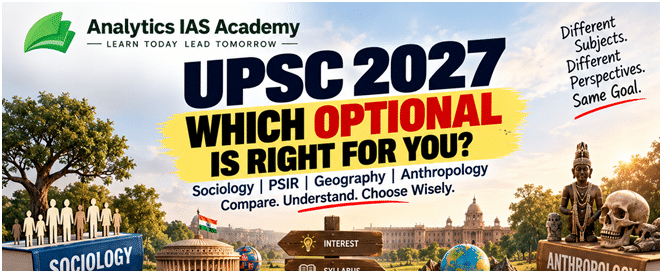
Quick answer: Which optional subject is best for UPSC 2027?
There is no universally best optional subject for UPSC CSE 2027. Sociology, Political Science and International Relations (PSIR), Geography and Anthropology each suit different interests and learning styles. The strongest choice is the subject whose official syllabus you can understand, whose previous-year questions you can interpret, whose material you can revise consistently and whose answers you can write analytically. Do not select an optional solely because a topper chose it or someone called it “scoring.”
Under the recent UPSC CSE Mains scheme, an optional consists of two papers of 250 marks each: 500 marks in total. Confirm the final examination scheme and subject list in the UPSC 2027 notification when published.
Check the most recent available official subject papers: UPSC Civil Services Mains 2026 official papers and subjects
Sociology vs PSIR vs Geography vs Anthropology: At-a-glance comparison
| Subject | Core intellectual focus | Best fit if you enjoy | What to watch for |
| Sociology | Thinkers, methods, Indian society, social change | Society, inequality, institutions, linking theory with everyday life | Answers must use sociological concepts, not generic GS prose |
| PSIR | Political theory, Indian politics, comparative politics, international relations | Constitutional ideas, political arguments, global affairs | Theoretical precision and sustained engagement with IR |
| Geography | Physical and human geography, India and world geography | Spatial patterns, environment, maps, diagrams | Large conceptual spread and consistent diagram/map practice |
| Anthropology | Human evolution, biology, culture, society and Indian anthropology | Human diversity, scientific concepts and ethnography | Specialised terminology, biological components and diagrams |
Five criteria that matter more than “scoring trends”
1. Interest and intellectual fit
Can you read a chapter voluntarily and explain it? Interest helps sustain repeated revisions.
2. Official syllabus and depth
Read both Paper I and Paper II outlines. Identify topics that look unfamiliar and estimate the effort to build foundations.
3. PYQ comprehension
Attempt to outline five questions from recent papers. Do you understand the demand and can you imagine building a strong answer?
4. Answer-writing aptitude
Can you organise arguments with subject-specific concepts, examples, thinkers, maps or diagrams as appropriate?
5. Resources and feedback
Assess credible books, accessible guidance, tests, evaluation and realistic time availability—not merely the volume of online notes.
Who should consider Sociology Optional?
Sociology may suit aspirants interested in caste, family, religion, social stratification, social movements, gender, urbanisation and the relationship between social structures and individual lives. Its topics intersect with parts of GS I and Essay, but optional answers require theories, sociological thinkers and discipline-specific analysis. Sociology is not automatically easy for someone without a social-science degree.
A useful trial: explain social mobility using both an everyday example and a sociological concept. If you enjoy moving between theory and contemporary India, Sociology deserves serious consideration.
Explore the course approach mentored by Pankaj Shukla Sir: Analytics IAS Sociology Optional 2027 course and mentorship
Who should consider PSIR?
PSIR may suit aspirants who enjoy political philosophy, constitutional debates, institutions, ideologies, diplomacy and international affairs. It connects to portions of GS II and contemporary issues, but its optional papers require more than current affairs summaries: political theory and conceptual frameworks matter. A good trial is to compare competing interpretations of liberty or justice, then connect those ideas to a real governance question.
Who should consider Geography?
Geography may appeal to candidates comfortable with physical processes, spatial relationships, human–environment interactions, maps and diagrams. It has conceptual intersections with GS I, environment and disaster management. Its breadth and the need for precise spatial explanation should be considered. Trial exercise: explain monsoon variability with a labelled diagram and connect it to agriculture and regional impacts.
Who should consider Anthropology?
Anthropology may suit candidates interested in human origins, evolution, genetics, culture, kinship, tribes and field-based perspectives. It combines biological and sociocultural content; this can be appealing or demanding depending on the learner. Try explaining human adaptation or a kinship concept using accurate terminology before deciding.
Which optional has the highest marks or success rate?
Avoid a simple league table. Optional-wise outcomes can reflect differences in cohort size, candidates’ backgrounds, preparation quality, marking patterns and year-to-year variation. An average score or a selected topper’s marks cannot establish that one optional is inherently superior. If using official statistics, state the exact year, denominator and source; do not infer a guaranteed advantage for UPSC 2027.
A seven-day optional-selection experiment
| Day | Action | Decision evidence |
| 1 | Download official syllabi for four subjects | Mark familiar and unfamiliar areas |
| 2 | Read recent UPSC PYQs for Sociology and PSIR | Rate comprehension and interest |
| 3 | Read recent UPSC PYQs for Geography and Anthropology | Rate comprehension and interest |
| 4 | Study one sample chapter from your top two | Record conceptual difficulty |
| 5 | Draft one short answer in each shortlisted subject | Compare quality and enjoyment |
| 6 | Check books, revision load, tests and mentoring | Assess realistic resources |
| 7 | Score each option and decide—or seek focused counselling | Document your rationale |
Use original papers for the experiment: Official UPSC previous-year question papers
Optional-subject suitability scorecard
Rate each subject from 1 (weak fit) to 5 (strong fit). These are personal ratings, not a scientific prediction of marks.
| Criterion | Sociology | PSIR | Geography | Anthropology |
| Interest | ___ /5 | ___ /5 | ___ /5 | ___ /5 |
| PYQ understanding | ___ /5 | ___ /5 | ___ /5 | ___ /5 |
| Syllabus comfort | ___ /5 | ___ /5 | ___ /5 | ___ /5 |
| Answer-writing fit | ___ /5 | ___ /5 | ___ /5 | ___ /5 |
| Resources + feedback | ___ /5 | ___ /5 | ___ /5 | ___ /5 |
| Total | ___ /25 | ___ /25 | ___ /25 | ___ /25 |
Use your total as a conversation starter. If the top two scores are close, compare two written answers and the time required to understand difficult chapters before making a final decision.
Common mistakes when choosing a UPSC optional
- Selecting a subject based only on a “scoring” label or social-media trend.
- Assuming GS overlap eliminates the need for optional-specific preparation.
- Ignoring the official syllabus and reading only coaching summaries.
- Changing subjects repeatedly without a structured trial.
- Choosing based on the availability of notes but not feedback on answers.
- Treating Sociology as generic Indian Society or PSIR as only current affairs.
Watch More: Analytics IAS YouTube
The links below search within the official Analytics IAS channel for relevant lessons. They are channel searches rather than unverified individual video URLs.
Pankaj Shukla Sir Sociology lectures
UPSC optional subject guidance
Read More: Related Analytics IAS resources
Sociology Optional Online Course for UPSC 2027
How to Score 300+ Marks in Sociology Optional: Preparation Strategy
Sociology Optional Coaching and Mentorship
UPSC preparation resources — Analytics IAS Academy
FAQs: Best optional subject for UPSC 2027
Which is the best optional subject for UPSC 2027 beginners?
No subject is best for everyone. Compare the official syllabus, PYQs, your interests, study resources and ability to write subject-specific answers.
Is Sociology better than PSIR for UPSC?
Sociology emphasises social theory and Indian society; PSIR emphasises political theory, institutions and international relations. Choose based on demonstrated fit rather than general claims.
Is Geography or Anthropology easier?
Neither is universally easier. Geography involves broad spatial and physical-human themes; Anthropology combines biological and sociocultural study. Try actual chapters and PYQs.
Does optional subject overlap with GS guarantee high marks?
No. Overlap can support preparation efficiency, but optional answers require deeper subject knowledge and specialised presentation.
Can an engineering or science graduate take Sociology or PSIR?
Yes, subject to UPSC eligibility rules. Academic background can help in some topics but is not a requirement for choosing these optionals.
How many marks is the UPSC optional worth?
Under the recent UPSC CSE Mains scheme, two optional papers carry 250 marks each, totalling 500. Verify the 2027 notification.
How should I choose between two optionals?
Write a timed sample answer in each, examine difficult topics and compare sustained interest, feedback availability and revision workload.
Still undecided? Ask for optional-selection counselling
Analytics IAS Academy invites UPSC CSE 2027 aspirants to enquire about optional-subject selection guidance. If Sociology fits your interests, ask about the Sociology Optional programme mentored by Pankaj Shukla Sir, including Paper I–II coverage, answer-writing support and current online batch availability. Counselling and course availability should be confirmed with the team.
Analytics IAS Academy | A-148, First Floor, Sector 63, Noida | Call/WhatsApp: 9990124010
Enquire about Sociology Optional 2027
Comment below: Which two subjects are you comparing—and what is the one factor stopping you from deciding?
