
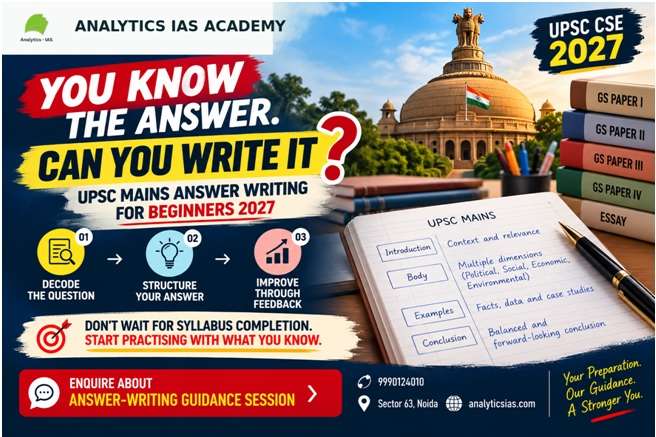
Quick answer: When should beginners start UPSC Mains answer writing?
Start after you understand the basics of a topic—not after finishing the entire UPSC syllabus. Begin with one untimed, open-book answer on a familiar GS topic, then move to closed-book practice, question-specific feedback and gradually timed writing. The objective is to develop relevance, structure and analytical depth alongside subject preparation.
Reading builds knowledge. Writing under a question’s demand tests whether you can select and communicate that knowledge. Both skills need practice.
Why aspirants who know the content still struggle to write
A candidate may know several facts about urbanisation but lose focus when asked to “examine the social consequences of rapid urbanisation in India.” Reproducing every fact about cities is not the same as addressing the consequences. The challenge is often selection and organisation, not simply a lack of information.
For UPSC Mains answer writing for beginners, the first priority is to answer the question asked, not the question you hoped would appear.
1. Decode the directive before writing
| Directive | What it usually asks you to do |
| Discuss | Present relevant dimensions in an organised, balanced way |
| Examine | Investigate an issue carefully, using relevant evidence |
| Analyse | Break the issue into causes, components and relationships |
| Critically examine | Assess strengths, limitations and counterarguments |
| Evaluate | Judge significance or effectiveness using clear criteria |
| Comment | Give a reasoned, supported assessment |
Directive meanings depend on the full question. Underline the core theme, scope (India, rural areas, recent years) and directive before drafting your answer.
Practise identifying the demand using Official UPSC previous-year question papers
2. Use a flexible introduction–body–conclusion structure
Introduction: In one or two sentences, define the issue, establish context or directly frame the problem. Avoid memorised openings that do not fit the question.
Body: Organise the main answer under two to four relevant dimensions. Use precise subheadings or short paragraphs where useful; support important points with an example, institution, policy or case.
Conclusion: Answer the question’s larger implication with a balanced, realistic way forward. Do not introduce an unrelated new argument.
This structure is a tool, not a rigid template. A direct compare-and-contrast question may benefit from a compact table; a geography question may benefit from a labelled sketch if relevant and accurate.
3. Worked example: Turn a broad topic into a focused answer
Illustrative practice question (not represented as an actual UPSC PYQ): “Examine the social challenges associated with rapid urbanisation in India.” (150 words)
Weak approach: Define urbanisation, list every government urban scheme and finish with “urbanisation is important.” This misses the demand: social challenges.
Stronger approach:
Introduction — Rapid urbanisation can create economic opportunity but also place pressure on housing, public services and social inclusion.
Body — (i) Housing insecurity and informal settlements; (ii) unequal access to water, sanitation and transport; (iii) precarious work and migrant vulnerability; (iv) gendered safety and care burdens; (v) social fragmentation and environmental-health exposure. Add a grounded example where appropriate.
Conclusion — Integrated urban planning, affordable housing, accessible services and participatory local governance can improve inclusion.
The improved outline directly responds to the question. A final exam answer must still be checked for factual accuracy, word limit and coherence.
4. How to handle 10-mark and 15-mark questions
| Aspect | 10-mark / 150-word answer | 15-mark / 250-word answer |
| Main aim | Address the demand directly and selectively | Offer wider dimensions and deeper evaluation |
| Planning | Brief mental outline | Slightly fuller outline before writing |
| Body | Two or three strong points or dimensions | Several well-connected dimensions with examples |
| Presentation | Compact and clear | Clear sequencing; diagram/table only if useful |
| Time | Practise pacing toward exam conditions | Practise pacing toward exam conditions |
Word limits and marks are common GS Mains formats, but always follow the specific paper’s instructions. Quality and relevance matter more than filling space.
5. Seven-day beginner answer-writing practice plan
| Day | Practice | Self-check |
| 1 | Decode five PYQs without writing full answers | Did you identify directive, topic and scope? |
| 2 | Write one open-book 150-word answer | Is every point relevant? |
| 3 | Rewrite the same answer more concisely | Did you remove repetition? |
| 4 | Write one answer using a simple example or evidence | Is the evidence accurate and relevant? |
| 5 | Practise a 250-word answer on a studied topic | Is the analysis balanced? |
| 6 | Write one answer with a reasonable time limit | Did you finish coherently? |
| 7 | Review both answers against a checklist and revise | What three improvements will you carry forward? |
This is a starter routine. Adapt it to your stage of preparation; writing more answers without reviewing errors may simply repeat the same weaknesses.
6. A simple self-evaluation rubric
| Criterion | Ask yourself |
| Demand | Did I answer exactly what was asked? |
| Coverage | Did I include the major relevant dimensions? |
| Analysis | Did I explain relationships and implications, not just list facts? |
| Evidence | Are examples and facts appropriate and accurate? |
| Structure | Can a reader follow my argument quickly? |
| Balance | Did I consider necessary limitations or counterpoints? |
| Conclusion | Does the ending respond to the question? |
A rubric helps diagnose progress, but it does not reproduce UPSC’s confidential marking process. Where possible, use constructive feedback from an experienced evaluator and compare your approach with the syllabus and PYQs.
7. Common answer-writing mistakes to avoid
- Waiting until the entire GS syllabus is complete before attempting any answer.
- Writing everything you know instead of prioritising the question’s demand.
- Using generic introductions and conclusions that fit every topic.
- Adding unverified statistics or quotations to appear impressive.
- Overusing headings, flowcharts or diagrams when they do not clarify the answer.
- Practising daily without reviewing why an answer was weak.
- Ignoring CSAT, Prelims and static preparation while focusing only on Mains writing.
8. Integrate answer writing with your existing UPSC study plan
After completing a Polity chapter, choose one relevant GS-II PYQ. After studying an Indian Society topic, attempt one GS-I question. For Economy, use a question that tests mechanisms and trade-offs. This avoids treating answer writing as a separate mountain to climb.
If unfinished subjects are holding you back, see Analytics IAS — UPSC 2027 syllabus completion and backlog strategy
For building revision alongside writing practice, explore Analytics IAS — UPSC Prelims 2027 revision strategy
Watch More: Analytics IAS YouTube learning resources
The following links search within the official Analytics IAS YouTube channel. They are channel searches, not verified individual video URLs; select a relevant video from the results.
UPSC Mains answer-writing lessons — Analytics IAS channel search
UPSC GS Mains preparation — Analytics IAS channel search
UPSC PYQ discussions — Analytics IAS channel search
Analytics IAS Academy official YouTube channel
Read More: Related UPSC 2027 preparation guides
UPSC 2027 Syllabus Completion and Backlog Strategy
UPSC Prelims 2027 Revision Strategy
UPSC Current Affairs Strategy 2027
Analytics IAS Academy — UPSC GS Foundation Preparation
FAQs: UPSC Mains answer writing for beginners
When should I start answer writing for UPSC 2027?
Start after learning the fundamentals of a topic. Begin with a short open-book answer and gradually add independent and timed practice.
Can I practise Mains answers before finishing the syllabus?
Yes. Choose questions from topics you have already covered and build depth as your syllabus progresses.
How many answers should a beginner write daily?
One carefully reviewed answer can be more useful than several unreviewed ones. Increase volume only when your feedback and revision routine can support it.
What is the ideal UPSC Mains answer structure?
A focused introduction, relevant analytical body and purposeful conclusion is a useful default, but adapt to the directive and topic.
How do I improve marks in UPSC Mains?
Work on demand recognition, relevant content, balanced analysis, accurate examples, readable presentation and systematic feedback. No formula guarantees marks.
Are diagrams necessary in UPSC GS answers?
No. Use maps, flowcharts or diagrams only when they accurately improve explanation.
Should I memorise model answers?
Use model answers to learn structure and identify missing dimensions, not to reproduce them mechanically.
Start with one answer this week
Choose a GS topic you already understand. Write one answer, compare it against the self-evaluation rubric and rewrite the weakest paragraph. That is a concrete starting point for UPSC Mains 2027.
Analytics IAS Academy offers structured UPSC preparation and mentorship options. For an answer-writing guidance session enquiry, contact our team to discuss availability and how to begin. A free session should be advertised only if confirmed by the academy.
Analytics IAS Academy | Sector 63, Noida | Classroom and online preparation options | Call/WhatsApp: 9990124010
Visit Analytics IAS Academy for answer-writing guidance enquiries
Reader question: What holds you back most—understanding directives, finding content, structuring an answer or completing it in time?
