
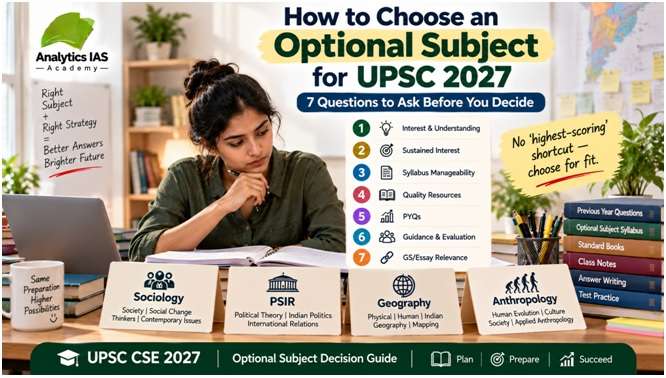
There is no universally “best” optional. The goal is to find the subject that best fits YOU.
What Is the Best Optional Subject for UPSC 2027?
Quick answer: There is no single best optional subject for every UPSC 2027 aspirant. Choose after comparing seven factors: your understanding of the subject, sustained interest, syllabus manageability, quality resources, previous-year questions, availability of guidance/evaluation, and useful overlap with GS or Essay. Do not choose only because an optional is described as “high scoring,” popular, short or selected by a topper.
The optional matters because UPSC Mains has two optional papers of 250 marks each. That makes your optional a 500-mark component of the written merit examination. The decision therefore deserves more than a YouTube recommendation, a topper list or a coaching advertisement.
If you are still building your overall UPSC 2027 plan, begin with our UPSC Preparation Guide for Beginners 2027–2029.
Why “Which Optional Is Highest Scoring?” Is the Wrong First Question
Marks vary across candidates and years. A subject does not write the examination for you. Your conceptual clarity, syllabus coverage, PYQ understanding, revision, answer quality and exam-day execution matter.
Instead of asking, “Which optional gives the highest marks?”, ask:
- Can I understand this subject deeply enough to write analytical answers?
- Can I revise its syllabus repeatedly?
- Can I find dependable resources and feedback?
- Do its PYQs make sense to me?
- Can I sustain the subject alongside GS and Prelims?
Choose for fit, not folklore.
The 7-Question Test for Choosing Your UPSC 2027 Optional
1. Do I Genuinely Understand the Subject?
Interest alone is not enough. Spend a few days reading the official syllabus, introductory material and recent PYQs. Ask whether the language, concepts and type of reasoning feel learnable.
You do not need an academic degree in the subject. But you should be able to imagine yourself moving from basic concepts to analytical answers.
Mini-test: Read one basic chapter or introductory lecture, then explain the concept in your own words without looking at notes. If the subject remains completely opaque after a fair trial, investigate why before committing.
2. Can I Sustain Interest for Months?
Optional preparation is not a weekend experiment. You will read the same themes multiple times, make notes, solve PYQs, write answers, take tests and revise before Mains.
Ask whether your curiosity survives beyond the attractive introductory topics. For example, liking current social issues is not the same as enjoying sociological theory; liking international affairs is not the same as enjoying political theory; liking maps is not the same as enjoying the full Geography syllabus.
Better question: Would I still study this subject after the novelty disappears?
3. How Manageable Is the Syllabus for Me?
Do not judge syllabus size by page count alone. A short-looking syllabus can be conceptually dense; a longer syllabus can feel manageable if it matches your background.
Print the official syllabus and classify every topic:
- Already familiar
- Can understand with standard sources
- Needs guided learning
- Appears highly technical/specialised
Then estimate the time required for first coverage, notes, PYQs, answer writing and at least two revisions. This gives a far more realistic picture than labels such as “short optional.”
4. Are Quality Resources Actually Available?
Before choosing an optional, check whether you can build a limited and reliable source list. You need enough material to cover the syllabus—but not twenty sources for every topic.
- Official syllabus
- Standard books/basic texts
- Reliable notes or lectures where needed
- Previous-year questions
- Current examples where the subject requires them
- Test series or answer evaluation if you need external feedback
Resource availability matters especially if you are a beginner, live away from major coaching hubs, or are preparing alongside a job or college.
5. What Do the PYQs Look Like?
This is one of the most important steps—and one of the most neglected.
Before selecting Sociology, PSIR, Geography, Anthropology or any other optional, open several years of actual UPSC question papers. Do not merely count repeated topics. Look at the type of thinking demanded.
- Are questions direct or interpretive?
- How much conceptual depth is expected?
- How frequently do questions combine multiple syllabus areas?
- Does the subject require diagrams, maps, thinkers, case studies or technical problem-solving?
- Can you understand what a good answer would need, even if you cannot yet write it?
Your optional should be selected with PYQs open—not from a ranking list.
Official source: UPSC Previous Question Papers.
6. Is Good Guidance and Answer Evaluation Available?
Not every aspirant needs full coaching, but every aspirant needs a way to identify mistakes. Ask whether the subject has accessible guidance, model approaches, test practice and meaningful evaluation.
This matters because optional answers must sound like answers from that discipline—not generic GS responses.
- Who will evaluate my answers?
- Will feedback identify conceptual and structural errors?
- Can I get help when a topic remains unclear?
- Are Paper I and Paper II connected where relevant?
- Does the guidance teach application, or only provide notes?
If you are considering Sociology, see our Sociology Optional Online Course for UPSC 2027 for an example of a preparation model built around concepts, Paper I–II interlinkages, answer writing, tests and mentorship.
7. How Much GS and Essay Relevance Does It Provide?
Overlap can reduce duplication, but it should be a supporting factor—not the sole reason for choosing an optional.
A subject may help you understand themes appearing in GS or Essay, but optional preparation requires much greater depth and discipline-specific vocabulary.
- Sociology can support Indian Society themes and social-issue analysis.
- PSIR can connect with polity, governance and international relations themes.
- Geography connects with physical, human and Indian geography themes.
- Other optionals may offer less direct GS overlap but fit a candidate’s academic strengths much better.
Use overlap as a bonus, not as a substitute for subject fit.
Sociology vs PSIR vs Geography vs Anthropology: What Should You Compare?
These are frequently considered by aspirants without a specialised professional optional. The purpose of the table below is not to rank them. It shows what to investigate before choosing.
| Factor | Sociology | PSIR | Geography | Anthropology |
| Core orientation | Society, theory, social change, Indian society | Political theory, Indian politics, comparative politics, international relations | Physical, human and Indian geography | Human evolution, biological/social-cultural anthropology and applied themes |
| Ask yourself | Do I enjoy explaining society through concepts and thinkers? | Do I enjoy political theory plus contemporary politics/IR? | Am I comfortable with conceptual breadth, spatial thinking and maps/diagrams? | Am I comfortable combining scientific/biological and socio-cultural material? |
| Current-affairs linkage | Useful for contemporary social examples | Important, especially for politics and IR | Useful for environmental, regional and geographic applications | Useful selectively, depending on topic |
| GS/Essay connection | Society/social issues; Essay themes | Polity/governance/IR; Essay themes | Geography/environment-related GS themes | Some society/science-related connections |
| Before deciding | Read theory + Indian society PYQs | Read political theory + IR PYQs | Inspect both physical and human/Indian geography PYQs | Inspect both biological and socio-cultural portions |
| Answer-writing check | Can I use sociological concepts/thinkers rather than GS language? | Can I combine theory, scholars and contemporary analysis? | Can I use concepts, diagrams/maps where relevant? | Can I handle terminology, diagrams and discipline-specific explanation? |
Do not select from this table alone. Download the official syllabus and PYQs for every subject on your shortlist, then conduct a trial before deciding.
A 3-Day Optional Subject Trial Before You Commit
If you are confused between two or three subjects, use this practical test.
- Day 1 — Syllabus Test: Read the complete official syllabus. Mark familiar, interesting, difficult and highly technical areas.
- Day 2 — PYQ Test: Read at least 3–5 years of Paper I and Paper II questions. Identify whether you understand the language and demands.
- Day 3 — Learning Test: Study one representative topic from a standard source/lecture, make a one-page note and attempt a rough answer framework.
Then compare subjects on understanding, curiosity, resource confidence, PYQ comfort and willingness to revise. This will tell you more than a generic “best optional” list.
When Should You Start Your Optional for UPSC 2027?
Short answer: Do not postpone optional selection until your entire GS syllabus is complete. If you are targeting UPSC 2027, decide after a focused trial and begin early enough to complete first coverage, PYQs, answer writing and multiple revisions without colliding with the Prelims-intensive phase.
The exact month depends on your starting point, available weekly hours, academic background and whether you are studying full-time, in college or working. What matters is that optional does not become a post-Prelims emergency.
For integrated preparation planning, read our UPSC CSE 2027 Foundation Roadmap.
Can a Beginner Choose Sociology Optional for UPSC 2027?
Yes, a beginner can consider Sociology even without a Sociology degree—but it should still pass the same seven-question test. Do not choose it merely because someone calls the syllabus short or scoring.
A genuine trial should include basic sociological concepts, at least one thinker/theory topic, Indian society themes and recent PYQs. This helps you see whether you can move beyond common-sense or GS-style answers toward sociological analysis.
If Sociology is on your shortlist, read Paper 1 vs Paper 2: How to Interlink Sociology Optional to understand the subject’s theory-to-Indian-society relationship.
You can also review the Sociology Optional UPSC 2027 course structure to see what complete preparation involves before deciding whether you need structured guidance.
Should You Choose an Optional Because a Topper Chose It?
A topper’s strategy can show that a subject is viable. It cannot establish that the same subject is right for you. Academic background, reading habits, available time, answer-writing ability and access to guidance differ.
Use topper strategies to understand preparation methods—not as a substitute for your own optional-selection test.
Should You Choose Based on Previous Success Rates or Marks?
Historical performance data can be one input, but it should not dominate the decision. Candidate pools differ across subjects, yearly marks fluctuate, and aggregate success rates cannot tell you how well a subject fits your strengths.
There is no credible shortcut called the universally “highest-scoring optional.”
Common Optional-Selection Mistakes
- Choosing because a friend or topper selected it.
- Choosing only for perceived scoring potential.
- Looking only at syllabus length.
- Ignoring Paper II while judging Paper I.
- Never reading actual PYQs before committing.
- Assuming GS overlap makes the optional easy.
- Buying a complete course before testing the subject.
- Switching optional repeatedly because another subject suddenly looks easier.
- Confusing availability of notes with availability of good evaluation.
- Waiting too long to decide and then rushing optional after Prelims.
A Simple Optional Selection Scorecard
Use this only as a thinking tool—not as a mathematical guarantee. Rate each shortlisted subject from 1 (weak fit) to 5 (strong fit).
| Factor | Question to Ask | Your Score (1–5) |
| Understanding | Can I grasp the basic language and concepts? | |
| Sustained interest | Can I study this repeatedly for months? | |
| Syllabus fit | Can I cover and revise it within my available time? | |
| Resources | Do I have reliable, limited sources? | |
| PYQ comfort | Do I understand the type of questions asked? | |
| Guidance/evaluation | Can I get useful feedback if needed? | |
| GS/Essay relevance | Does overlap save useful effort without distorting my choice? |
Do not automatically select the highest numerical total. Use the scores to expose where your assumptions are weak, then revisit the syllabus and PYQs.
How to Make the Final Decision
After your trial, reduce your shortlist to two subjects. For each, write one page answering:
- Why does this subject fit me?
- What are its three biggest preparation challenges for me?
- Which sources will I use?
- How will I practise PYQs and answer writing?
- Where will I get evaluation?
- How will I finish first coverage and revisions alongside GS?
If you can answer these clearly for one subject, your decision is becoming evidence-based rather than trend-based.
UPSC Optional Subject 2027 — FAQs
What is the best optional subject for UPSC 2027?
There is no universally best optional. The best fit depends on understanding, sustained interest, syllabus manageability, resources, PYQs, guidance/evaluation and your overall preparation plan.
Which optional is highest scoring in UPSC?
No optional can reliably be labelled universally highest scoring. Marks vary by candidate and year. Avoid choosing solely on perceived scoring trends.
How should a beginner choose an optional for UPSC?
Shortlist 2–3 subjects, read the official syllabus, inspect several years of PYQs, study one representative topic from each, assess resources and answer-writing demands, then decide.
When should I start optional preparation for UPSC 2027?
Start early enough to complete first coverage, PYQs, answer writing and multiple revisions before Prelims becomes your dominant focus. Do not wait for the entire GS syllabus to finish.
Is academic background necessary for choosing an optional?
No. Background can shorten the learning curve, but aptitude, interest, resources and answer-writing fit also matter.
Is Sociology a good optional for UPSC beginners?
It can suit beginners who are comfortable with social theory, thinkers, Indian society and sociological answer writing. Test the syllabus and PYQs before choosing.
Is GS overlap the most important factor?
No. Overlap is useful but should be secondary to subject fit, syllabus manageability and your ability to produce discipline-specific answers.
Should I choose PSIR because I follow current affairs?
Following politics or international affairs can help interest, but PSIR also requires political theory and discipline-specific preparation. Inspect the full syllabus and PYQs.
Is Geography optional good if I like maps?
Maps are only one element. Review physical, human and Indian geography across both papers before deciding.
Can I change my optional later?
You can reconsider during preparation, but repeated switching wastes time. Use a short, evidence-based trial before committing.
Do I need coaching for an optional?
Not necessarily. The key is whether you can obtain conceptual clarity, reliable resources, PYQ practice and useful evaluation. Some aspirants self-study; others benefit from structured guidance.
How many years of optional PYQs should I review before choosing?
Review multiple recent years across both papers—enough to see recurring themes, question language and the expected depth rather than relying on one paper.
If Sociology Is on Your Shortlist
Analytics IAS Academy’s Sociology Optional preparation for UPSC 2027 is designed around Paper I and Paper II coverage, conceptual clarity, interlinkages, current examples, answer writing, tests and mentorship. This section is not a claim that Sociology is the right optional for everyone; it is a next step for aspirants who have independently shortlisted Sociology after comparing subjects.
Explore Sociology Optional Online Course for UPSC 2027 or review Paper I vs Paper II Sociology Interlinking.
For course counselling: Call/WhatsApp 9990124010 | Analytics IAS Academy, Noida Sector 63 + Live Online
Final Takeaway
Do not ask the internet to choose your optional for you. Use the internet to gather evidence: syllabus, PYQs, resources, sample teaching and preparation methods. Then choose the subject whose demands fit your strengths, time and willingness to practise.
SYLLABUS → PYQs → TRIAL → RESOURCES → GUIDANCE → DECIDE → COMMIT
Read More
- Sociology Optional Online Course for UPSC 2027
- Paper 1 vs Paper 2: How to Interlink Sociology Optional
- UPSC Preparation for Beginners 2027–2029
- UPSC CSE 2027 Preparation: Complete Foundation Roadmap
- When Should You Start Answer Writing for UPSC 2027?
- UPSC 2027 Booklist for Beginners
- Online vs Offline UPSC Coaching for 2027
