
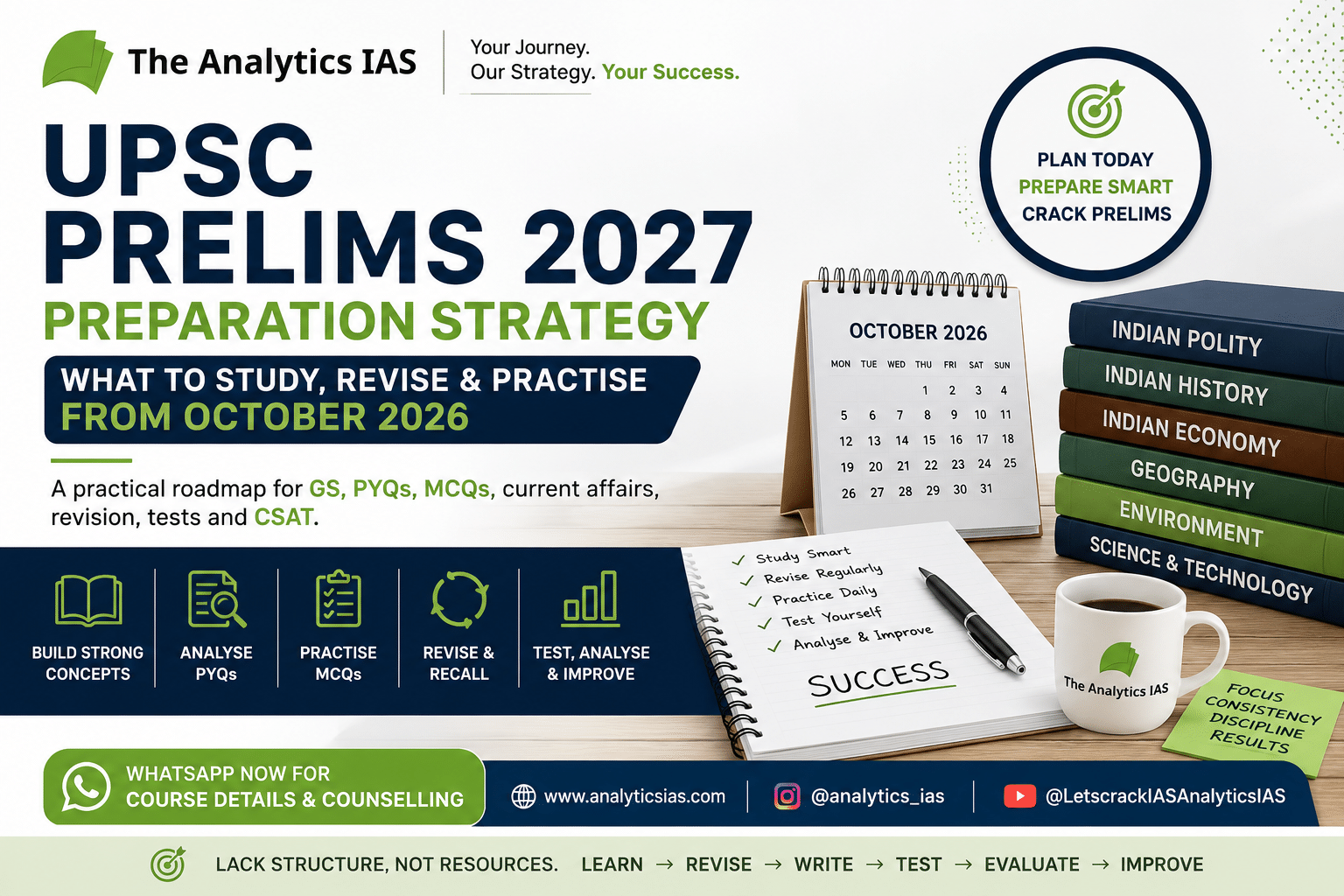
A practical October-to-Prelims roadmap for GS, PYQs, MCQs, current affairs, revision, tests and CSAT
UPSC Prelims 2027 Preparation Strategy: What Should You Do from October 2026?
Quick answer: From October 2026, a serious UPSC Prelims 2027 aspirant should stop treating preparation as only syllabus completion. Build strong core GS concepts, analyse PYQs topic-wise, practise MCQs every week, connect current affairs with static subjects, create a repeatable revision cycle, diagnose CSAT early and gradually move towards test-based preparation. The objective is not to read the maximum material; it is to recall, apply, eliminate and revise the right material repeatedly.
The working cycle for the next phase should be: STUDY → PYQs → RECALL → MCQs → ANALYSE ERRORS → REVISE → RETEST
Important: UPSC has not yet issued the Civil Services Examination 2027 notification as of early October 2026. Use the latest official UPSC notification and syllabus as the planning reference, and verify the 2027 dates, rules and any changes when the official notification is released.Check the official UPSC website.
Why October 2026 Is a Critical Stage for UPSC Prelims 2027
October is early enough to correct weak foundations, but late enough that preparation must become measurable. If you spend the next several months only reading books and watching lectures, you may enter the Prelims-focused phase with a large syllabus behind you but weak recall, limited question practice and no clear error pattern.
A better goal is to reach the end of December with a functioning preparation system: limited sources, completed or substantially covered core subjects, topic-wise PYQ familiarity, regular MCQ practice, current affairs integration, a revision calendar and a realistic understanding of your CSAT level.
If you are still building your foundation, first read: UPSC Preparation for Beginners 2027–2029 and UPSC 2027 Booklist for Beginners.
First, Understand What UPSC Prelims Actually Tests
In the latest official Civil Services scheme currently available, Prelims consists of two objective papers. GS Paper I covers current events, History, Geography, Polity and Governance, Economic and Social Development, Environment and Ecology, and General Science. GS Paper II (CSAT) is qualifying, with the minimum qualifying standard specified by UPSC in the official notification.
Authoritative reference: UPSC Civil Services Examination information and notifications
This means your preparation cannot be reduced to memorising static facts. A strong Prelims strategy needs conceptual clarity, current relevance, option elimination, disciplined question selection, repeated revision and enough timed practice to perform under uncertainty.
What Should You Study from October 2026?
Do not study every subject with equal intensity at the same time. Build a sequence that allows you to complete, revise and test subjects rather than keeping six books permanently half-finished.
| Area | October–December Focus | Practice | Revision Output |
| Polity & Governance | Constitutional concepts, institutions, Parliament, judiciary, federalism, local government | Topic-wise PYQs + statement MCQs | Short concept sheets + error log |
| Modern History | Chronology, movements, personalities, Acts, national movement themes | PYQs + factual/conceptual MCQs | Timeline + recurring themes |
| Geography | Physical geography, India, mapping, resources, climate | Map work + PYQs + MCQs | Maps + one-page topic revisions |
| Economy | Core concepts first; connect with current developments | Concept MCQs + current-static linkage | Definitions + mechanisms + current examples |
| Environment | Ecology basics, biodiversity, protected areas, climate frameworks | PYQs + current-linked MCQs | Species/places/conventions + concepts |
| Science & Tech | Conceptual basics + important contemporary applications | Current-linked MCQs | Short issue-based notes |
| Current Affairs | Daily/weekly selective coverage linked to syllabus | Weekly quiz + static linkage | Monthly compressed revision file |
| CSAT | Early diagnostic; targeted practice based on weakness | Timed comprehension/numeracy/reasoning | Weak-area tracker |
October 2026: Build the Prelims Engine
Your October objective should be to establish the system you will repeat for every subject. Do not aim merely to ‘finish Polity’ or ‘complete History’. For each topic, study the concept, inspect relevant PYQs, solve a small MCQ set, record mistakes and schedule the first revision.
- Finalise one primary source per major subject. Avoid changing books because another topper or video recommends a different source.
- Keep the UPSC syllabus and PYQs beside you while studying.
- Begin topic-wise MCQs immediately; do not wait for the full syllabus to finish.
- Create one error notebook or digital error log.
- Take a CSAT diagnostic test this month, even if you believe CSAT is your strength.
- Compress current affairs into syllabus-linked notes rather than copying the newspaper.
Resource discipline matters. See: UPSC 2027 Booklist for Beginners: NCERTs + Standard Books
November 2026: Expand Coverage Without Losing Revision
In November, continue core GS coverage but protect revision time. A common mistake is allowing new content to consume the entire day. By this stage, every completed subject block should have at least one scheduled revision and one round of question practice.
- Continue subject coverage according to your plan—typically Geography, Economy, Environment or pending foundation areas.
- Increase mixed MCQ practice so your brain learns to switch between subjects.
- Revisit October error logs and identify repeated mistake categories.
- Integrate current affairs with Polity, Economy, Environment, Geography and Science & Technology.
- Continue CSAT practice at a frequency based on your diagnostic result.
December 2026: Consolidate, Compress and Test
December should not become another month of uncontrolled source expansion. It should begin the transition from learning-heavy preparation to recall-heavy preparation. Your notes should become shorter, your PYQ familiarity deeper and your tests more diagnostic.
- Complete or substantially cover remaining high-priority GS foundations.
- Revise completed subjects instead of rereading everything from page one.
- Start mixed-subject tests and analyse every wrong answer.
- Compress current affairs into monthly or subject-wise revision sheets.
- Identify three weak GS areas and one weak CSAT area before January.
- Create a January action plan based on test evidence—not anxiety.
January 2027 Onward: Shift Gradually Toward Prelims-Dominant Preparation
As the examination approaches, the proportion of time devoted to Prelims-style recall, MCQs, full-length tests, current affairs revision and CSAT should rise. The exact transition date will depend on your syllabus status and the official 2027 calendar, but the principle is simple: the closer you get to Prelims, the less room there is for passive reading.
The Right Way to Use PYQs for UPSC Prelims 2027
PYQs are not merely old questions to solve after syllabus completion. They are a preparation compass. Use them before, during and after studying a subject.
- Before studying: scan topic-wise PYQs to understand what UPSC has historically considered testable.
- During studying: mark concepts, distinctions and recurring themes that connect with PYQs.
- After studying: solve the relevant PYQs without notes.
- Analyse every option: ask why the correct option is correct and why the others are wrong.
- Record the lesson: concept gap, factual gap, misreading, overthinking, poor elimination or weak revision.
This prevents PYQ practice from becoming a score-only exercise. The real value lies in understanding question framing and improving how you study.
How Many MCQs Should You Practise?
There is no universal daily number that guarantees success. Quality of analysis matters more than chasing a huge MCQ count. A beginner can start with small topic-wise sets and gradually increase volume as coverage improves. The important rule is that every practice session should produce feedback.
After each set, track: accuracy rate • avoidable errors • repeated mistakes • weak topics • questions you should have left.
If you solve 100 questions and only check the score, you have completed a test. If you identify why you lost marks and correct the pattern, you have completed a learning cycle.
Revision Strategy for UPSC Prelims 2027
UPSC preparation becomes fragile when the aspirant keeps adding new material but cannot retrieve what was studied two weeks earlier. Revision should therefore be scheduled, not left for ‘when the syllabus is complete’.
| Revision Stage | What to Do | Output |
| Revision 1 | Revisit soon after completing a topic; clarify concepts and remove unnecessary notes. | Cleaner, shorter notes |
| Revision 2 | Use active recall + PYQs/MCQs instead of passive rereading. | Recall gaps identified |
| Revision 3 | Rapid exam-oriented revision with error log and high-yield concepts. | Fast retrieval + fewer repeat errors |
A simple rule: if your notes cannot be revised repeatedly, they are probably too long. Your preparation material should become more compressed as the examination approaches.
Current Affairs for Prelims 2027: What to Do from October
Do not turn current affairs into a second full-time syllabus. Read selectively and connect developments with static subjects. For every important issue, ask four questions: What happened? Why is it relevant to the UPSC syllabus? What static concept does it connect with? What is its possible Prelims value?
- Use one dependable newspaper or current affairs workflow rather than multiple overlapping sources.
- Prioritise issues linked to Polity, Economy, Environment, Geography, Science & Technology, international developments and important institutions.
- Add current developments to existing static notes where possible.
- Revise current affairs weekly and compress monthly.
- Use MCQs to test whether you can distinguish similar institutions, terms, reports, species, locations and policy mechanisms.
Do Not Ignore CSAT Until the Final Months
CSAT is qualifying under the current UPSC scheme, but ‘qualifying’ does not mean ‘automatic’. Your October task is diagnosis. Take a timed sample from recent official CSAT papers and identify whether your weakness lies in comprehension, numeracy, reasoning, speed, accuracy or question selection.
- If weak: schedule regular CSAT sessions immediately.
- If average: maintain weekly practice and retest periodically.
- If strong: do not abandon it completely; maintain timed familiarity.
Use official papers wherever possible: UPSC Previous Question Papers / Examination resources
A Practical Weekly UPSC Prelims 2027 System
Your exact hours will depend on whether you are a full-time aspirant, college student or working professional. Instead of copying someone else’s timetable, protect the following functions every week:
| Function | Purpose | Minimum Weekly Evidence |
| Core GS Study | Build concepts and syllabus coverage | Topics completed with source discipline |
| PYQs | Understand UPSC demand | Topic-wise questions analysed |
| MCQ Practice | Build application and elimination | Question sets + error analysis |
| Revision | Protect retention | Old topics recalled without notes |
| Current Affairs | Connect static + current | Short syllabus-linked notes |
| CSAT | Prevent late-stage surprise | Timed practice based on diagnostic |
| Weekly Review | Course correction | 3 strengths + 3 gaps + next-week priorities |
The 5 Mistakes to Avoid from October 2026
- Waiting to finish the syllabus before solving MCQs.
- Changing books repeatedly instead of revising one dependable source.
- Making current affairs notes that are almost as long as the newspaper.
- Taking mock tests without analysing why marks were lost.
- Assuming CSAT will take care of itself.
A sixth mistake deserves special mention: measuring preparation only by study hours. A ten-hour day with weak recall and no practice may be less useful than a shorter, structured day that includes learning, retrieval, questions and revision.
How to Know Whether Your UPSC Prelims Preparation Is Improving
At the end of every month, do not ask only, “How much syllabus did I finish?” Ask:
- Can I recall last month’s topics without opening the book?
- Is my accuracy improving in topics I have revised?
- Are avoidable errors reducing?
- Can I eliminate options more confidently?
- Are the same mistakes recurring in every mock?
- Can I connect current affairs with static concepts?
- Do I know my CSAT weak areas?
- Can I revise my notes quickly enough for repeated cycles?
UPSC Prelims 2027 Preparation Roadmap at a Glance
| Period | Main Objective | Practice Focus | Do Not Do |
| October 2026 | Build system + core GS | Topic PYQs, MCQs, CSAT diagnostic | Collect multiple sources |
| November 2026 | Expand coverage + protect revision | Mixed MCQs, current-static linkage | Study only new content |
| December 2026 | Consolidate + compress | Mixed tests, error analysis | Keep making long notes |
| January 2027 onward | Increase Prelims orientation | Revision, MCQs, tests, CSAT | Passive reading without testing |
| Final Prelims phase | Recall + test + refine | Full tests, rapid revision, question selection | Experiment with new resources |
If You Are Starting UPSC 2027 Preparation Only Now
Do not spend October feeling ‘late’. Use it to remove confusion. Start with the syllabus, finalise limited sources, identify two core subjects to move forward with, begin PYQs and MCQs immediately, establish a current affairs routine and take a CSAT diagnostic. The worst response to feeling behind is to collect more resources and create an impossible timetable.
For a beginner-focused roadmap, read: UPSC 2027 Preparation Strategy: What Should You Do in Your First 90 Days?
Should You Prepare Prelims and Mains Together Right Now?
During the foundation stage, yes—where the syllabus overlaps, build concepts with both objective and analytical understanding. However, the balance should gradually become more Prelims-dominant as the examination approaches. For example, while studying Parliament, understand the institution analytically for Mains, but also train yourself for Prelims distinctions, procedures, constitutional provisions and statement-based questions.
For the broader integrated approach, see: UPSC CSE 2027 Preparation: Complete Foundation Roadmap
Frequently Asked Questions: UPSC Prelims 2027 Strategy
When should I start preparing specifically for UPSC Prelims 2027?
If 2027 is your target, October 2026 is an appropriate time to make Prelims skills part of your preparation. Do not wait for a separate ‘Prelims phase’ to begin PYQs, MCQs, revision and CSAT diagnosis.
Can I clear UPSC Prelims 2027 if I start in October 2026?
Starting in October still gives you meaningful preparation time, but the outcome depends on your background, consistency, source discipline, revision, practice and performance. Avoid guarantees; focus on building a measurable system immediately.
Which subjects should I prioritise first for UPSC Prelims 2027?
Aspirants commonly build their foundation through core areas such as Polity, History, Geography, Economy and Environment, but the exact order should reflect your current preparation level. The key is to finish, revise and test subject blocks instead of keeping everything incomplete.
How many hours should I study daily for UPSC 2027?
There is no universal number. A sustainable schedule with focused study, PYQs, practice and revision is more useful than an unrealistic hour target. Working professionals and students should design around available high-quality study blocks.
When should I start solving UPSC Prelims MCQs?
Start topic-wise MCQs while studying the syllabus. Do not wait until every GS subject is complete. Gradually progress from topic-wise to subject-wise, mixed and full-length tests.
How many years of UPSC PYQs should I analyse?
Use a sufficiently broad set of recent and older official papers to identify recurring themes and changes in framing. More important than a fixed number is analysing questions deeply rather than merely checking answers.
How should I prepare current affairs for UPSC Prelims 2027?
Use a limited current affairs workflow, connect important developments to the syllabus and static subjects, make concise revision-ready notes, revise periodically and test through MCQs.
When should I start full-length mock tests for Prelims 2027?
Start with topic-wise and subject-wise tests during foundation preparation. Move toward mixed and full-length tests as syllabus coverage and revision improve. Do not take full tests only for scores—analyse mistakes after every test.
Is CSAT important for UPSC Prelims 2027?
Yes. Under the current UPSC scheme, GS Paper II is qualifying, but candidates must still meet the qualifying standard. Take an early diagnostic and practise according to your actual weakness.
Should I stop Mains answer writing while preparing for Prelims?
Not necessarily during the early foundation phase. Maintain integrated preparation where practical, then reduce or pause Mains-heavy activities as you enter the dedicated Prelims phase based on your preparation status and the official schedule.
UPSC CSE 2027: Build a Preparation System You Can Measure
A strong UPSC Prelims 2027 preparation strategy is not a giant reading list. It is a repeatable system that converts study into recall and recall into correct decisions under exam conditions.
LEARN → PYQ → RECALL → PRACTISE → ANALYSE → REVISE → RETEST
If you begin this cycle in October and keep improving it, you will enter the later Prelims phase with something far more valuable than a pile of completed books: a clear understanding of what you know, what you forget, how UPSC tests you and what you need to fix next.
Need a Structured UPSC 2027 Preparation Plan?
Analytics IAS Academy offers UPSC CSE 2027 GS Foundation preparation with classroom learning in Noida Sector 63 and live online access for aspirants across India. The preparation framework focuses on GS concepts, PYQs, Prelims and Mains integration, answer writing, tests, revision and mentorship.
For current/upcoming batch counselling: Call/WhatsApp 9990124010
Explore the UPSC CSE 2027 GS Foundation Course | UPSC GS Foundation Course 2027 in Noida
Read More
- UPSC 2027 Booklist for Beginners: NCERTs + Standard Books You Actually Need
- UPSC 2027 Preparation Strategy: What to Do in Your First 90 Days
- How to Start UPSC Preparation from Zero: Complete Beginner’s Study Plan 2027–2029
- UPSC CSE 2027 Preparation: Complete Foundation, PYQ, Mains & Mentorship Guide
- UPSC GS Foundation Course 2027 in Noida: 1-Year Prelims + Mains Program
UPSC Foundation Course 2027: What Should You Get Beyond Classes?
